
 Peter Woodburn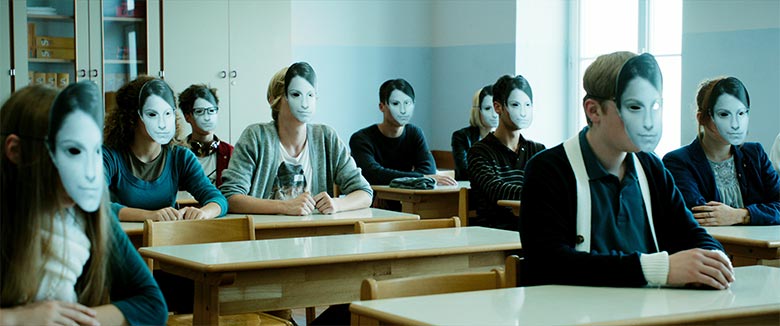
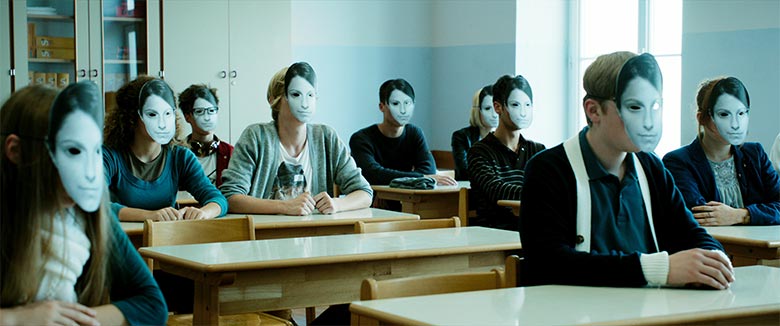
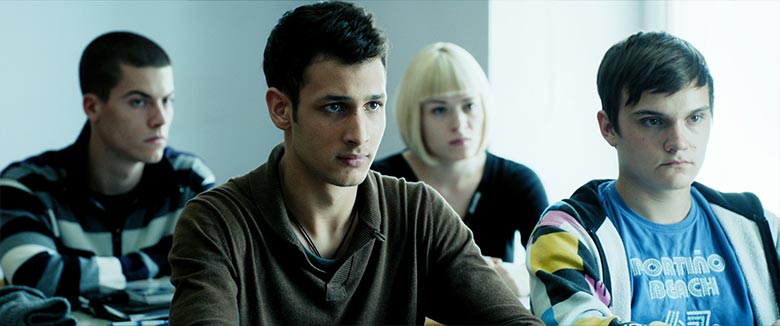
Rok Bicek’s debut feature-length film, Class Enemy, is an interesting exercise in grief, and Bicek undertakes the painstaking task of showcasing how it hits the cast of characters differently. Luka (Voranc Boh), who has just lost his mother, uses Sabina’s death as a way to shield himself from his own pain. Mojca (Doroteja Nadrah), Sabina’s best friend, blames Robert as a way to avoid the reality she had no idea her friend was in such a spot. Spela (Spela Novak), sees Sabina’s death as a symbol of everything that is wrong with the school. As pressure starts to mount from his rebelling class, Robert has to wishstand even more from the school’s administration, who feel that he is losing control of the people he doesn’t really know in the first place.
Class Enemy (Razredni Sovražnik) Theatrical Trailer
There isn’t much that is constant about grief, but the one thing that is true is that no one deals with it in the same way. Bicek deftly gives the students a unifying rallying point without turning them into one faceless mob. As the children cope with something they should never have to, Robert is required to adapt as well. He accepts that he is the bad guy in the situation, but keeps on teaching as if nothing happened, which only make matters worse for him in the classroom.
Class Enemy was the Slovenian entry for the Best Foreign Language Film but didn’t make the final cut. It is still worth a look at. At times, the plot drags a bit slowly, and some of the reactions of the students seem to be so self-involved that one would think nobody would possibly react like that. But the thing is, in times of grief, any reactions are arguably sane reactions. The camera is jittery throughout the film, which is perfect considering the volatile mindset of many of the characters, and Dicek, in a very promising debut, makes some pointed observations using characters who aren’t prepared for a world of grief.
Ω

 Vee Hua 華婷婷
 Thuc Doan Nguyen
 Saelyx Finna

CLASS ENEMY: AGEING OF TEENS
BY PRADIP BISWAS
The film Class Enemy by Rok Bicek broaches a new dimension as is found
in Slovenia.
In the compelling Class Enemy, a
group of teens accuse their demanding new German teacher and his demeaning
methodologies when one of their classmates commits suicide out of conflicting
situation. The death leads a colossal battle of wills at the high school, not
evident earlier. The Slovenian helmer Rok Bicek demonstrates an intense control of tension and suspense, making
each encounter between class and instructor, sparking off the possibility of
violence. The film is a given a convincingly climatic plot, character-and-situation-driven
drama. All that makes it a niche art-house distribution a possibility in some
territories.
At the outset we are
given an academic year nearly over for a tightly knit bunch of high school
seniors. But nastily the atmosphere in the classroom mutates when Nusa (Masa
Derganc), their beloved homeroom teacher, goes on maternity leave and is
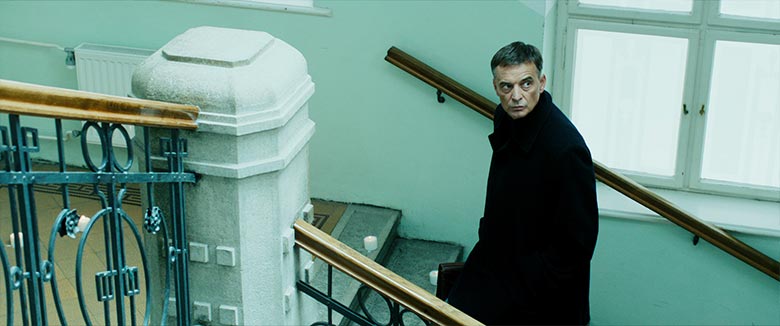
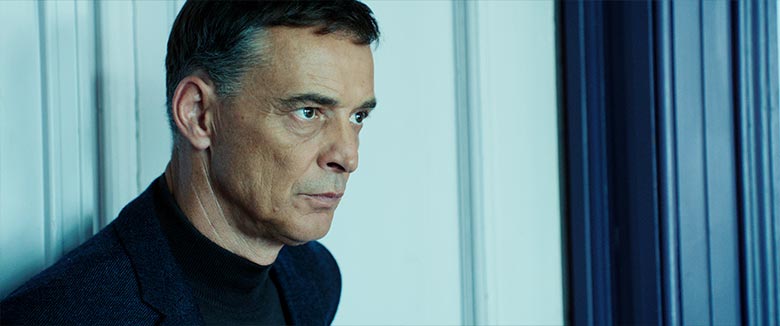
replaced by German authoritarian Robert (Igor Samobor). This cold, intellectual
brainbox believes in showing his
new charges who’s is to be the boss; he requires them to stand when he enters
the room and believes that he can only seem to have established order when they
show respect. While Nusa has shown great sensitivity to the students’ private
lives and personalities, Robert displays no such virtue if grace and softness.
Thus he ignores the feelings of the grieving Luka (Voranc Boh), whose mother
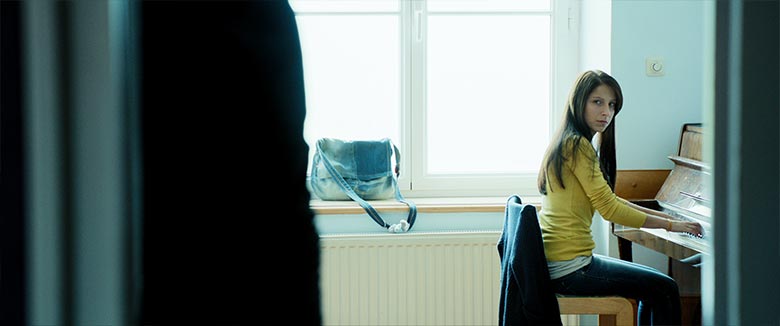
recently died, and of shy pianist Sabina (Dasa Cupevski), who is hypersensitive
to criticism. In twisting reality, When Robert delivers some scathing remarks
to Sabina and she hangs herself shortly afterward without leaving a note. The
tragedy sparks off a student rebellion against the system in general and Robert
in particular.
The credible screenplay
by Bicek stresses the generational binary between the students and the school
administration, reflecting a general dissatisfaction within contemporary
Slovenian society. At first it look like microcosm but in fact it is a major
macrocosm that needs to be probed. Moreover, positioning Robert as a German
teacher provides an important subtext: It introduces a model of a his characterization as a
Nazi by the kids, and his lessons from Thomas Mann, which is a comment on suicide in a way that not only
antagonizes the students but provokes them to ponder..
As a director, Bicek
capitalizes on the differences in energy among the teens and the adults to
persuasive effect. The tone set in a way reveals animosity against fascistic
tendency. Bicek even inserts pithy commentary on Slovenian social problems in
subtle manner so as to enlighten his countrymen through an outsider, Chinese
student Chang (Kangjing Qiu), who notes, “You Slovenians. If you’re not killing
yourself, you’re killing each other.” Class Enemy shows how not to make political film but how to make a film politically. The film
offers a three-dimensional reality, crude, cruel and inhuman.
XXXXXXXXXXXXXXXXXXXXXXXXXXXXXXXXX
CLASS ENEMY: AGEING OF TEENS
BY PRADIP BISWAS
The film Class Enemy by Rok Bicek broaches a new dimension as is found
in Slovenia.
In the compelling Class Enemy, a
group of teens accuse their demanding new German teacher and his demeaning
methodologies when one of their classmates commits suicide out of conflicting
situation. The death leads a colossal battle of wills at the high school, not
evident earlier. The Slovenian helmer Rok Bicek demonstrates an intense control of tension and suspense, making
each encounter between class and instructor, sparking off the possibility of
violence. The film is a given a convincingly climatic plot, character-and-situation-driven
drama. All that makes it a niche art-house distribution a possibility in some
territories.
At the outset we are
given an academic year nearly over for a tightly knit bunch of high school
seniors. But nastily the atmosphere in the classroom mutates when Nusa (Masa
Derganc), their beloved homeroom teacher, goes on maternity leave and is
replaced by German authoritarian Robert (Igor Samobor). This cold, intellectual
brainbox believes in showing his
new charges who’s is to be the boss; he requires them to stand when he enters
the room and believes that he can only seem to have established order when they
show respect. While Nusa has shown great sensitivity to the students’ private
lives and personalities, Robert displays no such virtue if grace and softness.
Thus he ignores the feelings of the grieving Luka (Voranc Boh), whose mother
recently died, and of shy pianist Sabina (Dasa Cupevski), who is hypersensitive
to criticism. In twisting reality, When Robert delivers some scathing remarks
to Sabina and she hangs herself shortly afterward without leaving a note. The
tragedy sparks off a student rebellion against the system in general and Robert
in particular.
The credible screenplay
by Bicek stresses the generational binary between the students and the school
administration, reflecting a general dissatisfaction within contemporary
Slovenian society. At first it look like microcosm but in fact it is a major
macrocosm that needs to be probed. Moreover, positioning Robert as a German
teacher provides an important subtext: It introduces a model of a his characterization as a
Nazi by the kids, and his lessons from Thomas Mann, which is a comment on suicide in a way that not only
antagonizes the students but provokes them to ponder..
As a director, Bicek
capitalizes on the differences in energy among the teens and the adults to
persuasive effect. The tone set in a way reveals animosity against fascistic
tendency. Bicek even inserts pithy commentary on Slovenian social problems in
subtle manner so as to enlighten his countrymen through an outsider, Chinese
student Chang (Kangjing Qiu), who notes, “You Slovenians. If you’re not killing
yourself, you’re killing each other.” Class Enemy shows how not to make political film but how to make a film politically. The film
offers a three-dimensional reality, crude, cruel and inhuman.