 Saelyx Finna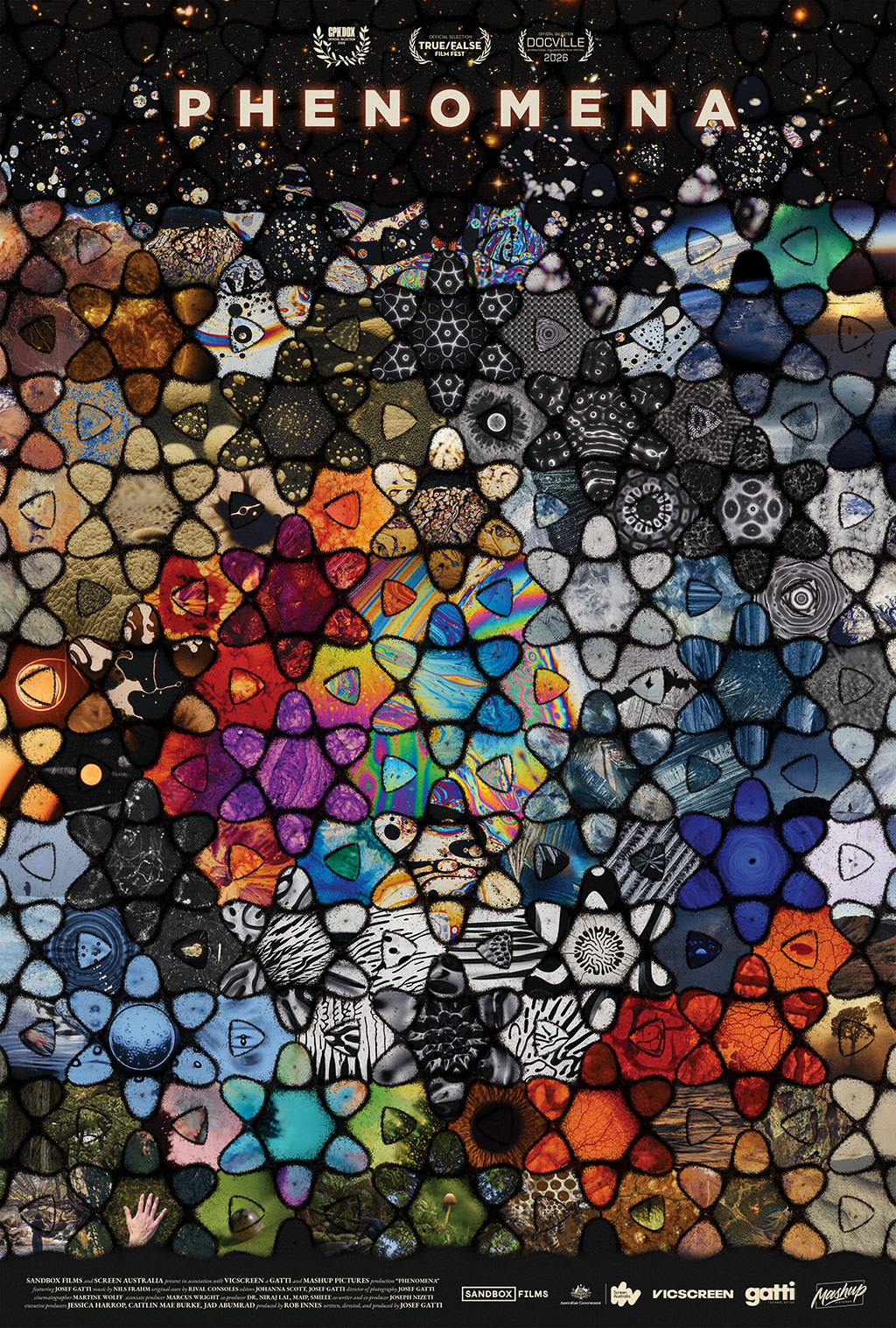
Ten Years, One Camera, Two Principles
Phenomena first began as a short-form web series broadcast by the ABC national television network in Australia. But the documentary feature was always Gatti’s destination; he held onto that answer whenever the inevitable question arose about how the film would differ from what already existed.
“This is a film,” he says. “It was always supposed to be a film.”
Ultimately, he accumulated two hundred terabytes of footage over ten years.
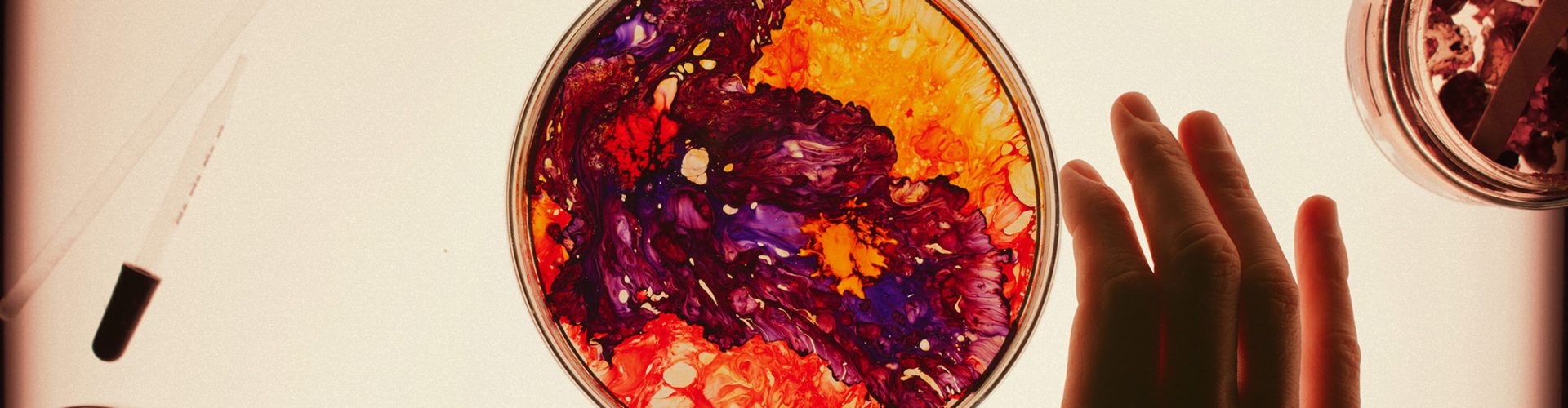
A gargantuan feat of cinematographic patience and innovation, Phenomena resists easy classification without ever feeling evasive about what it is. Centering entrancing psychedelic imagery rendered through the purest deployment of the scientific method via painstakingly staged experiments, this is a work that could be viewed in a movie theater, at a rave, as a gallery installation, in a middle school science class, or at home.
Gatti shot almost all of his footage on a single camera: a RED Dragon, one of the first 6k cameras available when he acquired it, and his primary tool throughout the entire project. Getting to know that camera intimately over years is part of what gave the film its visual consistency across experiments that at times took him weeks to develop and refine.
Phenomena‘s visual language is built on two operating principles that sound simple yet proved anything but. First: maximize contrast, in order to strip away the familiar world as completely as possible to reveal what Gatti calls “the world beneath the world.” Second: get out of the way. Early on, Gatti found that trying to impose his own aesthetic onto natural phenomena tended to work against it.
“When you just let nature do its thing, that was when it was the most beautiful,” he reveals.
The first of the film’s ten experiments focuses on light, demonstrated through glorious revelations of shifting colors and patterns across the life cycle of a soap bubble. The bubble’s surface cycles through a vivid range of colors before morphing into wild black and white patterns as color slowly drains away – with a few luminous specks clinging on before the whole thing disappears.
The bubble required weeks of trial and error for Gatti to find a soap solution that would be strong enough and hold for a duration that would allow patterning effects to emerge. Gatti’s breath affected it, disturbing the delicate bubble. The heat generated by the studio lighting needed to film the bubble also affected it, so the filming process required extremely close attention to detail.
The 100mm macro lens used across most experiments creates a 1:1 ratio between what’s physically in front of the sensor and what’s recorded – meaning the bubble needed to be at least the size of the sensor itself for full coverage to be achieved. Gatti also used a 5:1 macro for more extreme moments — essentially a microscope attached to a camera — which required him to move the entire camera body to find focus. As Gatti describes it, such a technique “just swallows light,” since extreme close-ups require an intense amount of light to execute.
On occasions, sequences in Phenomena pull from an epic wide into the extreme macro in a single continuous move. The motion was made possible by a motion-controlled robotic arm.
“[I] didn’t know if it would work,” Gotti reflects. “When we pulled it off the first time, it was like, okay, yeah.”
Gatti pointed out how the film’s opening sequence already contains everything he wanted to say, with a beginning, middle, and end.
As he describes, “From a story point of view, that [scene is] a really beautiful one, in that it has this beautiful arc to it,” he said. “The bubble starts as one thing, and it gets more beautiful and more complex over time. And it sort of hits this it hits this point where it starts to devolve, and it starts to go black and white, and the color begins to drain until it gets so thin and it’s just essentially black and white, and only a few speckles are holding on before it pops.”
“It’s just such a beautiful metaphor for life, really…” he continues. “[That scene is] one that sort of embodied the film as a whole, and that’s why we started with that one there.”
What transformed the project from discrete short pieces into a feature was the decision to put Gatti onscreen, both as the figure conducting the experiments and as narrator. He hadn’t appeared in his own films or narrated his work before. The turning point came when Sandbox Films (the Academy Award-nominated nonprofit documentary studio behind Fire of Love) came on as executive producers and the project moved into serious feature development. Through that process, it became clear that a human anchor was essential.
Phenomena opens with Gatti introducing himself with sparing personal detail: his dad was a physics teacher, but Gatti was never particularly interested in science until a spark of curiosity compelled him to delve deeper. As a guide and narrator, he functions as an everyman: the ordinary witness to extraordinary phenomena; someone to hold the door open while the universe does the rest. His presence offers a grounding anchor and sense of scale between the familiar and the incomprehensible.
The narrator’s role, as Gatti described it, is to guide audiences just far enough into each experiment that they understand what they’re seeing, but to leave them enough space to make their own discoveries.
“Just guiding you to the experiment in a way that allows you to enjoy it for what it really is,” he says.
Gatti credits Jad Abumrad, creator of Radiolab and an executive producer on the film, as a pivotal collaborator in crafting carefully calibrated narration that walks the line between science communication and sensory invitation.

When Words Fail
One of the most provocative lines in Gatti’s narration frames the chapter on “Energy:” “Science defines it as the capacity for a system to perform work. But for me, that fails to express what it really is. It’s hard to describe, and even harder to see directly.”
When queried further on this choice to gently poke at the insufficiency of scientific language, Gatti muses that science, “By its nature… [is] very sort of structural and rigid in its approach. And I feel like the world, our experience of the world, isn’t quite like that…”
“[Energy] was the one that stood out the most in all the concepts that we touch upon, that the ultimate functional description of what energy is, almost couldn’t be further from our intuition of what it is,” he continues. “I really wanted to make a point of that, because I think science has the capacity to be so profound and spiritual even.”
He points to luminaries like Carl Sagan, who managed to bridge the gap between science and spirituality for a wide audience.
Phenomena represents Gatti’s gift of permission to the audience to revel in this place where science and spirituality collapse into each other.
Many of the phenomena Gatti filmed have no natural sound. Microscopic interactions, timelapses recorded across weeks, patterns created by vibrations below the threshold of human hearing — the images arrive in silence. Music is what transforms them from artworks into experiences with emotional transcendence, and Gatti approaches its role in the film with the same seriousness he brought to the cinematography. He came up working as a cinematographer in Australia’s music, rave, and arts scene, and that background is evident in the carefully crafted symbiosis of sound and image in the film.
The primary source of the score is drawn from a decade of compositions from Nils Frahm, the German pianist and composer whose work moves fluidly between classical, ambient, and electronic idioms. He also collaborated with Rival Consoles (Ryan Lee West) whose original score bookends the film’s opening and close and weaves the chapters together with what Gatti described as a sci-fi-inspired sensibility. The hybrid style, meditative and texture-driven, is a precise match for what the images are doing: inviting you into something that builds slowly to transcendent effect.
When asked where he most wants people to see it, Gatti’s answer is specific. Festival circuit, yes — big screen, ideally with live music, maybe something closer to a rave. But for its longest life? A home theater. 4K OLED, high-end sound, intimate, maybe paired with a joint. The narration was always meant as a direct address, one voice speaking to one viewer, offering them something of what he had been accumulating across a decade in the studio.
“I really wanted to just speak to you, the audience, one on one,” he says.
Ω

 Vee Hua 華婷婷