
 Vee Hua 華婷婷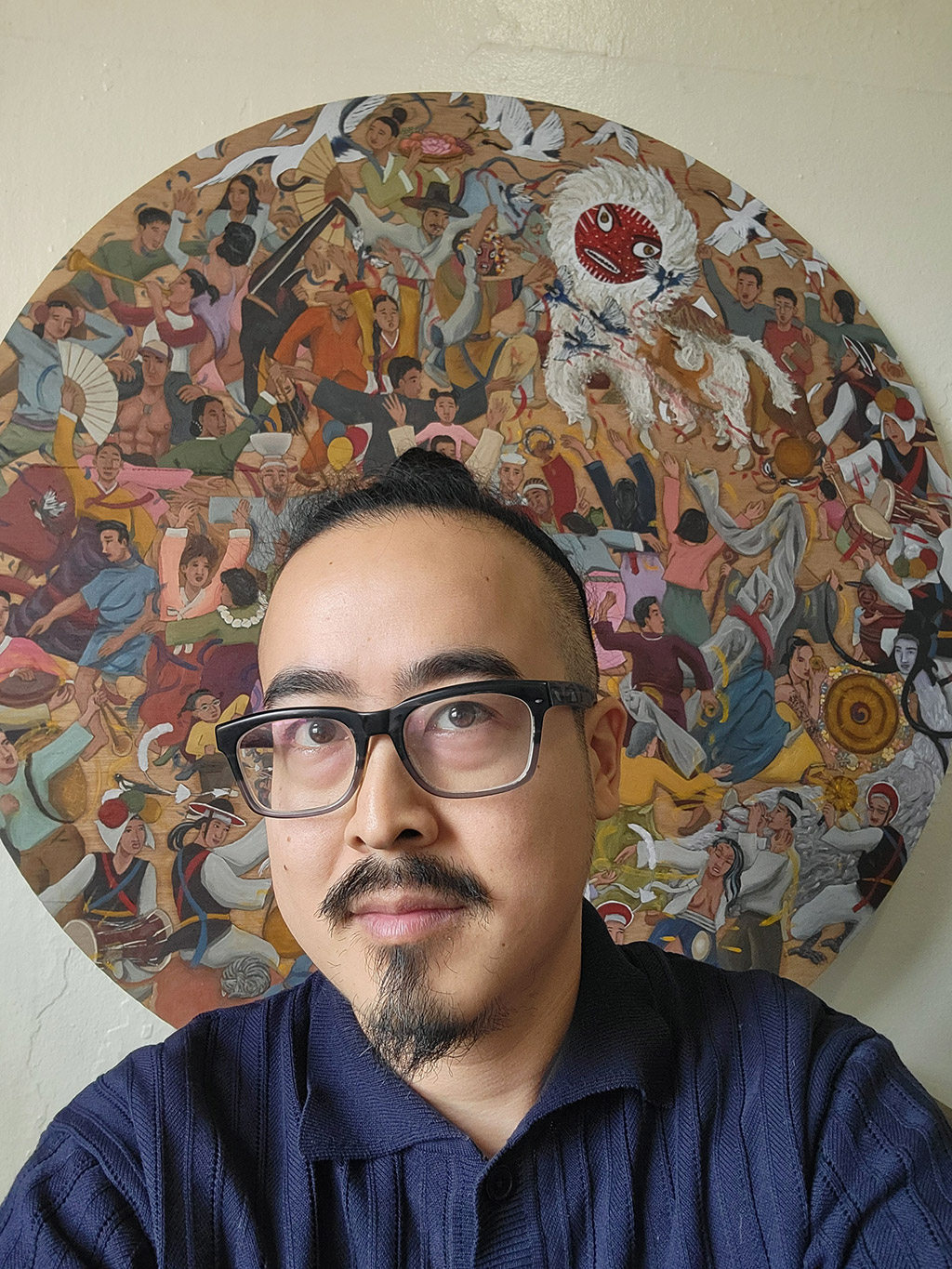
Learning & Relearning
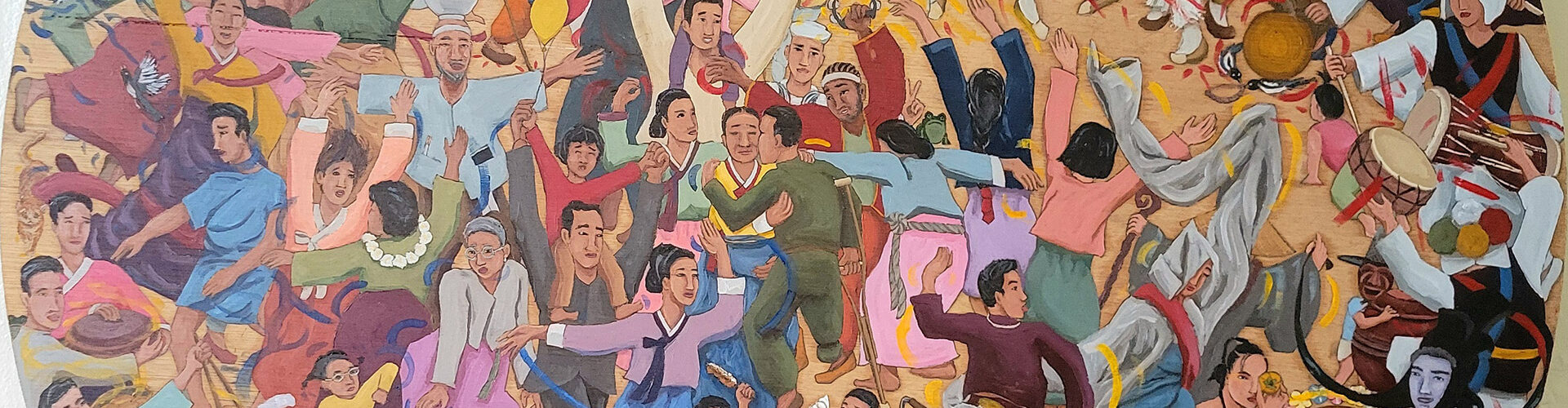
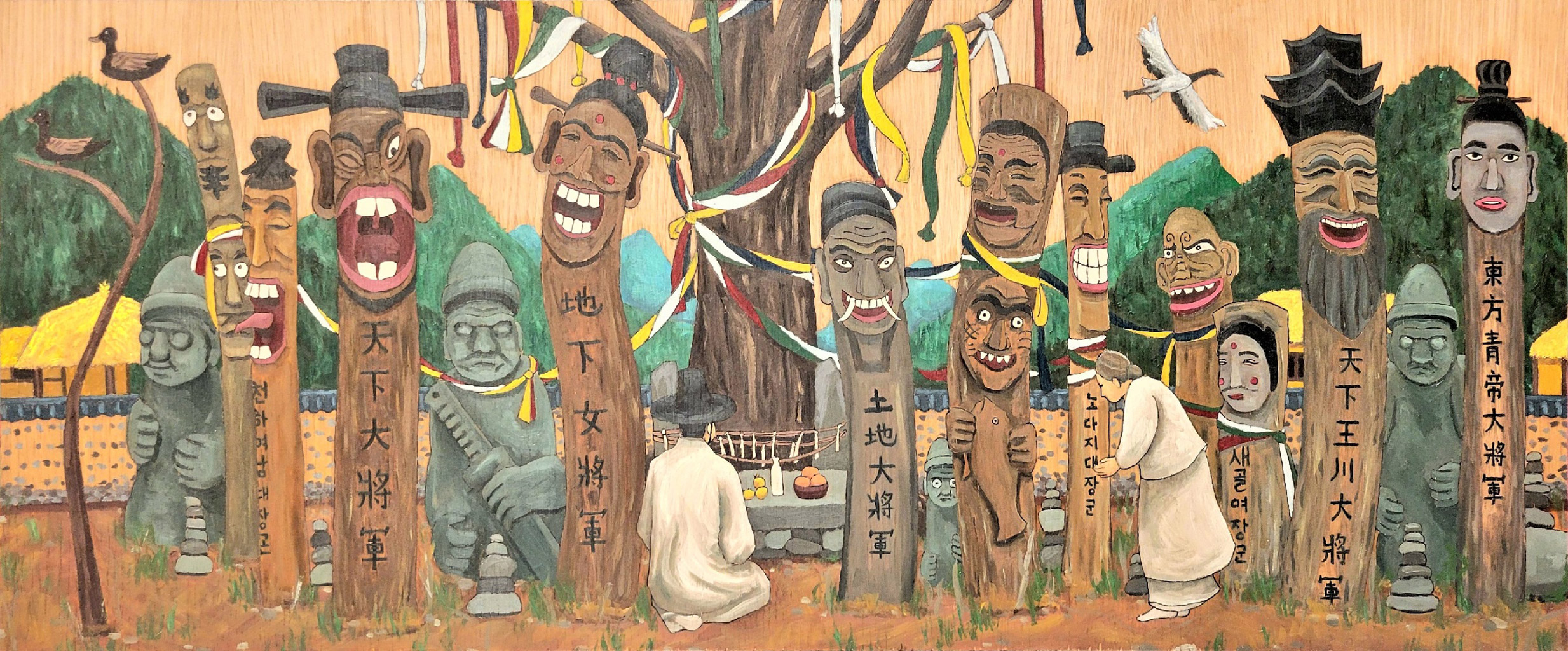
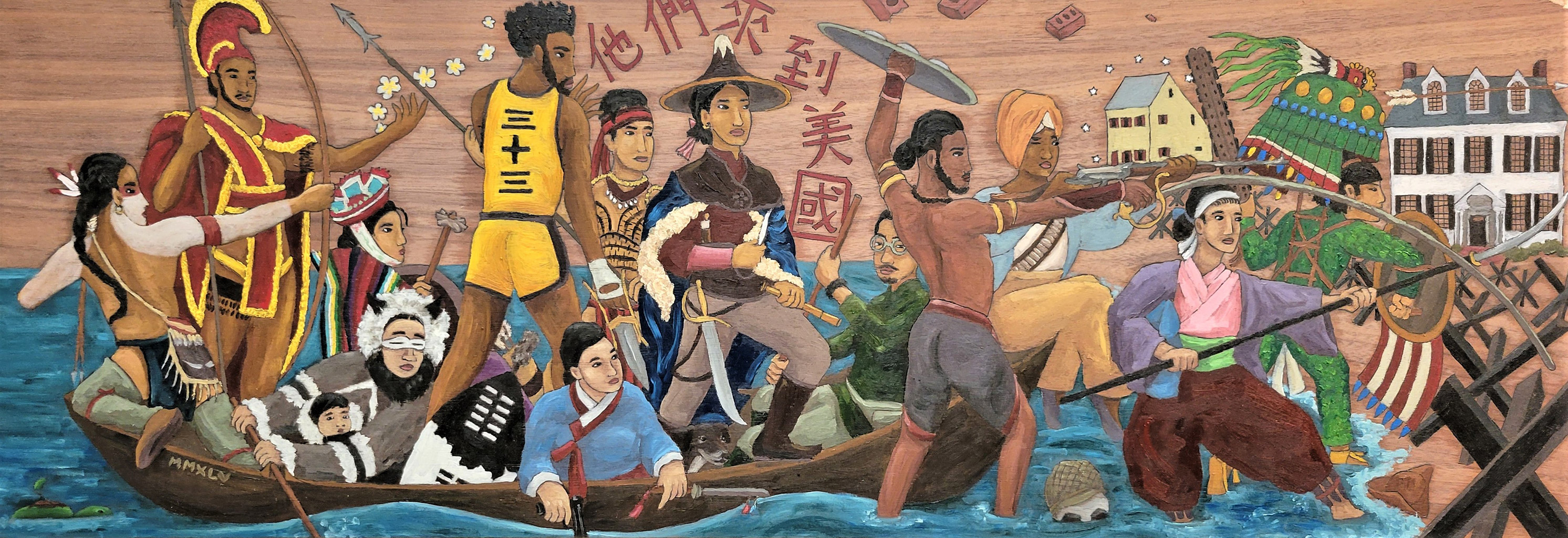
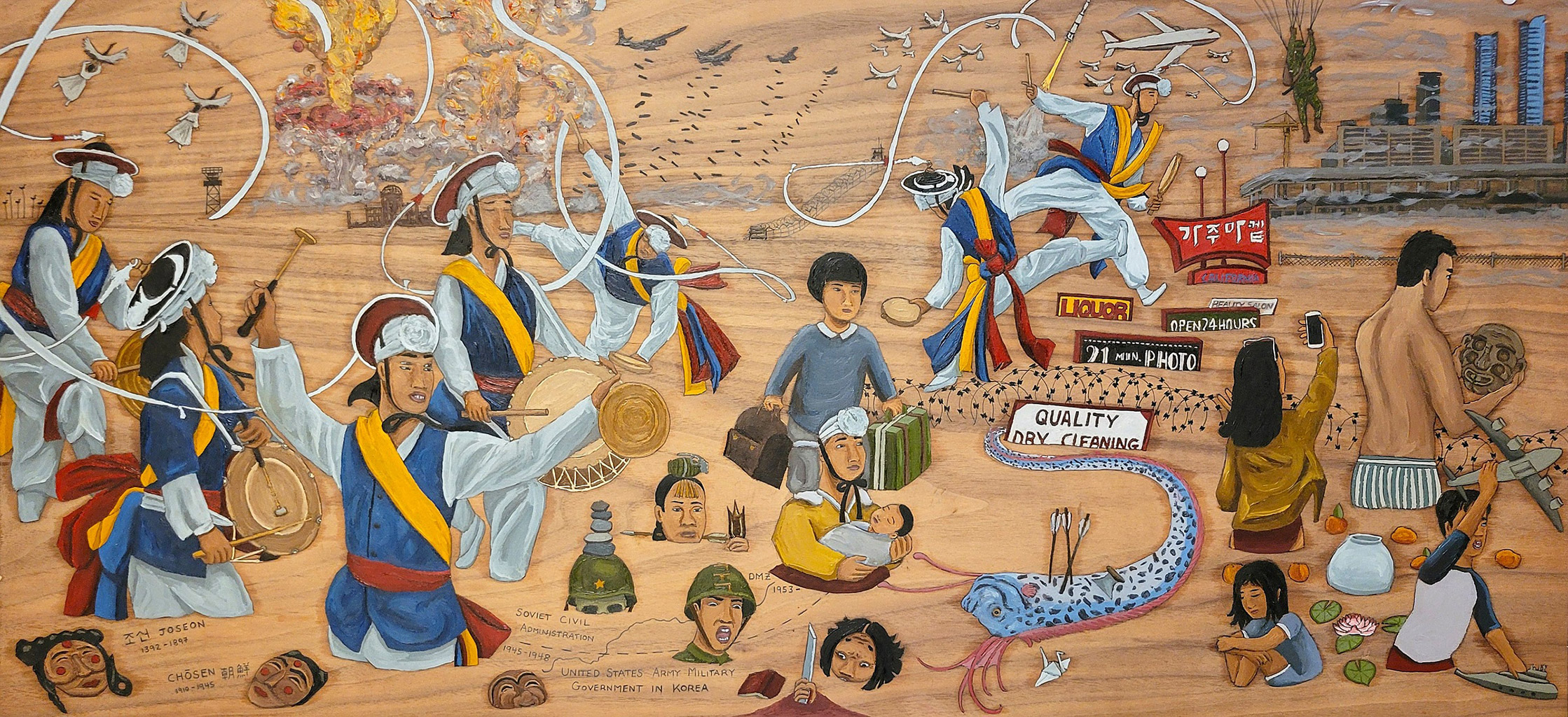
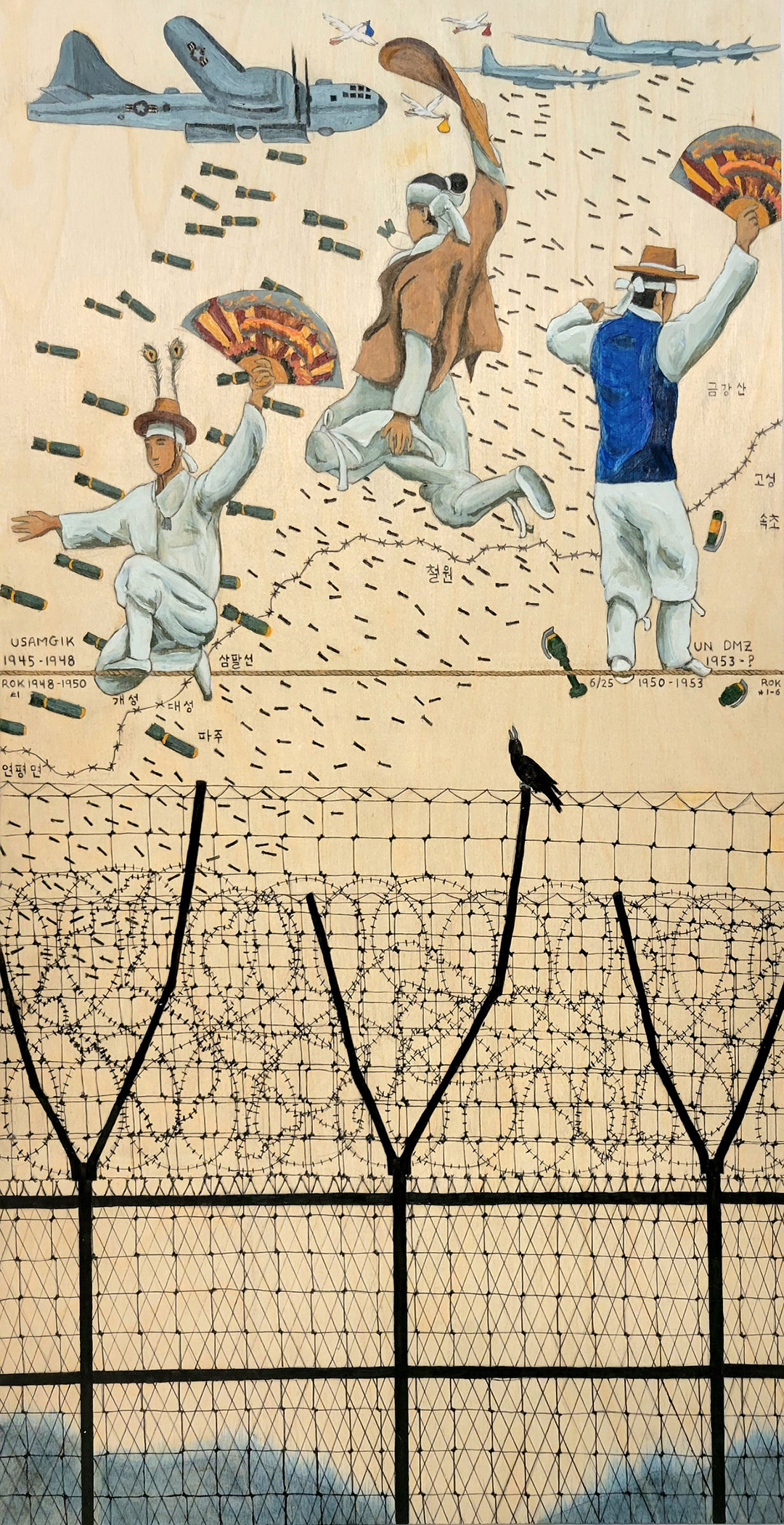
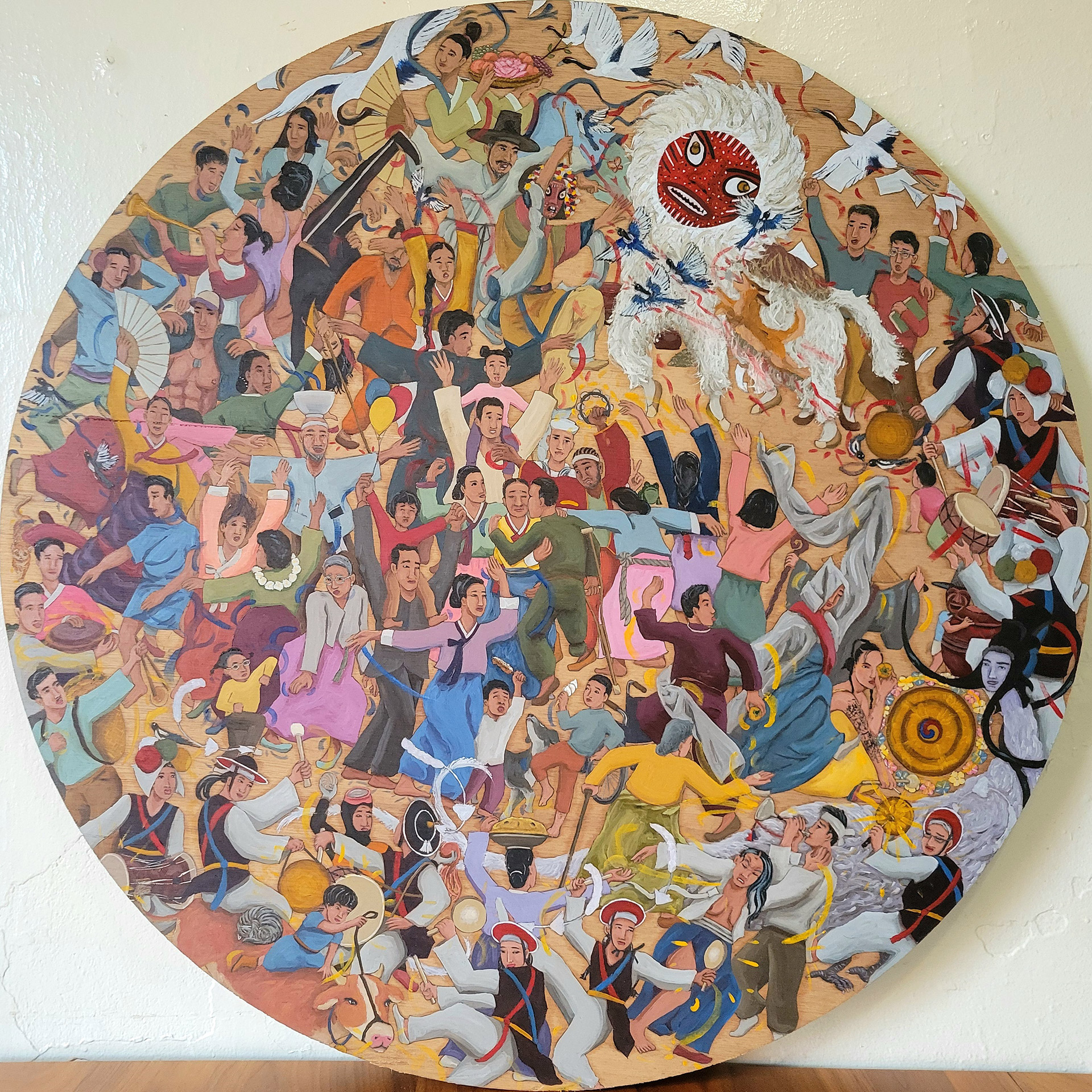
The resulting works, created in water-based oil paints on wood panels, give viewers an immense amount of material to unpack and interpret from their own perspectives. Those with identities that partially or fully overlap with Chan’s may find the most resonance, as they decipher words written in Korean or Chinese, find themselves in portrayals of queer bodies, or see objects that might have had meaning in their own lives.
“My artwork has allowed me to create a multicultural visual language that extends beyond my limited grasp and monolithic viewpoint of each of my parents’ and grandparents’ regional dialects, hometowns, and ethnic origins,” Chan explains. “As I continue to untangle and decipher folk art and ancestral traditions from afar, I hope to offer a knowingly unorthodox view of each of these histories to similarly displaced, diasporic, or hyphen-descendants and audiences who find moments of belonging to be extra precious when living within these in-between sometimes spaces.”
Chan’s process involves incorporating various complex components into his pieces. His undergraduate degree in Chinese and Education seems to play a role; through self-study, he directs himself towards the knowledge he needs to learn in order to create the works he wishes to create.
“Some of it is… relearning or learning language. Some of it is trying to reverse-engineer [things like] food or family history, or… immigrant things that maybe I didn’t make sense of as a child have better clarity now,” he explains.
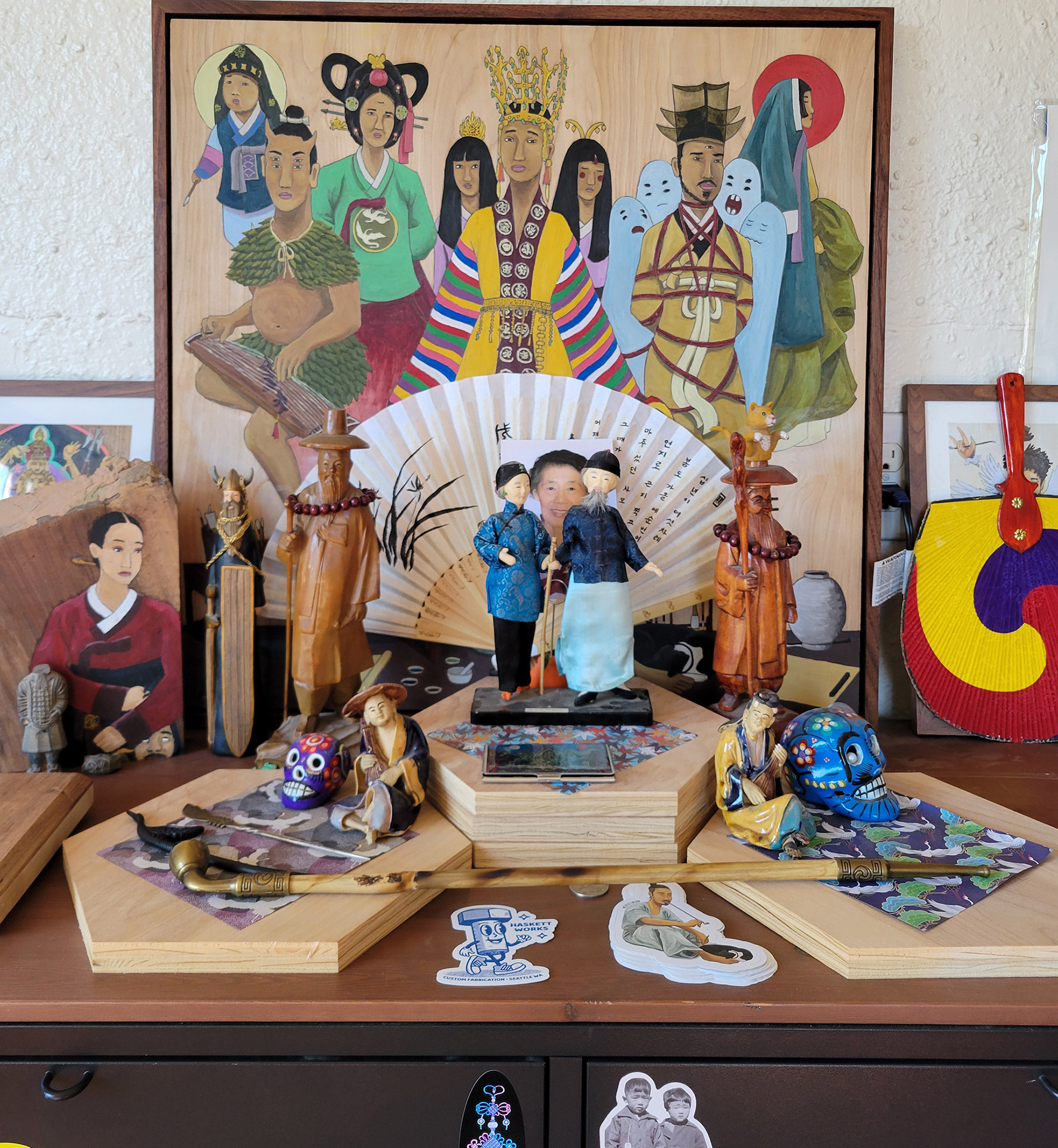
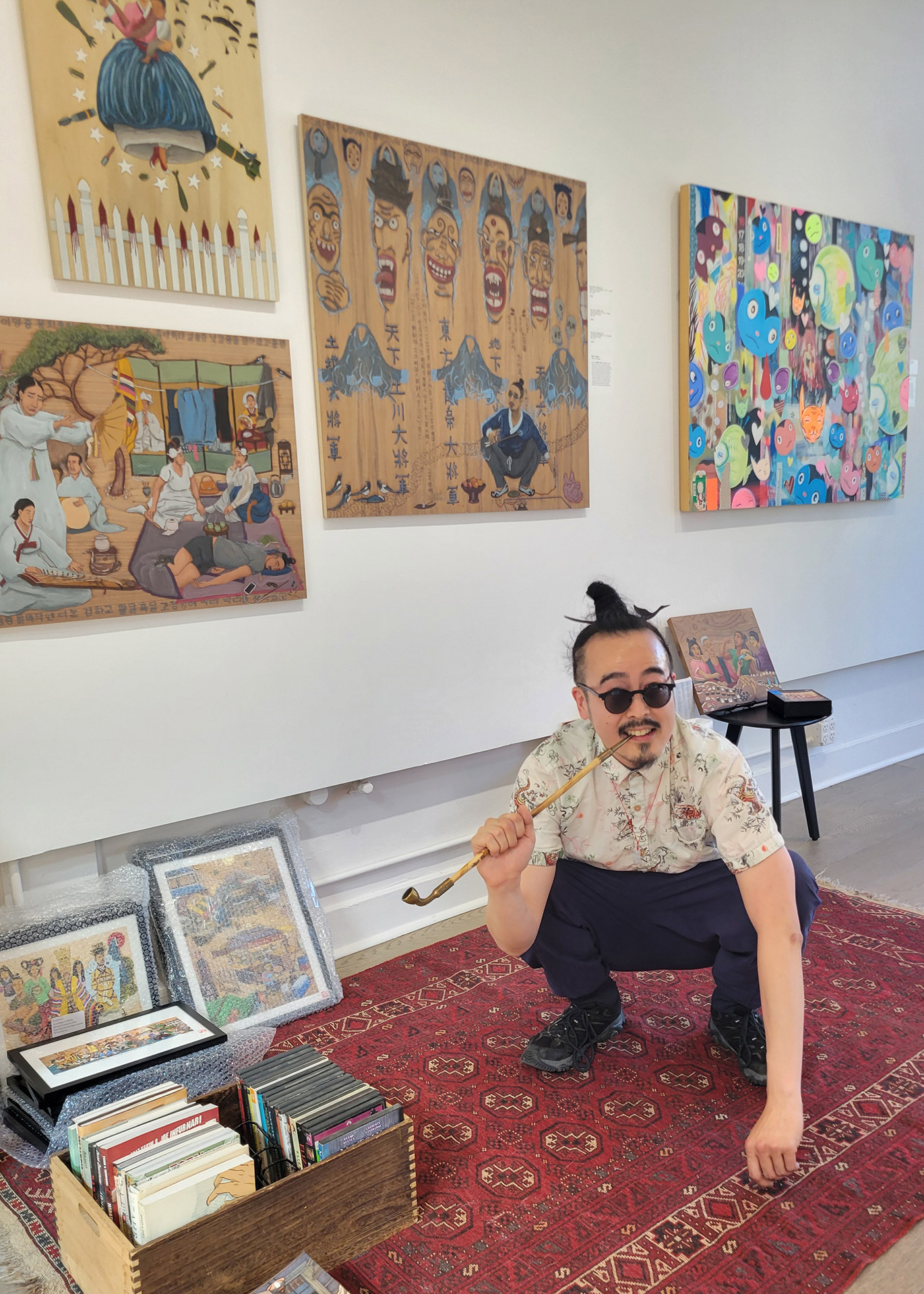
Chan’s art studio, located in Seattle’s Georgetown neighborhood, has on display an ancestor shrine. Celebrating his family history — which is Geoje-do Korean on his mother’s side and Cantonese on his father’s side — the shrine contains a number of important objects which have been handed down to him. They include a pansori 판소리 fan for traditional Korean musical storytelling, a wood hahoe 하회 mask, grandparent and ancestor totems, a beheaded terracotta warrior, calaveras, and a gombangdae 곰방대 smoking pipe, among other things.
“I use a lot of first-hand sources around object culture,” he states. “My grandparents were displaced by war and brought only a couple of things from Korea, but [I] really cherish both the utility and appearance of objects in ways that I didn’t really think about everyday American stuff.”
He notes that while a lot of Korean Americans are devoutly Christian, including his family, folk objects, rituals, and remedies retain an importance in their lives, to some degree.
“I would say it probably seems silly to my parents — the affectations [I have] of homelands I’ve never been to and cultures that I don’t have the full knowledge of,” notes Chan. “But to me, I have memories of just my grandparents’ peculiar decisions superseding my parents.'”
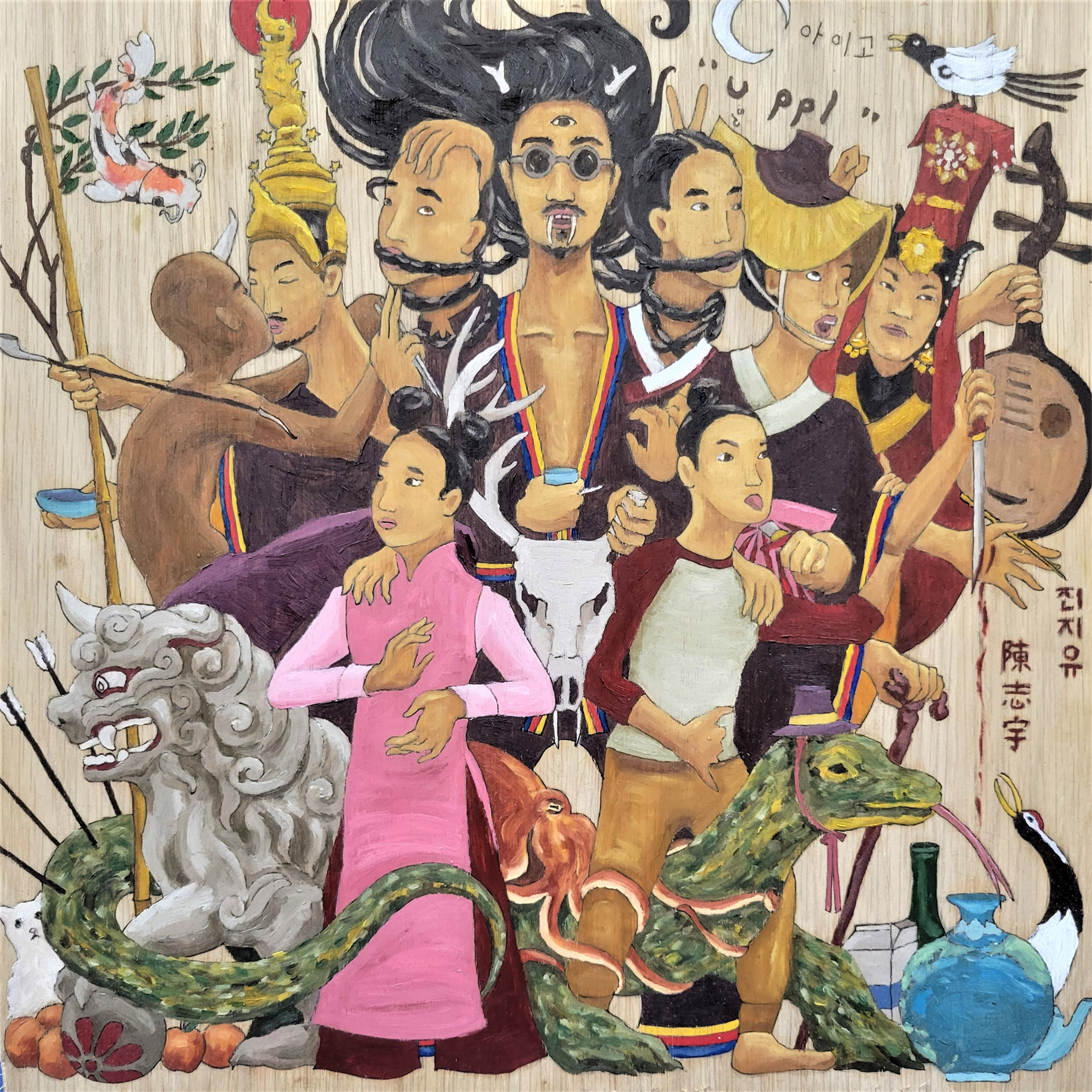
One such example can be found in his painting Deer Antler Velvet Red Ginseng Tea, which features a deer antler in its imagery.
“There’s an old Korean tea. It’s a Chinese tea too. It’s disgusting. It’s for elders and kids, for healthy bone growth?” Chan recalls. “The adolescent deer antlers’ skin comes off, and then that gets brewed (with red ginseng), and then it gets forced upon you by your family. I just have memories of watching PBS, and it taking three programs for me to finish this disgusting thing, but that sense-memory turned into a painting.”
For Chan, a small reference point can serve as the conceptual spark from which an entire complex work of art unfolds.
As he explains, “Having something as silly as a bad smell or a funny slang word or something like that in your memory, I think, is worthy of entire weeks or months of extrapolating into a painting and trying to put it into an art gallery.”
Connecting & Reconnecting
Chan grew up for most of his life in Connecticut, went to Vassar College in upstate New York, and in 2011, moved to New York City to work in book publishing for the majority of his 20s. It was through proofreading book jackets and cover art that he became interested in narrative art and history painting.
“When I moved to Seattle in 2018, I wanted a better understanding of the region, city, and neighborhood that my Cantonese grandparents, aunts, and cousins experienced for fifty years prior, and wondered how I could find continuity and belonging in Chinatown — a community that felt tangential and not essential to my own experience,” he explains. “I have code-switched, jetlagged childhood memories of visiting family in the [Chinatown International District (CID)] during spring and summer breaks.”
Two books from Seattle Asian American authors that Chan found particular poignant in helping him navigate how to be an artist himself include My Unforgettable Seattle by Chinese American community elder Ron Chew, who writes about growing up in the Chinatown International District, and the graphic novel Feeding Ghosts by Tessa Hulls, which weaves together three generations of Chinese immigration to the United States, from the perspective of Hulls, her mother, and her grandmother, who escaped from Communist China during the Cultural Revolution.
Other influential connections included Valerie Luu and Andria Lo’s Chinatown Pretty: Fashion and Wisdom from Chinatown’s Most Stylish Seniors, plus neighborhood connections to owner of Mam’s Bookstore, Sokha Danh, and muralist and activist Erin Shigaki.
“[Shigaki and Danh] are two examples of selfless and bold community members that have inspired me to explore how I might hold space and make change that is intergenerational, multicultural, and aspirational,” Chan says.
Even something as simple as seeing a rice cooker on display at the Wing Luke Museum of the Asian American Experience — part of Shin Yu Pai’s Ten Thousand Things exhibit — have led Chan to realizing that he had been all along “misvaluing” the mundane things in his life which he felt had personal importance.
“I think it goes back to the ancestor shrine, like totemism or animism — this sort of idea that the objects or the images aren’t holy themselves, but that we sort of use a shorthand,” he explains. “We have a pantheon or spirits or deities or folklore or myth to sort of evoke the same sort of broader themes [where] maybe the words have been lost — or the country that we’re living in, or the society that we are in, doesn’t necessarily make sense for it.”
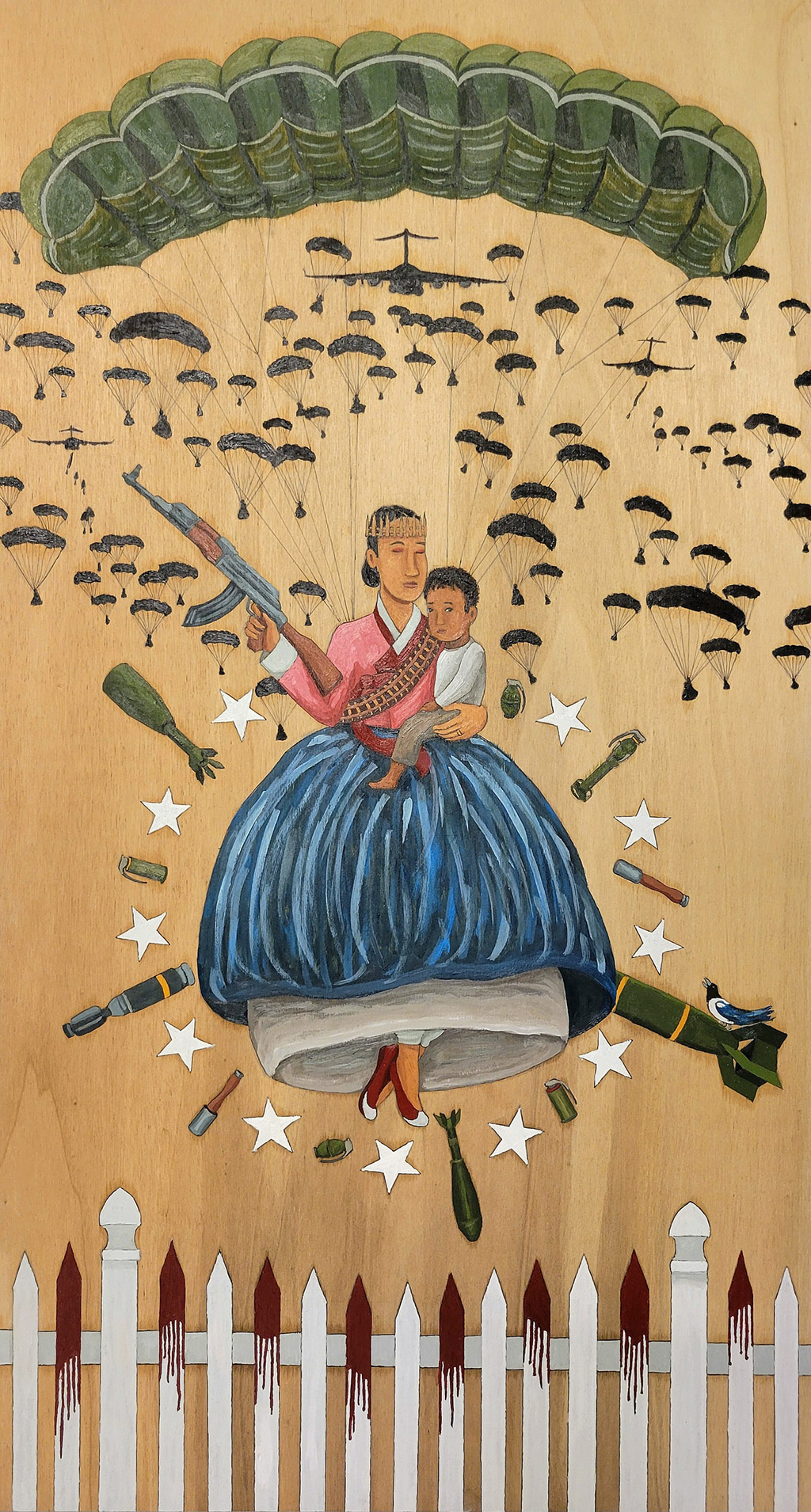
Chan extrapolates meaning from the mundane fluidly, through many methods. Depending on the piece, he may simply begin with the shape or dimension of the piece, which helps him visualize where to place certain figures — or he may begin with explicit inspiration from external sources.
“Maybe it’s a landscape, or maybe I’m starting to see where figures can go, and then I’ll realize, ‘Oh, this should be a dance, or maybe this is a military battle…'” he muses. “Sometimes it’s a song, or I’ll watch videos of other people making things — someone making arrows out of bamboo or wedging clay with their feet…”
“I feel like I’m doing an archive or taxonomy of folk art, and I call myself a folk artist because I’m trying to keep it analog,” he continues. “It’s not digital.”
But Chan does research and study a lot. At times, he understands the complex meanings behind what he is learning, and at times, his paintings represent his work-in-progress learnings.
“There are some minhwa 민화 rules in Korean [popular folk art]; there are some traditional Joseon-style [characteristics] — the five elements, winds, three colors, things like that,” he says, of inspirations that he includes in his work. “But I think to keep it in the art world, I just have to keep it personal, keep it present and daily and mundane and silly.”
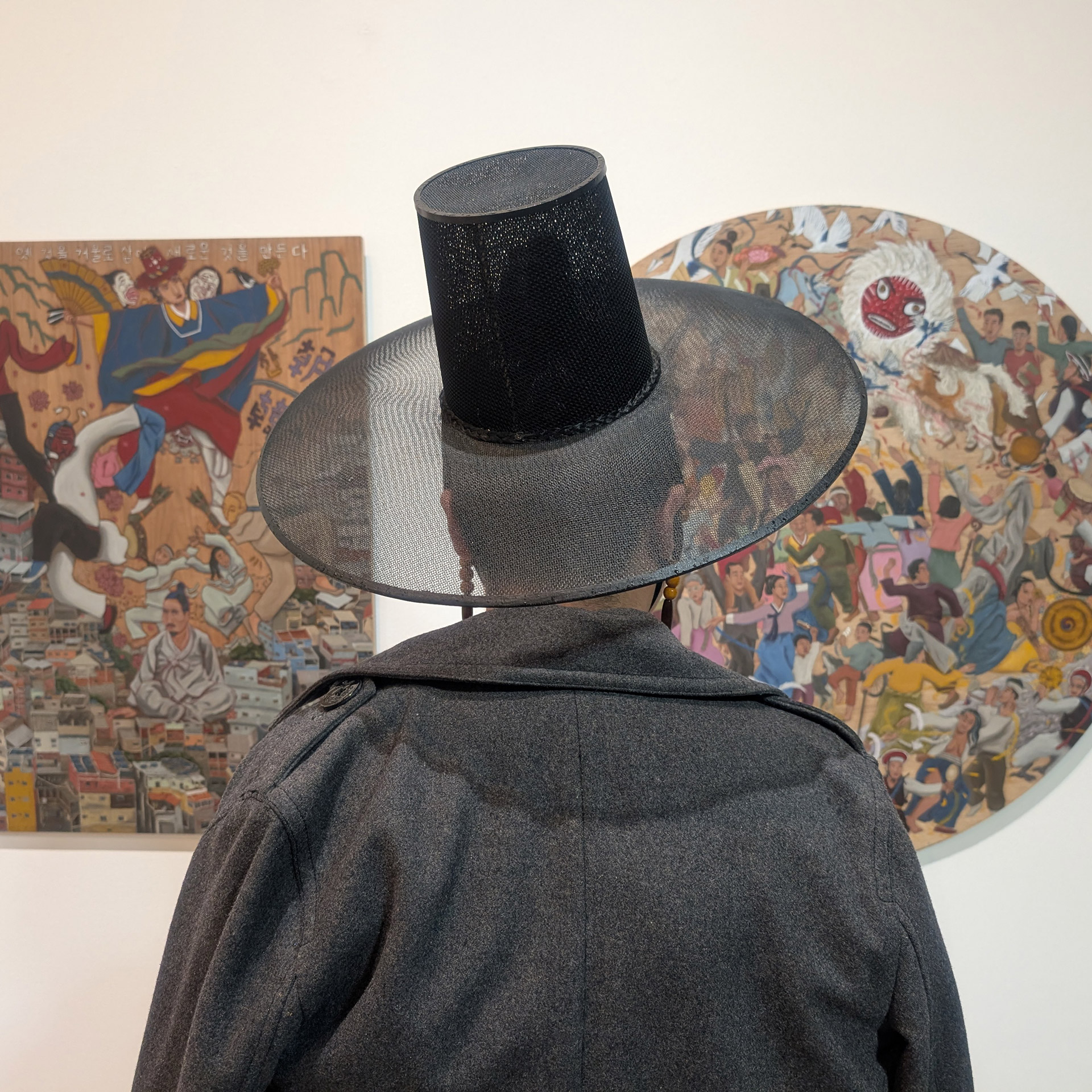
For instance, he recently went to Korea and acquired traditional Joseon attire, including a horse hair gat 갓 hat, sangtu-gwan 상투관 topknot hat, and manggeon 망건 beaded headband. On that trip, he learned the names of many of the hats, but admits that he still has much to learn about that aspect of the culture. The journey, for him, is all part of the reconnection process.
“I don’t ever claim authenticity, right? Somewhere stuck between,” he says. “But at least, if I know I’m doing the sort of formal academic [process], not losing it to someone else’s interpretation or whatever, then I’ve tried my best, [in] earnest, rather than authentic, I guess.”
For instance, while he reads first-hand references about what mudang and their husbands would ritualistically paint for different shrines, he understands that some things may be lost in translation.
“That’s the kind of cool thing about oratory matrilineal traditions: you’re not supposed to be able to read it. You’re not supposed to believe the formal binomial nomenclature date or anything,” Chan explains. “It’s supposed to be [for] everyone, from children to elders… you don’t need to be literate; you can understand a sort of timelessness, right? That’s what I’m attempting to do… even though [there’s] so much writing… I think it’s important that it has a non-verbal, has an evergreen [value beyond it].”
Diversity & Legacy
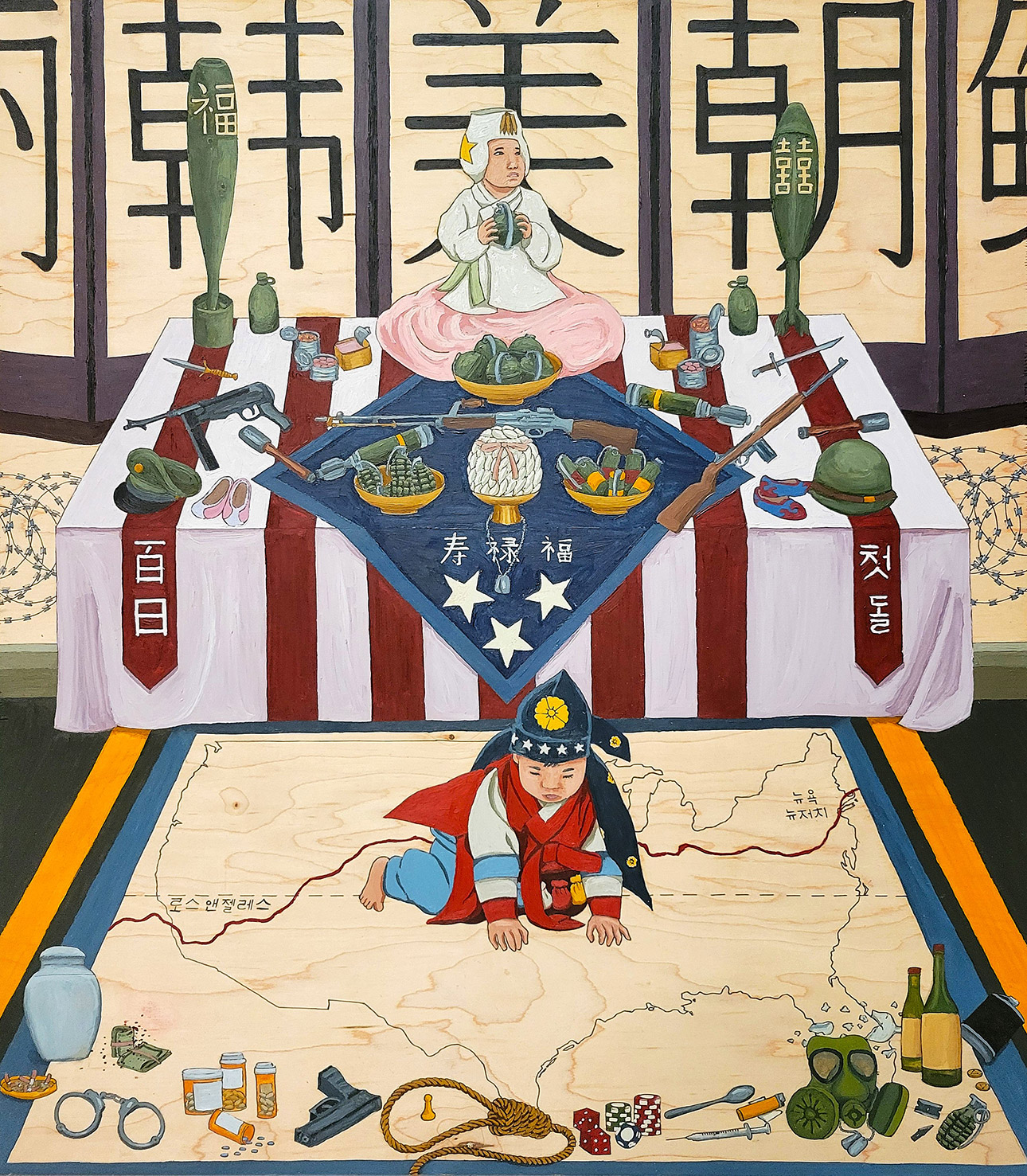
Queer elements are also strongly found throughout Chan’s work, often through nude Asian bodies of various shapes and sizes. For Chan, it is important to highlight the fact that there is no such singular presentation of beauty.
“With a lot of the Asian bodies, [I am] just trying more sizes and shapes and colors — never mixing the same color, never making the same figure, never forwarding one ideal of beauty, always trying to just explore how many wonderful variations there are in what we can express,” he explains. “Even if I paint myself, I don’t ever try to do it [the same]. My skin tone is never the same. What I’m wearing is not going to be the same. Just to show each painting is a… physical act.”
“Even though visual artists generally aren’t considered performers in the same way that musicians or dancers are,” he continues, “when I’m sitting down and doing the painting, start to finish, it’s full of human error and improvisation and all that sort of stuff.”
While there may be many queer Asian artists from a diversity of ethnic backgrounds, there may not be many like Chan.
“I don’t necessarily know… that many folks that are maybe three culture and queer,” he says. “Frida Kahlo is a big example, right? But contemporarily, I’m not super aware of it, because I feel like there’s so many ceilings happening that you might just pick one and hope that you can ascend in that way.”
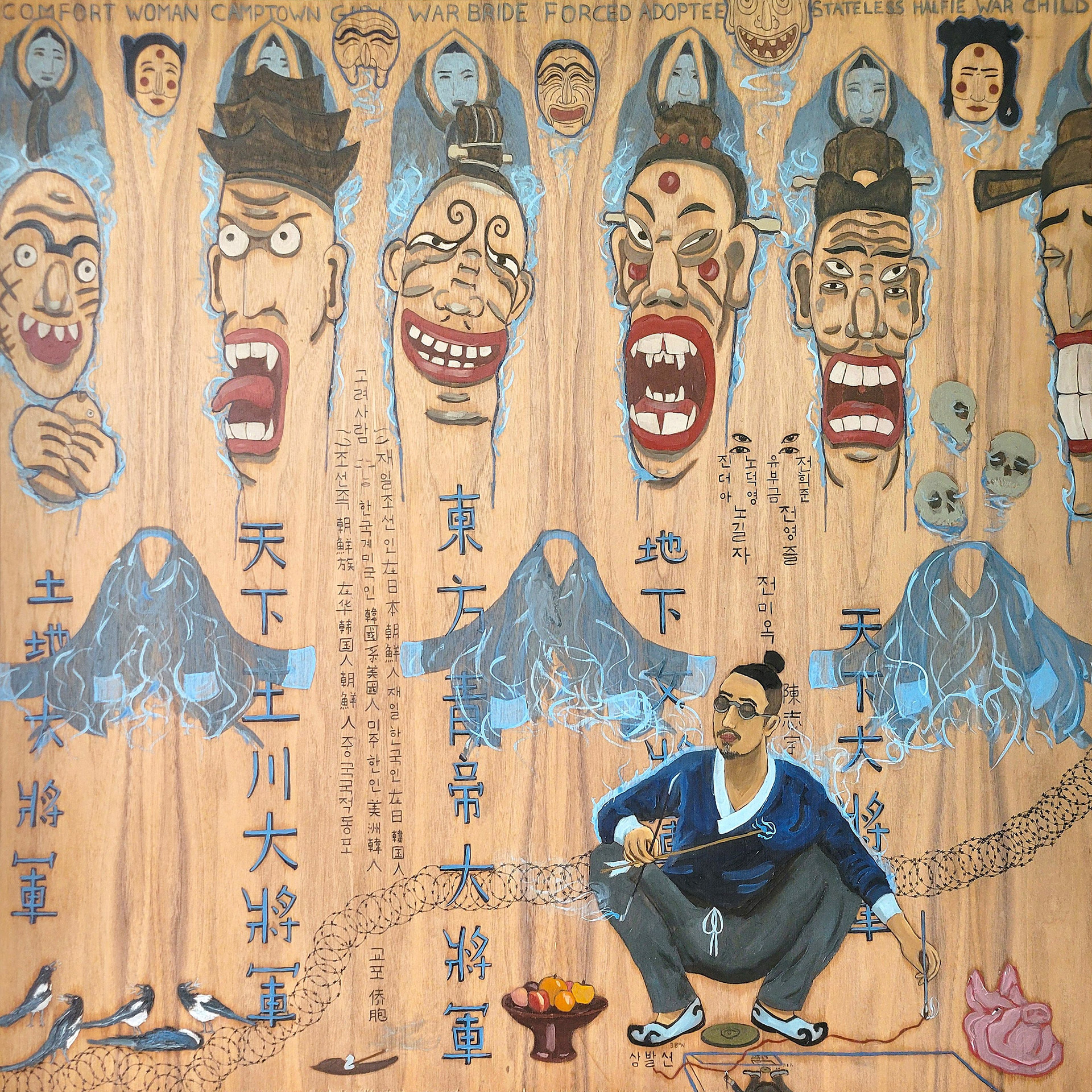
As a queer artist, Chan does think a lot about his legacy, in relation to his heritage. He speaks of one piece, 교포귀신굿 / Gyopo Gwisin Gut – a sendoff for Koreans who perish abroad, which features a “ghost that has unfinished business.” Through its portrayal, Chan questions aloud who would be responsible for giving funeral rights for Korean people who are not fully immersed in Korean culture or are resting outside of Korea. He wonders aloud if there are half-Korean mudang, and what the implications of all those questions might be for individuals like himself.
“I’m queer. I’m not leaving children. I’m not necessarily passing down Korean-passing children, so [what are] the sort of ways to think about the future legacy that don’t necessarily mean children [or] grandchildren?” Chan questions.
It seems that Chan is passing down those narratives with his paintings, through an endless process of self-study and exploration of things that hold personal meaning. Yet he admits it is always the most helpful when his works are reflected back at him through others in the community.
“Seeing children and or elders — especially if they’re Chinese or Korean — talk about my work is exciting because I can’t grab everything that they’re saying, but when I hear a couple things that I know I’ve imbued in it, it feels like as much as I’ve created it… it’s taken on another life for its own,” explains Chan. “I didn’t know what that life would be and for who, but when I show live and I can hear people’s reactions, it kind of helps me, validates me, that… I can use these [particular] objects in the same way that maybe paragraphs or statements or essays [can be used].”
Ω


 Thuc Doan Nguyen