

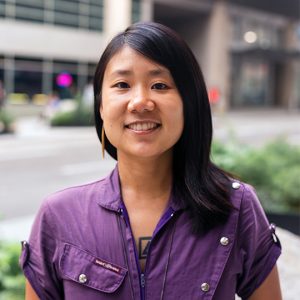
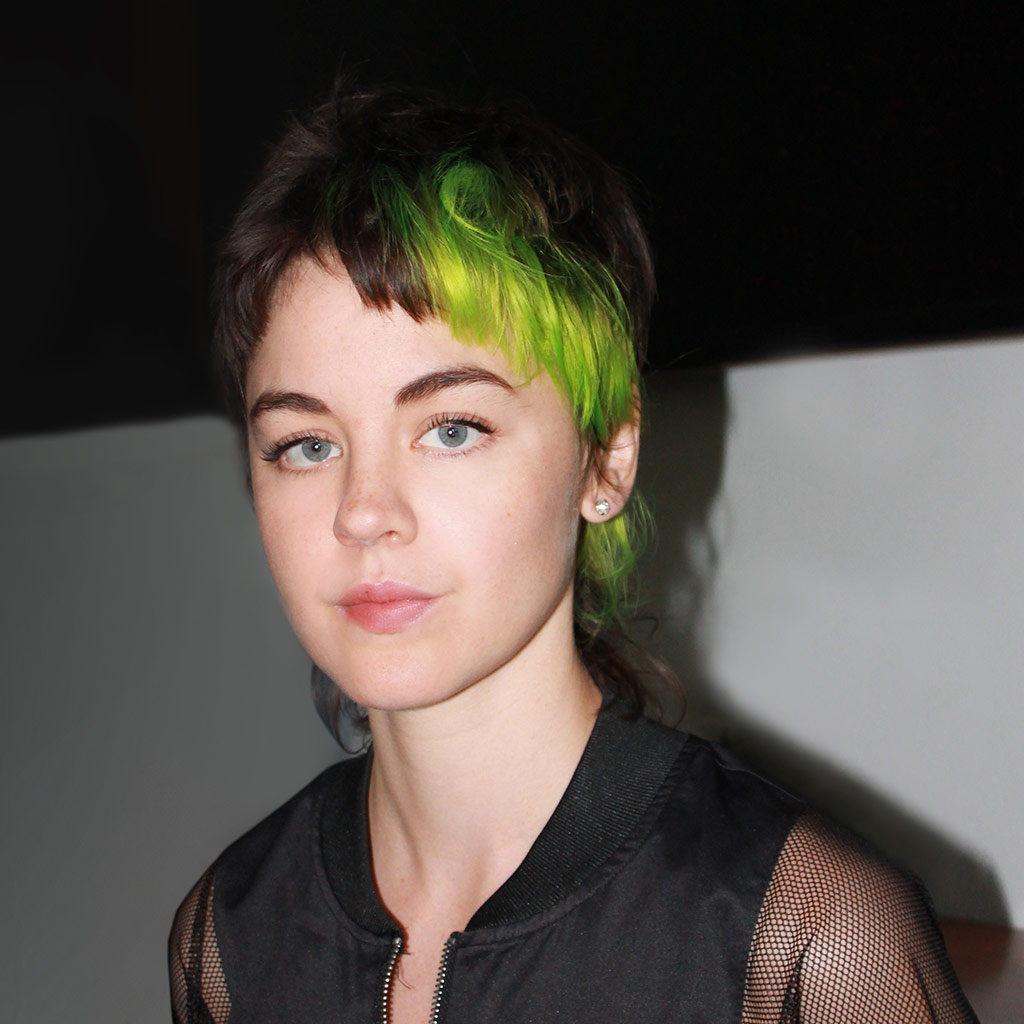
 Vee Hua 華婷婷

Ancestral Connections to the Chinatown-International District & Beyond
While their lineage originally comes from Hong Kong and Taiwan, their family first set foot on U.S. soil in the 1970s, where they immigrated straight to the CID and lived in its historically-significant Kong Yick Building. Their father’s side also had three different restaurants and a convenience store: China Gate, which is now a grocery store; Atlas, on the corner of King and Maynard; and Hong Kong Bistro, which remains open to this day.
“When my grandpa started getting older, he sold the restaurant and had a little deli convenience store,” recalls Chau. “Growing up in the International District was really significant to me. I think it is fully the reason why I am a community organizer. It really helped me see the ways that food had people gather, or the ways that people would gather around food for celebration, for grieving, for just meeting.”
Though Chau admits that they didn’t fully understand the history of the CID until they got older, they came to recognize eventually that “it was a place born out of exclusion and racism.” This realization led them to start organizing with the CID Coalition, an organization that builds “inter-generational, inter-cultural, community-based organizing for neighborhood resilience and collective power.”
“A lot of that work is based in anti-gentrification work, building collective power through our neighborhood, and mutual aid efforts,” says Chau. “[The CID] is a very special place to a lot of people, and I feel like all I wanna do is protect that.”
Chau’s ties to their ethnic roots, colorful hometown, and ancestry inform much of their work, including paintings and illustrations that take on diverse forms and presentations. Much of their work also taps into their heritage – which is made obvious through the use of certain colors, Chinese characters, or items of symbolic significance to the culture.
“[It] has felt very healing and very necessary,” they note, regarding how working with their own identity has resulted in a plethora of feelings and emotions. “Being able to do that work and bring myself with a relationality with the place that I occupy – specifically with the International District – has helped me get more political and get to a place beyond ‘boba liberalism’ and be able to really see issues of class and solidarity and imperialism for what they really are. That has been significant, helpful, healing.”
The artistic work is also deeply tied in with a connection to their ancestors.
“Doing work around my ancestors has been healing in a way that is beyond just art and art practice,” they say. “I feel like it has been very necessary for me to ground… recognizing the labor that they put into the things that they loved and cared about is something that really inspires me to do the same for everything that I do.”
Such information sometimes shows up for Chau in ways that they don’t initially realize or even intend, in the form of what feels like subconscious or ancestral messages.
“I found out recently that one of my great-grandparents was a town healer, and I think she’s been really trying to make herself known in my life as of late. I’m trying to really nourish that relationship and consider what are the kinds of things that she would want to bring forth into a world that is what we’re experiencing at this moment,” Chau explains, adding that they partake in rituals such as praying and making offerings. “I think doing ancestor work just really helps you connect to the world beyond yourself.”


Immersive Histories of Chinese Influence in America
Ancestors and rituals also show up in Chau’s Of Salt and Altars, two large-scale immersive murals that they debuted at the Tacoma Art Museum in 2024.
They formed a part of a multi-part series entitled [re]Frame, created in conversation with the museum’s Haub Family Collection, which presents a Euro-centric perspective of Western colonial expansion. To provide a “reframing” of such narratives, Tacoma Art Museum invited in curators of color to respond to the works.
Four offshoots of [re]Frame – which all started in May 2024 but will remain at various intervals throughout 2026 and 2027 – were eventually created: The Abiqueños and The Artist, Nepantla: The Land is the Beloved, Blackness Is…the refusal to be reduced, and Finding Home: The Chinese American West. Curator Lele Barnett invited Chau and mixed media artist Zhi Lin to participate in the Chinese American portion.
The project offered Chau their first opportunity to research deeply around the topic of Chinese Americans’ participation in Westward expansion. While they admit that they might not naturally be a person that connects easily with history, being able to pursue it through the vehicle of art really helped them “absorb that knowledge and experience.”
Chau dove in deep, learning about the Trans-Continental Railroad, Chinese laborers, and their experiences around it, although that information was sometimes hard to access.
“There were more than 250,000 letters that went between China, Japan, and the U.S. in 1876 alone – and despite the most strenuous research efforts, no message from or to a Railroad Chinese has been found or recovered due to the destruction and pillaging of Chinese belongings,” Chau explains. “That’s also why the Chinese laborers are called ‘Silent Spikes,’ because there’s no account of them speaking on their own.”
Yet one crucial resource was scholar Gordon H. Chang’s book, Ghosts of Gold Mountain, which Chau describes as “one of the most comprehensive recollections around the Chinese migrants.”
Reading it, Chau aligned deeply with the spiritual aspects of the Chinese laborers’ experiences.
“One of the accounts that some white dude had about the Chinese laborers coming off of the boats… was that the ‘Chinese build altars wherever they go,'” Chau explains. I thought that was so beautiful and so resonant.”
For that reason, central to the Of Salt and Altars panels is the presence of goddesses that are significant to Chinese culture.
“When you first walk into the exhibit, you have to cross past my mural, and so, the initial first half of it is the ocean, where you see the goddess Mazu, who is the protector of seafarers.”
“If you do go in-person, I try to invite people to have a really close-up experience with the ocean, because you’ll see that there are folk songs that are written into the waves,” Chau adds.
In the second mural, one finds Guanyin, the multi-faceted Bodhisattva of compassion known to many Buddhist cultures. She is surrounded by tools and offerings that are accurate to objects that Chau pulled up from a Smithsonian database of items that were used during the time period; meanwhile, a railroad track horizontally partitions the scene in half, in an almost aggressive way.
“[It] represents that despite these really intense and magnificent efforts of this railroad track, it was also cutting through sacred and Indigenous lands,” Chau explains.


Paying Homage to Community Organizing in Chinatowns
Returning to their connections to the CID, Chinese restaurants, and activism, Chau’s latest project – a collaboration with artist Meilani Mandery – is an as-of-yet untitled book centered around stories of resistance from Chinatowns in the United States.
“It honestly feels like a pregnancy, I say as someone who has never been pregnant,” Chau jokes. “This has honestly been a dream project for a really long time for me. I’ve always wanted to travel and visit all the different Chinatowns and make work about it.”
Chau explains that Mandery finished their thesis, “The Gentrification of Chinatown, the Museum’s role,” two years ago. Now, the two are “coming together” to birth the project, with support from the local grantmaking organization, 4Culture.
“We’re doing interviews with grassroots organizers,” Chau explains. “To not overwhelm ourselves, we’re starting with the West Coast, and I think to not hurt any Chinatowns’ feelings, [we are] specifically working with historical Chinatowns and ones that have been around before 1965, because that looks different after that timeframe.”
“The idea is: as grassroots organizers, we want to connect better with other grassroots organizers,” they continue.
To put it simply, Chau and Mandery believe that by collecting stories of individuals who are truly doing the work, it can inspire others to get involved in their own towns.
“We’re really wanting to connect these struggles so we can learn from each other and not reinvent the wheel every single time, because often, the issues and threats that Chinatowns are facing look the same,” says Chau, citing topics such as state governance, state violence, public transportation, and sports stadiums. “What are people doing in their own Chinatowns to preserve the history and the legacy?”
Though the project is still very much in its early gestation phases, Chau shares that it will eventually live in multiple formats. The duo will begin by conducting interviews, visiting all of the locations, and eventually make art in response to all of those neighborhoods. The final book will include some pictures of the works and interview excerpts, then be released as a gallery show and book launch party around summer 2027.
“A lot of what we’re talking about right now is tenant organizing, massage parlor organizing…” Chau adds. “It’s been a very nourishing project that has been teaching us a lot.”
Ω



 Saelyx Finna