
 Carl Lawrence
I’m Coming Home
Nothin’ tastes better than the poisonous fog
Seeping from the sewers in my slummy neighborhood
But the ghetto got love and the love is all good
– Lyrics from “I’m Coming Home” by Insane Clown Posse, Riddle Box, 1995
I was introduced to Insane Clown Posse through a childhood friend while growing up in Colorado. I was 11 and he was 14. He was the son of one of my father’s coworkers, and we met while living in the same long-term stay hotel in Colorado. Our dads were welders and mechanics who regularly traveled for work, which meant we both moved around a lot. In my case, over 20 times before I turned 18. Over the next couple of years, our families grew close—so much so that whenever one of us moved, the other would follow to stay nearby. My friend and I became inseparable during this time, spending most of our days skateboarding, listening to music, and smoking cigarettes.
He was the youngest of three siblings, and his entire family, mom and dad included, were Juggalos. Their musical diet consisted almost entirely of ICP, with exceptions made only for artists affiliated with the group, mainly from their label, Psychopathic Records. They knew the lyrics of seemingly every song by heart, wore ICP shirts daily, and their lives were marked by the presence of the label’s logo, the Hatchetman. My new friend proudly wore it as a pendant on his necklace, and their 1990s-era Ford Bronco displayed it prominently on the rear window.
I was mesmerized. Right away, I could tell there was something different at work in this music. I had never seen someone—let alone an entire family—shape their lifestyle around the identity of one band.
At this point in my life, I had a meager but developing vocabulary for strange, pugnacious music thanks to my dad’s appetite for punk music. Suicidal Tendencies, Black Flag, and Alice Cooper were sounds I remember hearing in the car as a kid. For my first concert, my dad took me to see Megadeth, Arch Enemy, Opeth, and Lamb of God. It’s safe to say that these sounds predisposed me to ICP. They checked many of the same boxes: playful sacrilege and irreverence, wrapped in a theatrical display of excess.
ICP still felt like they occupied a category all their own. In retrospect, I think it was because of their extraordinary talent for storytelling. While some might argue they lack technical prowess (after all, they don’t play instruments!—a fact they are first to admit, often with a chuckle), they more than make up for it with their compelling and provocative narratives.
What made the music even more unique and outlandish was the camaraderie shared among Juggalos. Seeing perfect strangers nod and smile at my friend and his family in acknowledgement of a shared musical love was as inspiring as it was strange. Camaraderie is central to ICP’s music. It’s a notion expressed through their concept of “Family,” which has little to do with the traditional nuclear family, but a deeper sense of collectivity. It’s a notion of family that’s rooted in fellowship and demands unflinching compassion and tolerance towards others.
Referred to colloquially within Juggalo subculture as “Fa-mi-ly!” or “clown luv,” Family is an improvised and mutable commune whose scaffolding materializes in the meeting between two Juggalos.7 It ejects from the imaginary, liberatory space of ICP’s music and provides shelter from the stratifying expectations of the real world.
This safety is needed because Juggalos largely identify as outcasts. Juggalos are mocked for being nerds, losers, freaks, ugly, poor, and fat—pejoratives that ICP affectionately celebrates as “scrub life.” Not fitting in or living up to normative expectations is the very way to fit in in their world. One price of admission is compassion toward other Juggalos.
I remember thinking that the kindness and support shared among Juggalos seemed almost utopian. Outside of religious charity, I had never encountered anything like it. The fact that it existed independently of any religious or government institution made it especially impressive. It may have been because I didn’t grow up with a strong sense of community. Even the idea of family was tenuous at best. My parents didn’t have healthy relationships with their respective families. They didn’t seem to like each other very much, either. Conflict was rife between them, with my dad often abandoning us for days or months at a time while he nursed his alcoholism. Oftentimes it was just me, my sister, and my mom.
Between my dad’s disappearances and the transient nature of his work, money was often tight. My childhood oscillated between the relative stability of middle-class suburban life and the harsh realities of homelessness, including periods spent in shelters and sleeping in cars. Relying on church food boxes and the generosity of faith-based shelters for single mothers was a normal part of my childhood. The instability made it difficult to cultivate and sustain friendships for very long.
The idea that listening to ICP’s music could grant me membership to an entire community of people I didn’t personally know struck me deeply. It was probably my earliest encounter with mutual aid. I couldn’t fully grasp the extent of it, but I felt its benefits. Sometimes, I’d be wearing an ICP shirt at the grocery store with my parents and a complete stranger would smile and say “whoop whoop” as they passed by. It felt like I had privileged access to an exhilarating secret world.
Even my parents were charmed—my dad, especially. After buying a couple of their CDs, he developed a real admiration for their music and nurtured my burgeoning obsession. My family’s gradual conversion to Juggalo-dom was in full effect. While I was buzzing off the bizarre fantasyland of their songwriting and the thrill of joining a new community, my dad appreciated their social criticism, particularly the working class ethos of their music. Years later, long after both of us stopped listening, I told him I saw ICP perform on a boat. He chuckled and said, “I still understand their appeal. They speak for a lot of people who don’t have a voice.”
Money was a constant source of worry for my parents, cultivating in them a perennial bitterness toward those with more means. My father’s common refrain was, “I’m going to work until the day I die,” which, sadly, proved true. He passed away unexpectedly at 57, leaving behind little more than his debts.
My nascent affiliation with ICP didn’t always elicit positive responses, though. It was common to walk down the street and hear the words “FUUUUCK JUGGALOOOOS” ring out from a passing car. Other times, the insults came from kids at school or the skate park. If I wasn’t alone, my friend and his siblings would boldly fire back with a choice insult, two middle fingers, and an invitation to fight. Scuffles would occasionally ensue. Fighting never came naturally to me, but my new friends taught me the importance of never letting anyone denigrate you for how you look or the music you love.
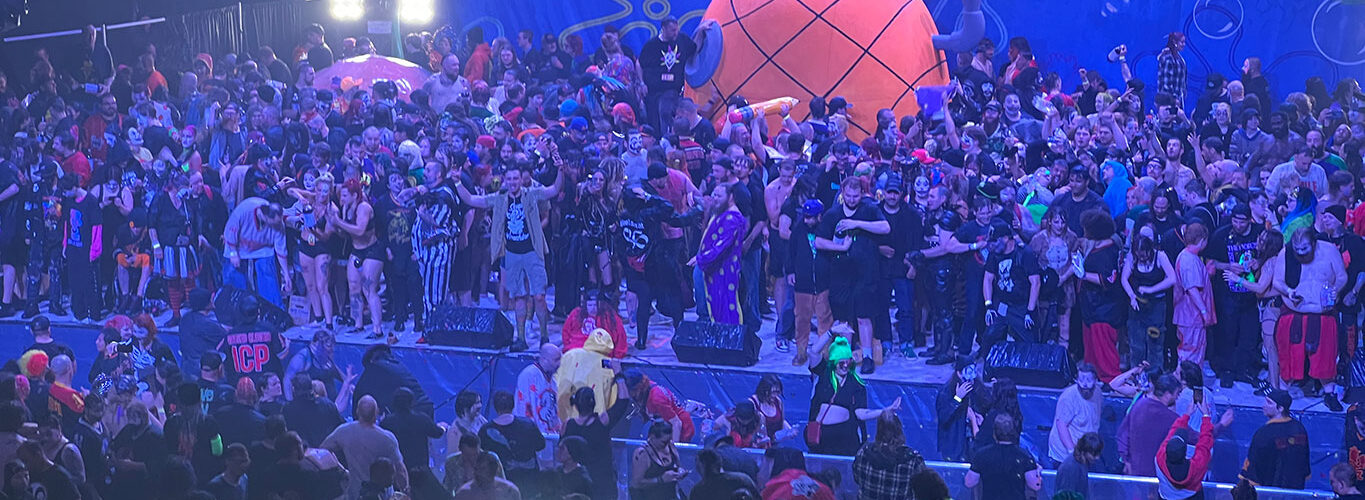
All kinds of memories were stirred up in the days that followed Ballas on a Boat. What I thought would be a one-off, bucket-list experience became something else entirely. I didn’t walk away a born-again Juggalo, but I felt a tug pulling me in ICP’s direction. I found myself, once again, charmed by their sheer strangeness and the small piece of their world I was able to glimpse that night. Something about it felt spiritually resonant. I wanted to know more.
What I learned was that the strange complexity of their music is matched by the improbable trajectory of their career. Peeling back the layers of their history reveal all the makings of an incredible story—one that would even satisfy our American enchantment with rags-to-riches stories—albeit a clown-themed one. Yet, this is a story that is rarely told in media portrayals of the group.
Most conversations about ICP tend to be clouded by suspicion, mockery, or disgust. To be fair, the group consists of two guys who paint their faces as clowns and a fanbase known for its unusual and religious-like devotion. It’s easy to understand, then, why assumptions and misunderstandings abound. This is a dynamic that has persisted for more than 30 years, creating an aura of mystique and notoriety around the group.
For many, this is enough to simply speed past ICP in their cultural adventures. For me, however, the peculiar and seemingly nonsensical nature of ICP’s persona is an occasion to stop and linger. As I reimmersed myself in a surfeit of ICP material—books, documentaries, interviews, articles, podcasts—I kept feeling like no one was quite getting their story right. The narratives were mostly either: arcane, tailored for Juggalos who already had a deep knowledge of and appreciation for ICP; or they were troublingly superficial, offering exploitative and, frankly, offensive portrayals of the band and, more gruesomely, their fans. Even those who harbor sympathy tended to unquestioningly reinforce many common stereotypes about the duo that date back to their beginnings. ICP and Juggalos have long been characterized as inbreds, trailer trash, failures, and imbeciles—all classicist tropes rooted in prejudiced views of the American Midwest where ICP is from. What begins as an honest attempt at giving the group their roses usually devolves into the decontextualization of their lyrics for comedic effect and mocking examinations of Juggalo subculture.
There were so many interesting things about ICP that were simply being left out. Why, for example, wasn’t anyone probing deeper into their own mythmaking and establishing meaningful connections between it and the fascinating social and political history of Detroit?
The only exception to this trend was a relatively small selection of academic essays that were published in the wake of the FBI’s 2011 assessment. These works largely focus their attention on Juggalo subculture through a sociological lens. They highlight the real dangers of rushed judgments—of which the FBI designation is the most extreme example—without necessarily taking a clear stance on the band itself. The value of this work can’t be overstated; the attempt to de-stigmatize these clowns is no easy feat, especially when you consider the deeply entrenched prejudices that long predate the FBI designation.
Academia, no doubt, has a role in the growing cornucopia of conversation about ICP, but filtering them through the sieve of the university’s epistemological norms domesticates their strangeness. It attempts to render them more respectable, thereby making them more worthy of serious consideration, when what makes their work so impactful stems precisely from its defiant eschewal of decency and meritocracy. This is, after all, how they’ve earned and embraced their reputation as failures. They are delightfully irreverent and steeped in a serious commitment to unseriousness. This gets lost in scholarly translation.
To be clear, though, ICP’s artistry and cultural impact are not only worthy of critical analysis but long overdue for it. However, to engage seriously with ICP, you must be willing not only to play but to play on their terms. You are called to relinquish the ring buoy of conventional understanding and bathe in the debased stew of their world.
My call for a commitment to play is inspired by queer writer and theorist Jack Halberstam and his concept of the “silly archive.” Halberstam uses this phrase to emphasize the value of seeking knowledge in the wrong places, such as the juvenile terrain of Pixar movies, offbeat stoner comedies, SpongeBob SquarePants, and other so-called low-cultural sites.8 If we are invested in rejecting prevailing social hierarchies, we must search beyond traditional intellectual spaces and immerse ourselves in the absurd, the childish, the failed, and the seemingly trivial. The silly archive encourages us “to be underachievers, to fall short, to get distracted, to take a detour, to find a limit, to lose our way, to avoid mastery, and….to recognize that empathy with the victor invariably benefits the rulers.
The mockery and condescension directed at ICP obfuscates what’s hiding in plain sight in the biodiverse marshlands of their music: a giddy and adventurous blueprint—a terrific carnival of revolt against economic inequality, systemic racism, police violence, and urban renewal. For this reason, the case for defending them as failures should be explored.
To be fair, they don’t come across as the most obvious candidates to consult about societal transformation. Scrub off the clown paint and you’ll find two rather plain-looking straight men peering back at you. ICP has also been rightfully criticized for their use of homophobic slurs in their music, especially in the 1990s and early 2000s.9 They have their flaws, but if we forgo a strictly identitarian lens, which the clown paint may help facilitate, I think we’ll find that these perverse jokers along with the eclectic coterie of social lepers that adore them (among whom I find myself) are worthy of our attention.
Picture this: J and Shaggy are having their big moment, strutting their stuff down the red carpet at the VMAs after decades of rejection. Both are wearing immaculately tailored suits, and both look infinitely more impressive than anyone else at the event. It’s safe to say, they’re crushing it. Shaggy sashays marvelously in a white paisley suit that beautifully highlights the impeccable detail of his masterfully applied face paint. Violent J raises Shaggy’s outfit by one. He dons a bright, rainbow tie dye butterfly-themed suit bedazzled in rainbow rhinestones. The ombre of his collar glimmers in a magnificent rainbow glow against the rippling camera flashes firing off all around him, creating a stunning halo effect that both frames and enhances his pristinely primped clown cosmetics. Only the Nature Boy himself, Ric Flair, has any chance of doing it better.
A photographer calls out for them to pose. They stop and arrange themselves in their best Hardy Boyz stance, throwing up “wicked clowns” and “forks up, forks down” hand signs. They smile politely. There’s an uneasy look in their eyes that says, “I don’t know what’s going on. What did I do to deserve this? Are the mushrooms kicking in? How did I get here?”
These, my friends, are the dweebs I propose we keep company with. Like Melville’s Moby-Dick, their childish debauchery is “a dumb blankness, full of meaning.” As we splash and stamp around in the puddles of their degenerate play, we catch glimpses of a brilliance—one that, when viewed from the right angle, erupts into a terrific prismatic play of light.


 Vee Hua 華婷婷


 Thuc Doan Nguyen

 Saelyx Finna