
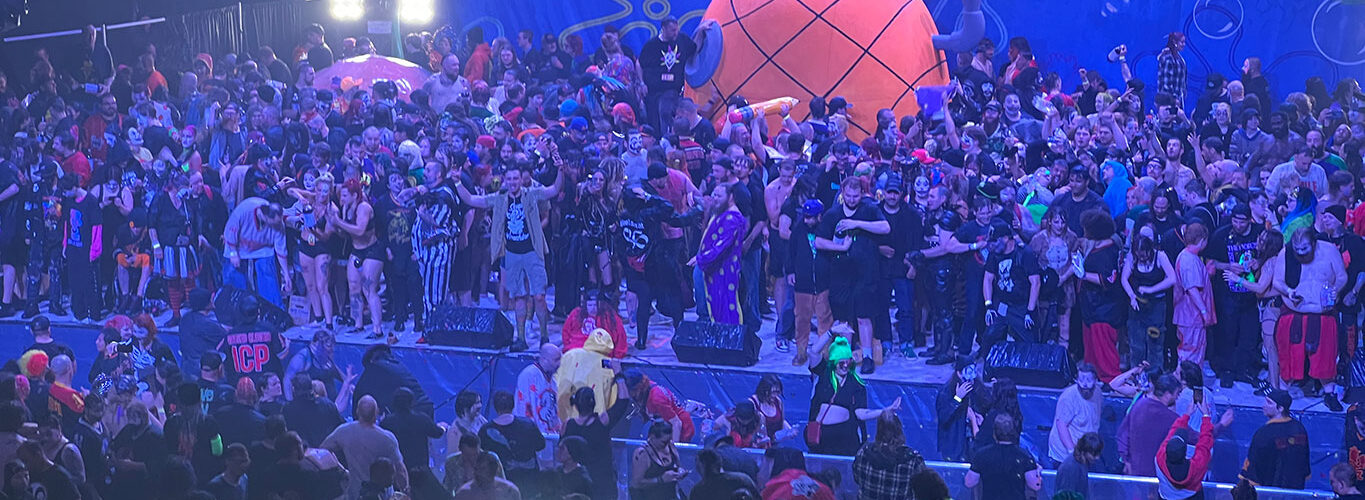
 Carl Lawrence
In the Haughhh!
I breath toxic fumes and throw my lungs up
All over your brand new patent-leather penny loafers
You fuck!
I’m 2 Dope
I got sick ass sewer sludge stuck in my throat
And I live in a big pipe on Zug Island
So stop by and have a bowl of rust
– Lyrics from “In the Haughhh!” by Insane Clown Posse, Beverly Kills 50187, 1993
“In the Haughhh!” lurches forward with a treacherous, sluggish churn, powered by what feels like a dying engine coughing out its last plumes of smog. The track staggers forward only to collapse again with each thump of the beat, landing like the labored breath of someone on their deathbed. The song sounds poisoned by the very polluted landscape it describes. Listeners are hypnotized by an intoxicating rhythm that carries the sensation of inhaling secondhand smoke, although it’s probably something much more insidious than that: polychlorinated biphenyls, polynuclear aromatic hydrocarbons, heavy metal, sulfur dioxide. When Violent J mutters, “I’m in the Southwest Detroit Delray inner city,” the words slither through the speakers like a toxic blowback, delivered from his mouth and into your ears.
The song conjures an austere portrait of Detroit, but it also expresses fierce pride for the Southwest enclave that ICP claims as home and mythologizes in their music. Each verse evokes images of toxic pollution, bodily deformity, poverty, and gang violence.
The phrase “in the haugh” could be understood simply as slang for “in the house,” but haugh also has a topographical meaning. According to Merriam-Webster, a haugh is a low-lying meadow beside a river, a term of Scottish origin rooted in the Old English healh or halch, meaning “corner” or “recess,” and related to holh, meaning “cavity” or “hole.”. By definition, a haugh forms through the downstream flow of a river; it is land shaped downriver.
It’s interesting to think about that in the context of Detroit, where “Downriver” carries a very specific meaning. It’s a geographic term that refers to a cluster of working-class communities located south of Dearborn, north of Monroe, west of the Detroit River, and east of the Detroit Metropolitan Wayne County Airport. These neighborhoods include Ecorse, Wyandotte, Lincoln Park, Allen Park, and River Rouge. Because these communities are overwhelmingly working-class, Downriver can take on a pejorative meaning. Downriver usually implies a distinction that is both racial and economic: poor Black, brown, and white residents are relegated to the polluted slums of the inner city, while more affluent white communities live upriver within the insulated safety of the outer suburbs.
Shaggy describes this divide: “People in the suburbs hate me (Why?).” J echoes this sentiment with the threat of rebellion:
I don’t exist to you fucks
You fucks
You green-grass fucks
Fuck me, and I’ll fuck you, fucker
We comin’, motherfucker
We comin’ to get ya
The veiled threat of rebellion is embedded in the title of the EP on which the song appears: Beverly Kills 50187. The title is a play on the popular 1990s teen drama Beverly Hills, 90210–a TV show about a wealthy suburban group of friends in Los Angeles—and it’s also a reference to Beverly Hills, Michigan, an affluent suburb located roughly twenty miles northwest of Detroit, between 13 and 14 Mile Road, near the wealthy Birmingham neighborhood. The appended zip code 50187 fuses “5-0,” slang for police, with “187,” the California penal code for murder. Taken together, the number reads as “cop killer.”
Beverly Kills 50187 is an early and comparatively minor work in ICP’s catalog—a “sideshow” album, as they’re colloquially referred to by Juggalos, to distinguish their EPs from the “main attractions” or “Joker’s Cards” that are their full-length LPs. Released in 1993, just a year after their first LP, it captures the group at a moment when they were still forming their sonic identity.10 “In the Haughhh!,” for example, shows them undergoing a lineup change. Shaggy’s brother, John Kickjazz, had recently left the group, and Erik Olson, performing as Greez-E, made a rare appearance on their recorded music. Yet the EP is significant precisely because it contains many of the themes and preoccupations that ICP would go on to develop more fully in later albums.
What sets these early releases apart is their relatively explicit, almost documentary-like depiction of life in Detroit during the ‘80s and ‘90s—a characteristic that would become more abstract in the poetic language of their later work. As ICP were young artists who were experimenting to find their sound, listeners are afforded the ability to hear ICP’s influences with greater transparency. This includes their musical inspirations, such as the production stylings of Mike E. Clark and Esham, who contributed to these early recordings. Equally as influential is the imprint of Detroit’s social and political landscape, the impact of the radical Black Power and Leftist movements that reshaped the city and the long history of racial and economic violence that preceded that rebellion resonate throughout their music. To fully grasp this, let’s take a look at ICP’s humble beginnings.
There is far less biographical information available about Shaggy 2 Dope compared to Violent J, who has spoken extensively about his life publicly and published an autobiography. J has always been the more outspoken of the duo, while Shaggy is often more reserved, perhaps out of a preference for privacy. For this reason, my discussion of the group’s adolescence in Detroit will draw primarily from Violent J’s biography.
Shaggy 2 Dope (real name: Joey Utsler) and Violent J (real name: Joe Bruce) grew up in working-class families in suburban Detroit.11f Bruce spent his early years near 11 Mile Road in Berkley and later Oak Park, while Utsler grew up in Ferndale.
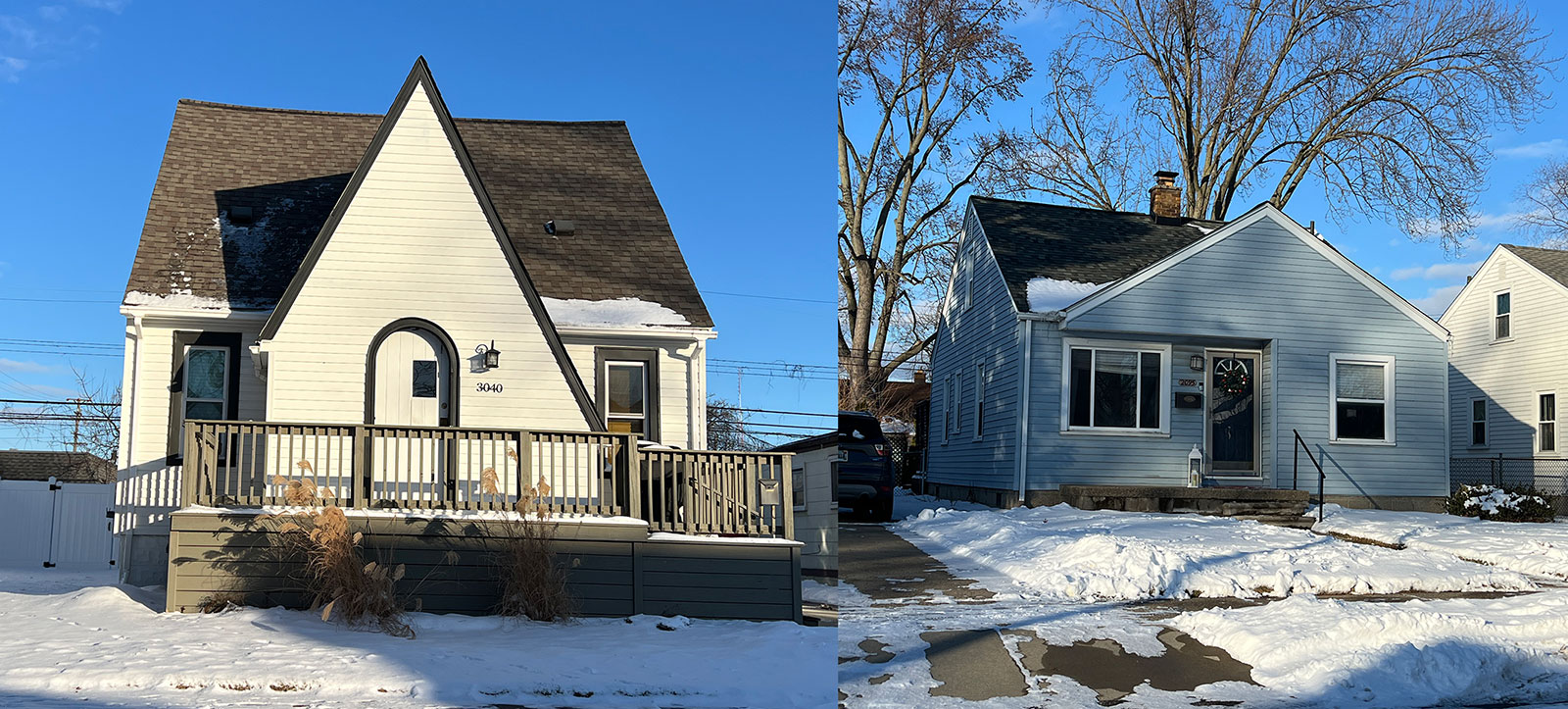
Bruce, the son of Linda Harwood and Richard Bruce, is the youngest of three children: Theresa (b. 1968, approx.), Rob (b. 1970), and Joe Bruce (b. 1972). Linda and Richard had a violent and tumultuous relationship. One of Bruce’s earliest memories is witnessing his father throw a television set down the staircase at his mother. Bruce was directly in its path but was pulled out of the way just in time by his mother. Amid ongoing violence and infidelity, the couple agreed to separate. Before doing so, Richard robbed Linda and left the family without any money. Bruce was two at the time and would not see his father again until he was 42.
As the eldest child, Theresa had a more developed relationship with Richard and maintained intermittent contact with him, sometimes even staying with him during difficult periods. For Bruce and Rob, though, Richard remained an absent and illusory figure. Known only as an abuser who left the family destitute, they had no interest in forming a relationship with him and maintain a critical view of him to this day.12
Despite this distance, Richard’s influence on Bruce’s life cannot be overstated. The opening lines of Bruce’s autobiography describe his earliest memory:
Outside of my mom’s neden,13 the first thing I remember is my real dad, Richard Bruce, building a haunted house in our basement.14 I must have been two years old at the time. My brother, Rob, my sister, Theresa, and I explored all through the haunted house, which he had built out of blankets and shit like that. He recorded this tape of his voice saying, “I’m over here….I’m over here. Find me….I’m over here. He hid the tape player under some blankets. We crawled through this haunted house – all dark and scary – until we found the tape, and realized it wasn’t really him. To me, that was the shit.15
The parallels between this foundational memory and ICP’s music are staggering. In this childhood scene lie the embryonic elements of the Dark Carnival mythology that animates their music: theatrical play, disorientation, and fear. There is the figure who calls out from the shadows, beckoning us but never revealing themselves. It is almost as if the Dark Carnival is a dramatized recreation of Bruce’s earliest memory: the absent and illusory father figure. The architecture of this experience reappears throughout ICP’s discography, especially in the introductory tracks to their first six records.
Take, for example, the “Intro” track to their third album, Riddle Box (1995). It opens with the sound of Violent J and Shaggy 2 Dope driving together. ICP’s music is playing faintly on the car stereo while J is heard giving Shaggy directions. Without warning, the scene is shattered by an explosion of noise—screeching tires, metal tearing, voices screaming. They’ve been hit by another car. Amid the chaos of the crash, the sounds of wreckage slowly dissolve into sinister carnival music. A disembodied voice greets them, indicating that they have died. They are at the crossroads of the afterlife.
“Welcome, sir!”
“Where the fuck am I? Wh-where am I?”
“It’s not where you’re at! It’s where you’re going, and you won’t know until you… turn the crank!”
(“Turn the crank.”)
“I was good. I was good! Please, please, please. I was good”
“Umm…”
*Trap door opens*
“AAAAAAAAHHHHHHHHH!!!”
Violent J claims that the concept of the Dark Carnival was revealed to him in a dream.15 In this dream, each Joker’s Card—six in total comprising one deck—represented a sacred auger, holding up a mirror to humanity to reveal their wickedness and inspire change for the better. Riddle Box is one such auger. Upon death, it judges the totality of a person’s life, determining whether they are condemned to an eternity in hell, tormented by those they harmed, or welcomed into heaven among those who lived with empathy and compassion. Bruce describes these prophets as harbingers of an apocalyptic reckoning: “After all six prophets showed up, then it would be time for the Dark Carnival to surface on the mortal Earth, like the Apocalypse. In what form will it surface? We’ll all have to wait to see.”
The religious undertones are unmistakable. The Dark Carnival can easily be understood as a reimagining of Christian morality, portraying a struggle between good and evil for the redemption of souls. It’s just delivered in a “wild, face-paint wearin’, Faygo-chuggin’” kind of way with Violent J and Shaggy 2 Dope as its flamboyant prophets. Some have even referred to ICP as a Christian musical group, pointing to the closing track “Thy Unveiling” from their sixth Joker’s Card, The Wraith: Shangri-La (2002), in which they announce that “The Carnival is God and may all Juggalos find him.”
But this interpretation is contradicted by ICP themselves. Citing his own limitations as a songwriter, J has explained that “God” was never meant as a literal endorsement of any religion; rather, it served as a placeholder for faith in a greater creative force, which the Dark Carnival represents. Driven by “a great concern for people,” the purpose of this faith has always been to help others navigate the challenges of their lives.15
The integration of religious motifs in ICP’s music seems more an artifact of their upbringing than any explicit religious commitment. Bruce’s mother Linda, who was deeply religious and worked for many years as a church janitor, imparted Christian values to her son. This instilled in him a sense of fear and wonder for the supernatural abounding in Christianity.
If J’s father Richard represents immorality and cruelty, J’s mother Linda personifies the opposite and would go on to have a far more positive, enduring influence on his life and music. She was certainly the most significant protective force in his life. She was also the first-ever Juggalo, serving as ICP’s earliest and most steadfast supporter. A great deal of ICP’s music can be read as an incantation of his mother’s love. The Dark Carnival’s parallels with Christian morality is evidence of this. ICP’s gratitude for Linda is most clearly expressed in their 2001 track “The Mom Song.”16
After Richard’s disappearance, Linda became a single mother and supported her three children through janitorial and housekeeping work in the wealthy Birmingham suburb four miles north of where the Bruces lived in Berkley. Without the aid of child support to supplement her meager income, the Bruce children had to make the most of what little they had. This meant that they often wore the same set of clothes to school and relied on food stamps or donations from church hunger barrels to eat. Their financial hardship was especially difficult to conceal at school since the names of the kids who hadn’t yet paid for their lunches were announced daily on the school’s PA system. This made the Bruces easy targets for bullies.
Without extended family to help, Linda struggled to find decent childcare during her long work hours, especially during the kids’ summer breaks from school. She found temporary relief when she remarried, but this was short-lived. She ended the relationship after discovering that her second husband had been subjecting Bruce and his siblings to physical and sexual abuse.17 They were otherwise left in the care of a neglectful babysitter who treated them like “stray dogs,” confining them in the backyard without food or water.18
Imagination became their defensive strategy. The make-believe worlds of wrestling, ninja movies, and role-playing games served as a welcome distraction from the challenges of day-to-day life. Bruce recalls, “Fantasy kept us happy and busy. Rob and I were out on our own; from the time I was nine on, I was mentally gone. I stayed in a fantasyland and I’M STILL THERE.”15
They created their own backyard wrestling promotion inspired by the WCW and WWF wrestlers they met while loitering behind Joe Louis Arena and Cobo Arena, hoping to snag autographs from stars like Al Costello of the Fabulous Kangaroo Brothers. Using railroad logs and garden hose to build a ring, Bruce and Utsler developed characters and staged matches with friends.
Their imaginations also deepened their appreciation for nature’s wonders. Like their fabulous wrestling matches, the outdoors became an incredible canvas for fantasy where the mundane could easily be transformed into sublime experiences. Watching a june bug shed its skin and take flight, for example, took on epic proportions. What at first seemed like death revealed itself as a sudden and miraculous rebirth, unsettling their nascent understanding of the cycle of life.15
In another instance, Bruce and Rob caught a butterfly and placed it in a jar. In total awe of its color and form, which appeared less “like an insect [and more] like a bird,” they decided to keep it overnight in the jar as a special guest in their house. But when they found it dead the next morning, they were overwhelmed with guilt and sadness. They held a funeral for it in the backyard, vowing that one day they would make it to heaven to ensure the butterfly’s well-being and apologize to it face-to-face. Bruce writes, “If insects are not allowed in heaven, then we would ask to change that policy on the Butterfly’s behalf.”15 This loss so profoundly impacted Bruce that he dedicated his life’s work to preserving this vow. Every ICP album bears the words “Dedicated to the Butterfly.”19
No other place symbolizes their enchantment with nature better than Picker Forest, which became an important refuge for Bruce. The exact location of Picker Forest is difficult to pinpoint as it doesn’t appear on current maps of Detroit, but Bruce describes it as an undeveloped plot of land on Greenfield Road between 11 and 12 Mile Roads, about three miles from his home in Berkley.20 It was an open expanse of wooded area rivaled in size only by their imaginations. There, they invented games like “The Japanese Olympics,” their own version of sumo wrestling, and acted out kung fu battles inspired by Charlie Lum’s Kung Fu Theatre, which aired on the WMYD network on Channel 20.
Picker Forest became what they dubbed the official “Floob” headquarters:
We may have been these scrubby losers during middle school and then high school, but we turned it around and made it cool to be a scrub. Of course, it wasn’t cool to anyone else, but it was cool to us. We gave us scrubs (and scrubs like us) our own name: ‘The Floobs.’ Before there were Juggalos, you see, there were Floobs. We wore the same old shoes and shitty clothes from rummage sales, but to us, we didn’t have to be cool, because we were Floobs!….We turned scrubiness into something we could be proud of.15
While other kids were spending their time at roller rinks and arcades, the Floobs escaped to a “a dark, muddy, forest full of ghosts.”15 These ghosts manifested in a flurry of supernatural occurrences, sparking an early fascination with the occult and paranormal. Picker Forest was the site of eerie encounters with ghostly apparitions, a vanishing house, and what appeared to be a wizard disappearing in a puff of smoke.
What reality denied Bruce and the proto-Juggalo “Floobs,” they reclaimed through fantasy. Bruce later recalled, “Picker Forest raised us. It also kept us out of the house…I didn’t want to deal with what was going on there: my mom crying, fighting with my sister, yelling on the phone. Rob and I stayed away from it all. We went from having a fucked-up childhood to having the greatest childhood imaginable.”15
Sometimes nature itself would assume the role of a supernatural character in their fantasies. For example, the quest to verify a Detroit urban legend about the infamous Drahner Road in Oxford Township, known simply as “The Road,” led the Bruce brothers, Utsler, and their friends on an adventure to an otherworldly landscape possessed with a sinister life force of its own. Urban legend contended that it was not possible to fully travel the length of Drahner Road because it teemed with an eccentric band of murderers, psychiatric hospital patients, and monks who, when provoked, would set the surrounding forest on fire to prevent anyone from entering or leaving.21 As they ventured roughly 30 miles north of Oak Park one night, the landscape transformed around them. “The woods seemed to be reaching for [them] on both sides,” enclosing the road in a grip of “secrecy and evil,” while in the surrounding darkness unseen animals “made strange guttural breathing noises that lead you to believe that they are mad, and about to attack you.” The situation proved so densely fogged with unease and paranoia that it ignited something primal within them, filling everyone with “bloodlust.”22
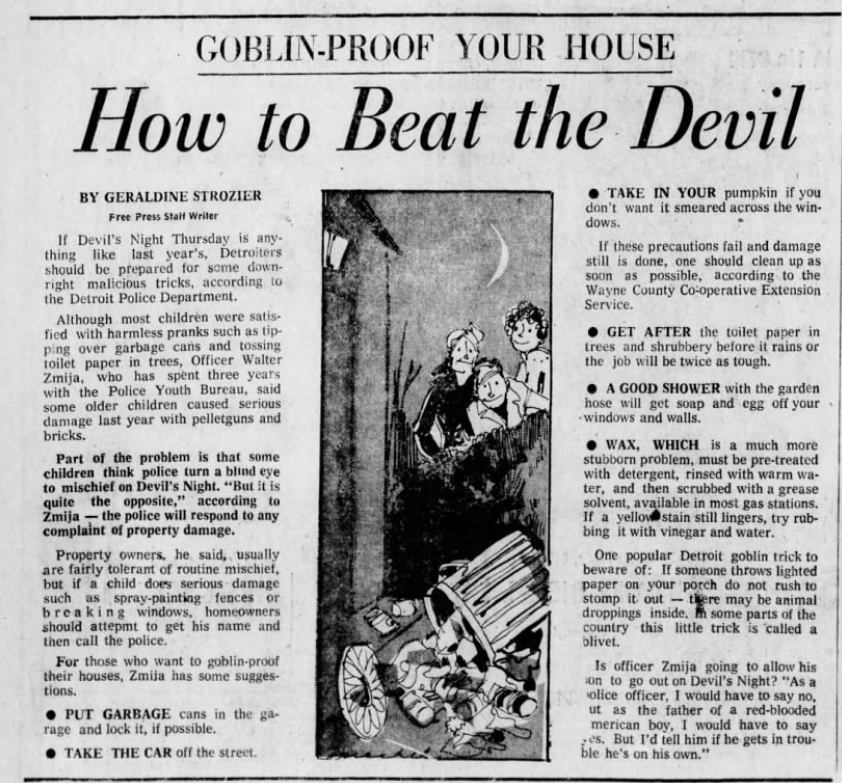
This experience was heightened by the occasion on which they chose to embark on their adventure: Devil’s Night. Observed annually on October 30th, the night before Halloween, Devil’s Night was a notorious event in Detroit in which people “commit[ed] crazy illegal acts of terror all around the city.”15 The event became synonymous with chaos, fire, and destruction.
While the exact origins of Devil’s Night are difficult to trace, it is believed to be a variation of the centuries-old British tradition known as Mischief Night, during which both children and adults engaged in pranks and acts of vandalism. In Detroit these “festivities” escalated to alarming proportions. Rampant arson, among other violent acts, became the defining feature of Devil’s Night, with more than 100 fires reported across the city annually between 1979 and 2010.
As Detroit’s population steadily declined—driven by the collapse of the auto, steel, and manufacturing industries, crumbling city services resulting from shrinking tax revenue, and suburbanization—many neighborhoods were left abandoned. These vacant properties became easy targets for arsonists, which fueled an ongoing cycle of destruction that, in some cases, resulted in death.
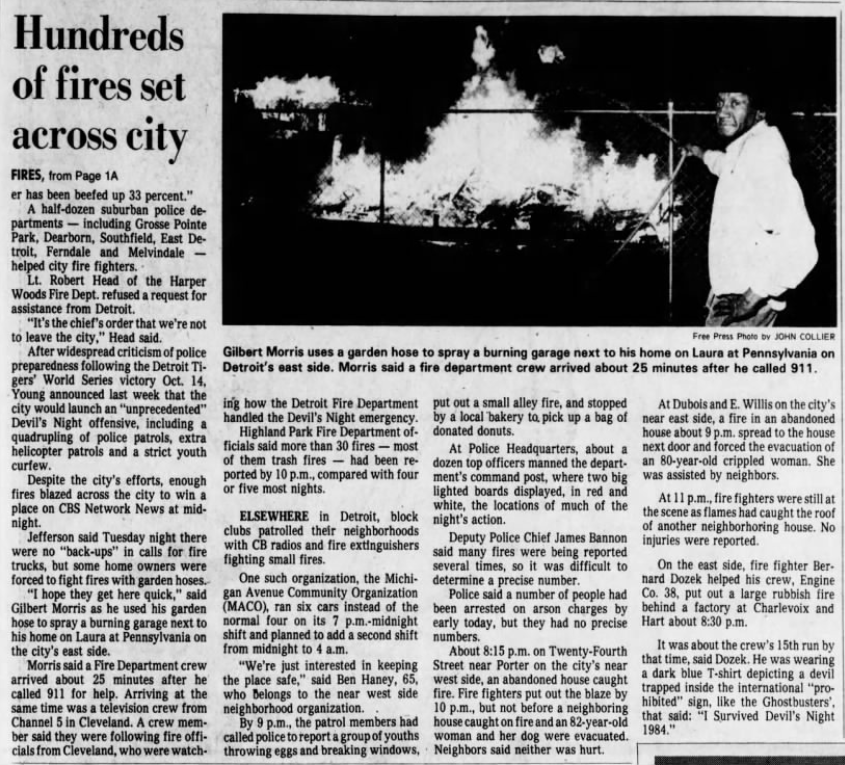
But 1984 marked a turning point. That year, the chaos reached unprecedented levels with the Detroit Fire Department responding to more than 800 fires in a single night. The crisis sparked a media firestorm, pressuring city officials to take decisive action. Because city services were already stretched thin, the fire department alone could not contain the destruction, so city officials imposed a curfew and mobilized tens of thousands of volunteers into neighborhood watch groups—an effort known as “Angel’s Night” that continued well into the 1990s.
These events show us that the violent and horror-laden imagery in ICP’s music isn’t just a fantasy; it is a biographical depiction of Detroit in the 1980s. Even a cursory understanding of Devil’s Night and the city’s crumbling social and economic state makes it easy to see Detroit as a literal hellscape—complete with fire and brimstone—that its residents were struggling to survive.
Songs like “24” from ICP’s 2004 record The Wraith: Hell’s Pit invoke the chaos and debauchery of Devil’s Night.23
(All night) find me robbing your jewels
Setting fires, damaging, and breaking into schools
(In the darkness) it’s much easier to be heartless
Break the window out the Lincoln and screwdriver start this
Mugging people, dropping on ’em from street lights
Stab them with garden tools or beat ’em with pipes
So don’t come out, stay inside, cozy and tucked
And if I’m breaking in, your old lady’s gettin’… fucked
Although they possessed boundless intellectual curiosity and imagination, conventional schooling would, ultimately, prove not to be in their wheelhouse. Both Bruce and Utsler dropped out in the 9th grade. Their struggles did not end there, though. They were looking for a way out. Bruce’s sister Theresa made repeated attempts to run away, but his brother Rob was the first to succeed. He enlisted in the military, leaving his siblings to navigate a hostile home life on their own.
This only lasted a short while. Bruce eventually escaped and moved in with a wrestling pal, Rudy “Rude Boy” Hill, in the southwest Detroit neighborhood River Rouge. Once again, friendship had rescued Bruce from the turmoil of his home life.
Whereas Picker Forest had been an imaginary playground, Southwest Detroit was the real deal. The River Rouge and Delray neighborhoods specifically, along with the nearby industrial Zug Island, became his new sanctuary and would remain pillars of his personal and creative life.
Bruce describes the first time he visited Southwest Detroit:
When you’re driving down the I-75 freeway, south from Downtown, the road goes right up on a bridge over all of Delray. From up there, Delray looks like Gotham City. Factory smoke always fills the sky with a steady gray cloud; huge pipes shoot out fire all the time. Buildings are black from smoke. Seeing all this for the first time was incredible to us….Rudy [Hill] showed Joey and I this one park, where at night you can sit on these benches and look at the Detroit River. Then, out of nowhere, the whole sky would light up yellow! It would all of a sudden be like daytime, then it would fade out back to dark again, all within about 45 seconds. The park was next to a giant steel factory. When they’d pour these giant tubs of hot, melted, glowing steel in the factory, the whole fuckin’ sky would light up for blocks and blocks, bright as day. I thought about how great it would be to live there. You’re in your bedroom, and you go to sleep, and your whole room lights up like daylight four or five times at night.15
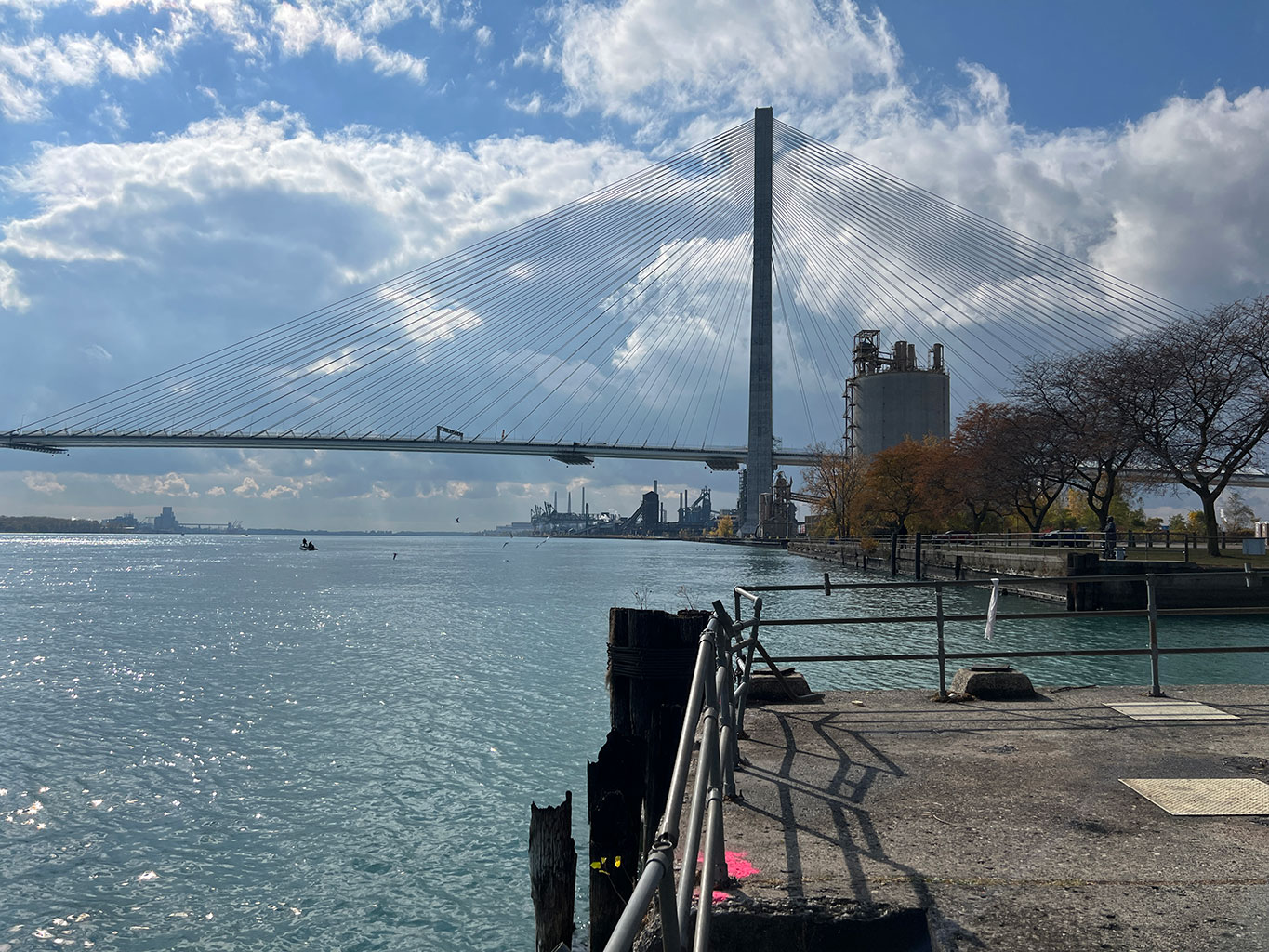
The histories of Delray and Zug Island are deeply intertwined as they both share a role in Detroit’s industrial development. Delray is located just north of Zug Island and separated from it by the Rouge River. It was originally home to Hungarian, Polish, and Armenian immigrants who settled there as inexpensive labor for the growing number of manufacturing jobs emerging there in the 1890s. In 1905, it was annexed from Springwells Township by Detroit as part of the city’s efforts to transform it into an industrial corridor. Companies like Detroit Edison, Peerless Portland Cement Company, Allied Chemical, Fleetwood Metal Body, and several others moved into the area, transforming the primarily Hungarian village into an industrial complex.
At around the same time, the swampy peninsula to the south was dredged to create a shipping canal linking the Rouge and Detroit Rivers. This effectively turned the peninsula into an island, giving birth to what is now Zug Island. Initially part of Delray, Zug Island became part of the River Rouge neighborhood to its south in 1922. Detroit Iron Works built the first blast furnaces there in 1902, and the site would eventually house one of the world’s largest steel mills, operated by U.S. Steel. Coking plants, iron works, and tar and paper manufacturing soon followed.
The spectacle of smoke and fire on Zug Island is a constant presence in the backyards of Delray residents, along with the acrid stench of chemicals that hangs in the air. Pollution is a serious problem in the area. Residents experience high rates of cancer and asthma, wildlife has all but disappeared, and metallic dust is sometimes known to fall from the sky and leave a thin film on houses and cars. For this reason, Zug Island has often been described as “the dirtiest square mile in Michigan,” earning nicknames such as, “Detroit’s Area 51,” “Mordor from The Lord of the Rings,” and “Gotham City,” as Bruce describes it.
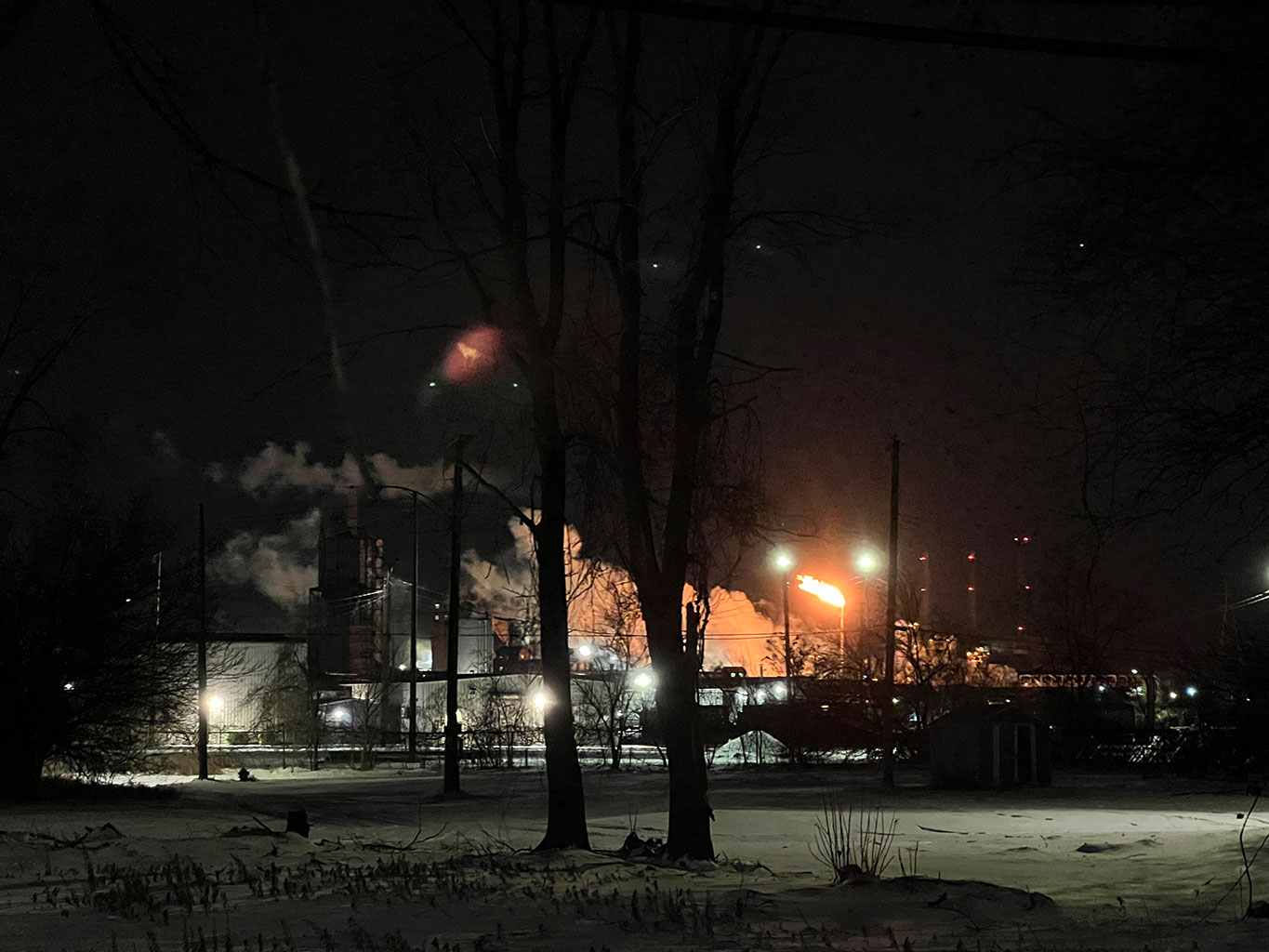
Similarly, Delray is regarded as Detroit’s backwater region—or, to put it more bluntly, its bowels—a designation that carries a stigma similar to the pejorative connotations associated with Downriver Detroit, which it directly borders. It’s home to the Detroit Wastewater Treatment Plant, whose incinerators augment the discordant polyphony of smells “with a God-awful stink.”
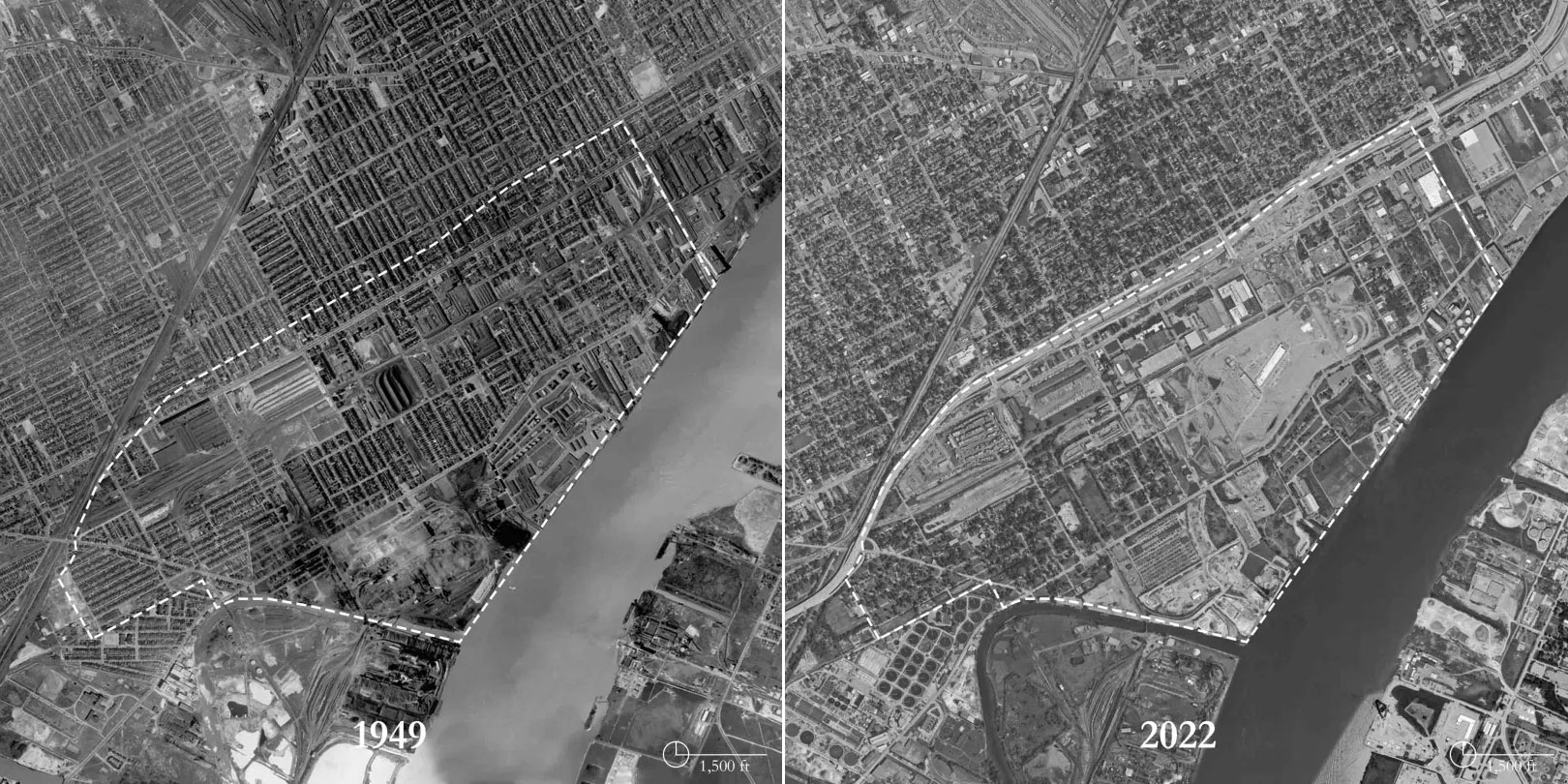
The industrialization of Southwest Detroit led to a sharp population decline following its peak of more than 49,464 residents in 1930. Pollution was a major factor. The city also spent decades displacing residents to make room for expanding industry and city infrastructure. Residential zoning in Delray has been steadily phased out since the 1950s to accommodate the construction of the I-75 freeway, the wastewater treatment plant, and later, the Gordie Howe International Bridge. Other factors such as suburbanization, the crack epidemic of the 1980s and ’90s, and the subsequent rise in crime, accelerated the neighborhood’s decline. Around 1990—when Bruce would have been living there—the population was estimated to be 5,588. By 2020, it had fallen to just 1,994. Today, the residents who remain are largely those who cannot afford to leave or those who choose to stay out of a deep sense of attachment to the place they call home. With a 2020 median household income of roughly $8,279 and 43.1% of residents living below the poverty line (compared to 48.2% in 1990), the destitution in Delray is both staggering and undeniable.
John Carlisle of the Detroit Free Press describes Delray as a “landscape of empty streets that are eerily quiet except for the constant hammering sounds and banging noises of all the industries here.” Among those sounds is what locals on both sides of the Detroit River call the “Windsor Hum,” an eerie, low-frequency rumble believed to emanate from Zug Island’s steel mills, though the source has never been confirmed.
The spectral quality only deepens given that much of Southwest Detroit was built on top of razed Native American burial mounds. An archaeological survey conducted in 1925 recorded more than 600 such mounds in Greater Michigan of varying sizes, the most notable being the “Great Mound” near the confluence of the Rouge and Detroit Rivers in Delray. Measuring roughly 800 feet long, 500 feet wide, and 40 feet tall, the Great Mound is believed to have served multiple Indigenous communities over time. As the area was developed, farmers and developers excavated the mounds, unearthing pots, beads, and tools. When the Great Mound was finally leveled, more than 1,300 skeletons were uncovered and, in a further genocidal act, discarded into the Rouge River.
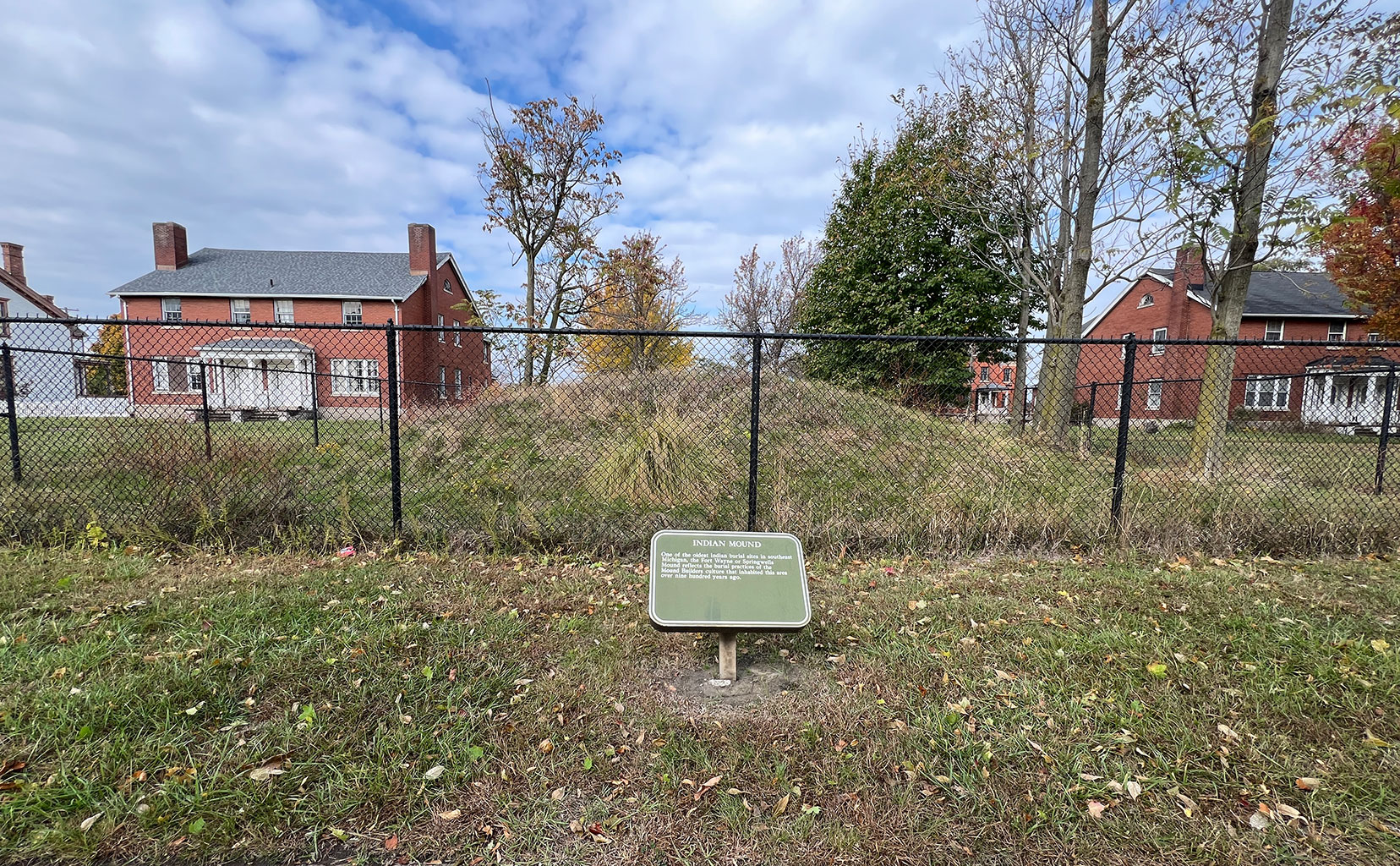
Bruce describes the spiritual presence of these mounds in his autobiography, specifically one near his mother’s house in Ferndale.24 In a humorous gesture that seems inspired by the iconic staircase scene in the movie Rocky (1976), Bruce would run to the top of the mound and shout “Ultimate Warrior!” during his nightly workouts. One night, however, he recalls being chased by a monstrous figure with horrifyingly long arms and a stride that spanned more than ten feet. Bruce believes that his nightly ritual had been received as a provocation to the spirits of the Native people believed to be buried there. He cites it as a moment of spiritual awakening, writing, “When something like that happens to you, then you realize how much more there is to life than what meets the human eye.”15
As smitten as Bruce was with Southwest Detroit, his transition to life in River Rouge and Delray was not easy. Having grown up in the inner-ring suburbs of Berkley and Oak Park between 8 and 11 Mile Road, he was perceived by his new neighbors as a rich white kid from the north. The racial and economic inequalities facing the River Rouge and Delray communities were far more acute than anything Bruce had previously experienced, and those disparities shaped how he was perceived. Many locals were members of gangs like the X-Men, Young Guns, and Latin Counts, and Bruce was regularly harassed by them. By this time, though, Bruce was familiar with being an outsider. He encountered it first when his family relocated from Berkley to Oak Park during his junior high years, where he first met John and Joey Utsler, who lived in nearby Ferndale. Although the move was only two-and-a-half miles south, Oak Park’s class and racial dynamics were markedly different from those of Berkley. The same was true in Royal Oak Township located off of 8 Mile Road, where he often spent time with a wrestling friend named Lacy. These dynamics stemmed from Detroit’s troubled history of segregation.
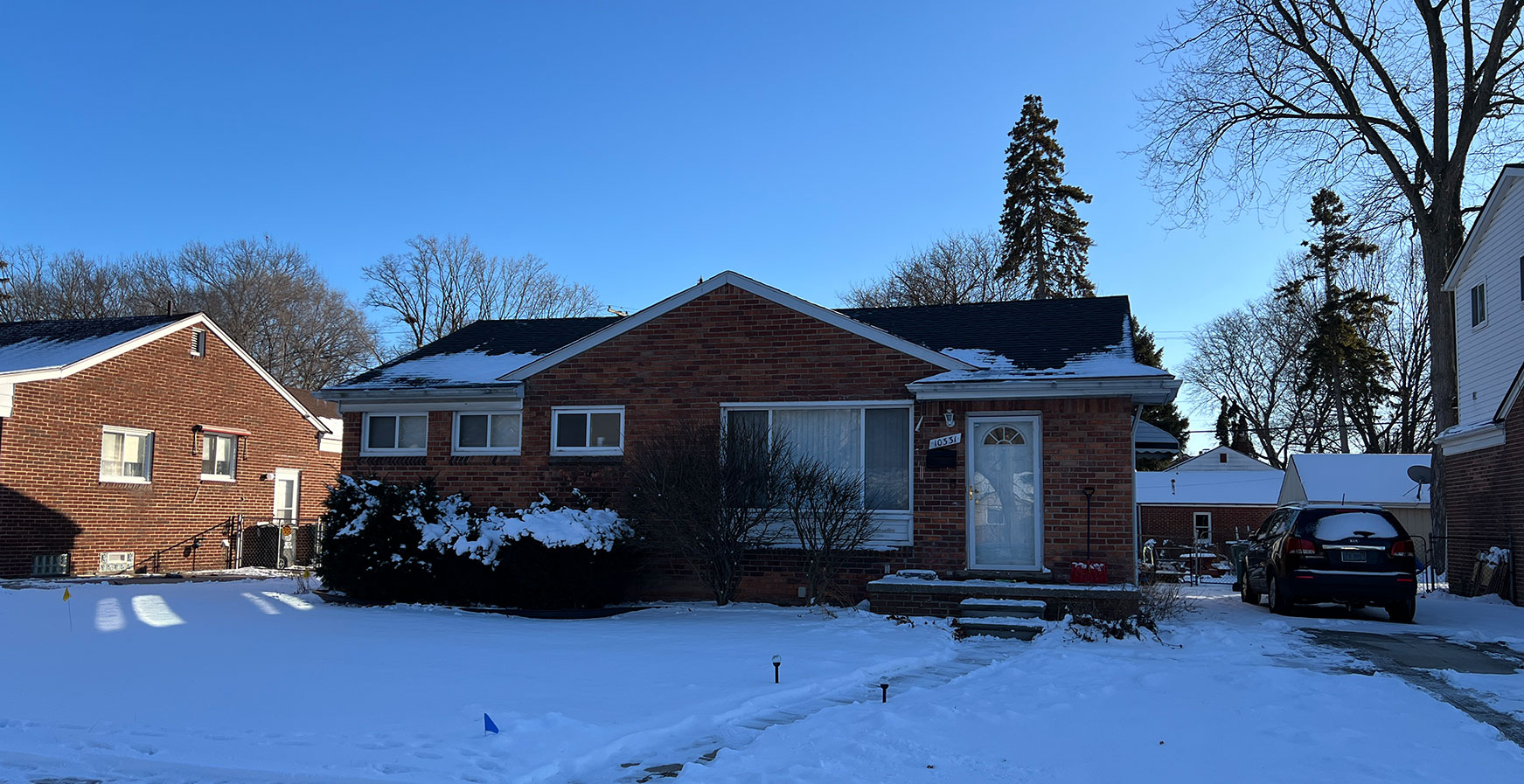
Ulysses S. Grant Elementary School, which is located in Ferndale, is a historic example of this. Despite receiving several complaints from the federal Department of Health, Education, and Welfare between 1968 and 1973, the Ferndale school district upheld a de facto segregation policy at Grant Elementary that it was determined to preserve. Its resistance was so entrenched that, in 1973, Ferndale became the first northern school district to lose federal funding as a result of its refusal to integrate. This came as the result of several legal battles with local agencies, the Secretary of Health, Education, and Welfare, the Sixth Circuit Court of Appeals, and, finally, the US Supreme Court, who declined to hear their case.
Meanwhile, in 1974, the NAACP, on behalf of Black student Ronald Bradley, sued the Detroit public school system and the state of Michigan in the landmark U.S. Supreme Court case Milliken v. Bradley. They argued that twenty years after Brown v. Board of Education outlawed the “separate but equal” doctrine, Detroit’s schools remained segregated in practice (or de facto as in the case of Grant Elementary). The plaintiffs sought to remedy this by implementing a cross-district busing plan that would include the surrounding suburbs. But on July 25, 1974, in a narrow 5–4 decision, the Supreme Court ruled against Bradley, holding that because the suburban districts had not enacted policies explicitly barring Black students, they could not be compelled to participate in a regional integration plan. Imposing such a plan, the Court said, would infringe on the suburbs’ “local control” of their schools. The Court’s decision provides insight into the insidious nature of the structural racism operating within the school and judicial systems: it cannot be traced to discrete individuals or intentions, but instead emerges through institutional structures and practices that perpetuate inequality over time.
In 1975, the Ferndale school district made a half-hearted attempt at integration by establishing a small magnet program at Grant Elementary that admitted both Black and white students. However, magnet students were not allowed to eat with the “normal” students, all of whom were Black. The initiative was opposed by the U.S. Department of Justice under the Equal Educational Opportunities Act of 1974.
It was not until 1981, twelve years after receiving its first federal complaint and after forfeiting roughly $2 million in federal funding, that Ferndale was finally dragged kicking and screaming into integrating its schools. The result was an exodus of white families to wealthy suburbs such as West Bloomfield Township and Rose Township.
Oak Park underwent a similar transformation. Before integration was enforced, its overwhelmingly white school system was regarded as one of the strongest in Michigan.But as state-enforced integration began and white families relocated to other suburbs, Oak Park’s demographics shifted rapidly and the school system declined in the years that followed.
Bruce would have begun junior high sometime between 1984 and 1986, only a few years after integration was enforced. The memory of segregation would have been fresh in the minds of locals, and the racial composition of both Ferndale and Oak Park would have been very much in flux. In his autobiography, Bruce paints a picture of a diverse student body: “Best Junior High was made up of about sixty percent black kids, twenty percent Middle Eastern kids, and twenty percent white kids.25 There were a lot of tough black kids who would pick on me.”
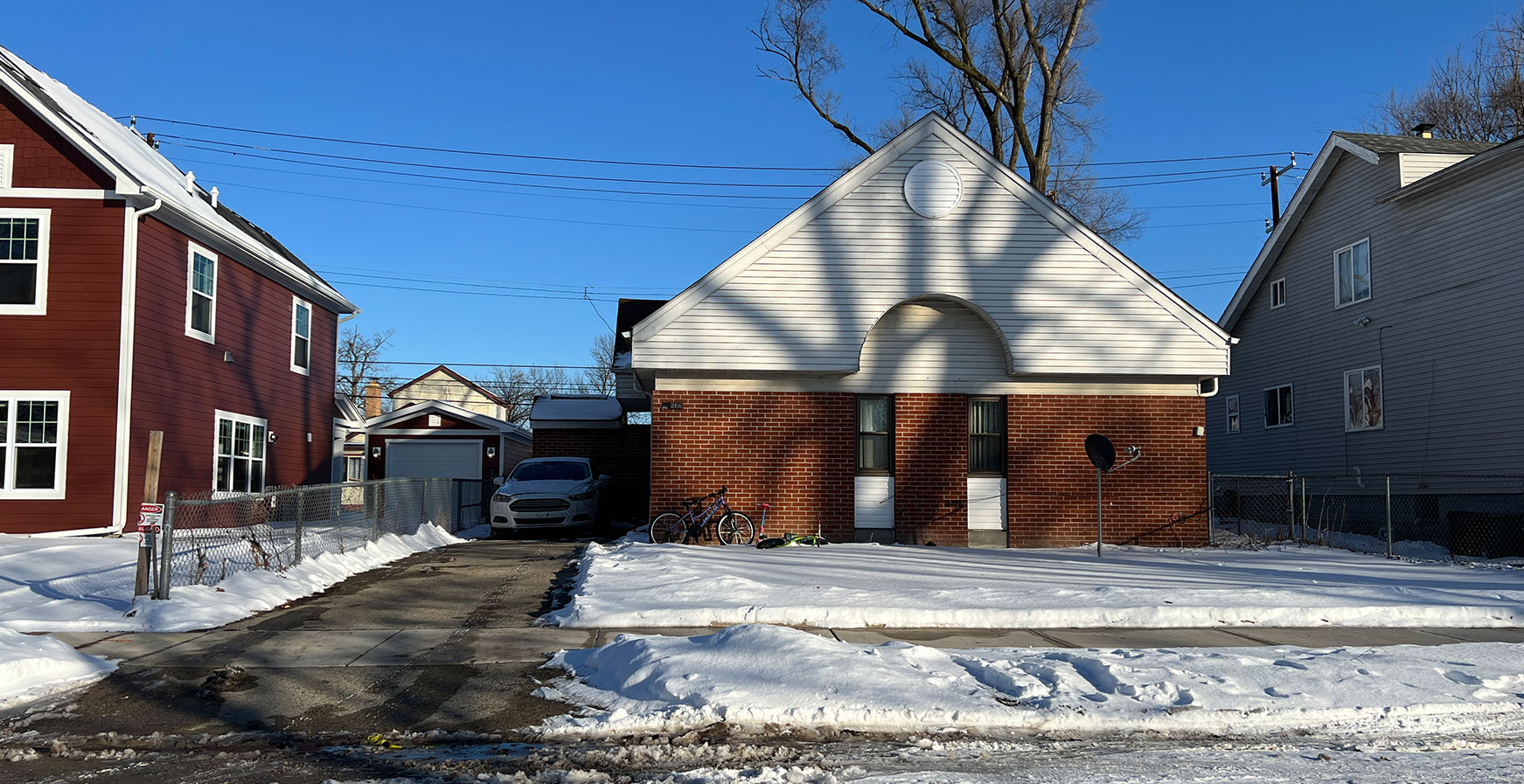
The same racial and economic dynamics could be found in neighboring Royal Oak Township where Bruce’s friend Lacy lived. The two would steal and joyride cars through the neighborhood, which Bruce recalls as “Detroit’s version of Compton” and his first real encounter with what he understood as a “bad” neighborhood.15 It was not a place he could safely navigate alone. He recalls early encounters of being shot at by locals, including one harrowing incident where a gun was shoved in his mouth in an effort to coerce him into using his mother’s car for a drive-by shooting—a demand he ultimately complied with.15 He was only left unbothered when chaperoned by Lacy and other Black friends who lived in the area.27
In contrast, the 10 Mile segment where Bruce lived before was almost exclusively composed of middle-class white families. Although there were many working-class families struggling to make ends meet, including Bruce’s own, there was a racist social hierarchy defined by one’s distance from neighborhoods like the Township. Because of this, Bruce was often scrutinized by his teachers for his association with kids in the Township. They would warn his mother during parent-teacher conferences, “[Bruce] takes the bus every day in the Township, and that’s not a very nice place.” But Bruce felt a kinship there. It instilled in him a sense of class consciousness and solidarity. In his autobiography, he writes, “As new as all of this was to me, it was also kind of familiar. The Township kids were on welfare, and got food from the hunger barrel; it felt like a whole neighborhood of Bruce Brothers.”15
Prior to integration, white families in Oak Park and Ferndale had little sustained interaction with the Black community in Royal Oak Township. When Bruce moved to Oak Park, both Black and white residents were only beginning to experience regular interracial encounters in schools and public life. These early moments of integration were often tense and awkward. In this context, it makes sense that Bruce—now arriving as a newcomer—would have been perceived as a privileged white kid and bullied as a result.
During Bruce’s junior high years (~1984–1986), the pattern of white residents fleeing Detroit’s inner city in response to shifting racial demographics was an already all too familiar story. The 1967 Uprising27 is often identified as the decisive turning point that accelerated the great wave of white flight, but this pattern had already been decades in the making.
Between 1940-1967, Detroit’s white residents had organized some 200 neighborhood homeowner associations that operated as armed militias to prevent what they regarded as the “invasion” of Black families. These associations set houses on fire, burned effigies, threw rocks, assaulted Black residents, dumped snakes in basements, and poured salt onto lawns to force Black families out. These acts of terror were the informal enforcement of the federal government’s racist housing policy.
When court-mandated integration continued to reshape Detroit’s demographics in the 1970s and 1980s, sending white families into historically Black or brown neighborhoods and vice-versa, the hostility Bruce experienced becomes a little bit easier to understand. It can be seen as a defensive strategy against outsiders. The key difference, of course, is that when white homeowners organized militias to police neighborhood boundaries, their actions were effectively state-sanctioned. However, when Black and brown Detroiters defended their neighborhoods, it was regarded as criminal activity.
The Federal Housing Administration (FHA) created low-interest home loans for white families, enabling them to buy houses and build wealth. Black residents, however, were barred from applying for FHA loans altogether, including those who earned more than their white counterparts. Meanwhile, the government-sponsored Home Owners’ Loan Corporation (HOLC) introduced a color-coded grading system that effectively restricted access to mortgage lending in Black neighborhoods. The only workaround available to Black residents who wanted to buy a house in a desirable area (i.e. a white neighborhood) was to do so in cash. But this had devastating consequences. If a Black family moved into a white neighborhood, the HOLC would redraw the map and place a red line around the area–a practice also known as “redlining.” Once this happened, no one could obtain loans, home values tanked, and white families saw their investments evaporate overnight. Panic followed, and white residents fled to the suburbs to preserve their upward mobility and personal safety. New FHA-backed developments welcomed them with open arms and, once again, excluded Black residents through racially restrictive covenants written directly into municipal codes.
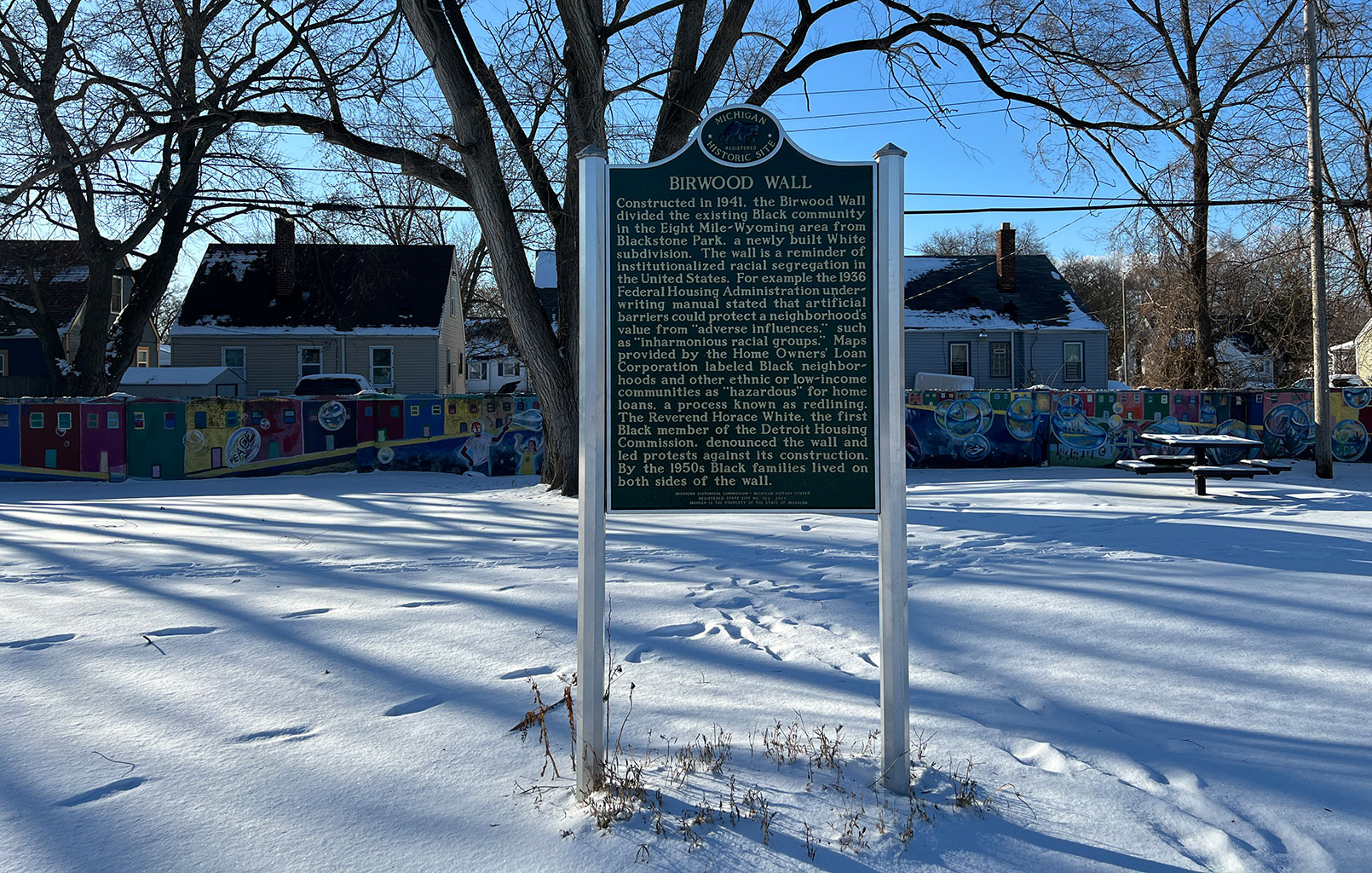
Federal and state governments further reinforced this divide by building new schools and an expansive highway system to connect the city to its suburbs—projects that frequently relied on eminent domain to cut directly through Black neighborhoods.31 Nowhere was this more devastating than in Black Bottom and Paradise Valley, two vibrant Black neighborhoods that were razed in the 1950s and 60s to make way for the I-375 freeway. In addition, physical barriers, such as the Birwood Wall, were built to separate black and white communities under the guise of protecting property value from “blighted” (i.e. Black) neighborhoods nearby.29 The suburbs essentially became a federally subsidized “white bubble,” fortified not only by public policy but, in many cases, by local homeowners’ associations acting as de facto militias. The very policies that enabled this suburban exodus siphoned wealth from Detroit’s inner city to its outer suburbs, hastening and deepening the city’s decline.
By the 1950s, Detroit had reached its peak population of 3,016,197 and remained a majority-white city, but the effects of white flight were tangible. Black population grew by more than 180,000 while the white population declined by more than 350,000.30 These demographic shifts were compounded by the increasing use of automation in factories, which intensified the existing “racialized aristocracy of labor” and contributed to rising unemployment.31 When Black and white workers began organizing against the erosion of worker control, industrial firms responded by relocating outside the city. As industries left, Detroit’s unemployment rate surged, as did its prison population. Although Black residents made up just 20% of the city’s population in 1950, they accounted for 89% of all drug-related arrests. Stop-and-frisk tactics were implemented and Black Detroiters experienced an increasingly militarized police presence occupying their neighborhoods.31
So, when Detroit police raided an unlicensed bar at 12th Street and Clairmount in Virginia Park where locals had gathered to escape a heat wave on July 23, 1967, Black Detroiters had had enough.32 Decades of police brutality and inequality in housing, employment, and education had created the perfect storm for a rebellion. The 1967 Uprising lasted five days. By the end, 1,700 fires had burned across the city, 552 buildings lay in ruins, more than 7,200 people had been arrested, and 43 people—33 Black and 10 white—had been killed, most by police. The destruction was so widespread that President Lyndon Johnson ordered the National Guard and 4,700 army paratroopers into the city to quell what became the largest domestic uprising since the Civil War.
What followed in the period between 1967 to 1971 was a swell in radical Leftist activism and community organizing. This included the formation of groups such as the League of Revolutionary Black Workers (LRBW), which organized Black factory workers and focused on gaining control over production rather than seeking political office, and the Black Panther Party for Self-Defense, which mobilized and supported those who were criminalized and underemployed. Inspired by the Black Panthers, an explicitly anti-capitalist formation known as the White Panther Party—later renamed the Rainbow People’s Party to avoid impressions of dog whistling—emerged from Ann Arbor. The group established food cooperatives, voter registration drives, free health clinics, and free childcare programs.
By the 1980s, however, many of these organizations had long been crushed through FBI surveillance, infiltration, and an increasingly militarized police force, which resulted in death, exile, or mass incarceration for numerous activists. Instead of delivering on the dream of Black liberation and a classless society, there was, instead, the selective recognition and incorporation of Black political leaders into existing power structures. This shift laid the groundwork for the neoliberal appearance of progress while obscuring the deeper, ongoing systems of structural racism that continued to shape the city.
In 1974, Detroit elected its first Black mayor, Coleman Young, who criticized his white conservative opponent, John Nichols, for being too soft on crime.31 Gun sales in the city increased significantly after the 1967 Uprising as did the city’s homicide rate. Detroit reported 138 homicides in 1965. In 1974, that number rose to 751. By 1975, Detroit was considered the murder capital of the U.S. Meanwhile, suburbanization continued unabated with white residents and businesses fleeing what was being described as a “zone of decay.”
Over the following decade, Detroit flipped from a majority-white city to a majority-Black one. The city’s 1980 census shows that the Black population had risen to 758,939 while the white population had fallen to 413,730—a roughly 84% decline from 1950.33 That same year, the unemployment rate rose to a staggering 18.5% as automation continued to accelerate and industrial firms relocated away from Detroit, laying off workers and shrinking the city’s tax revenue in the process. Much of this was the result of Reagan-era economic policies, which relocated manufacturing jobs to the Sunbelt states or offshored them entirely, leading to the formation of the Rust Belt.34
If there’s a neighborhood that embodies Detroit’s unique history of development and decline, it is Delray. What began as the sacred ground for Indigenous burial mounds, leveled in the genocidal name of progress, became a bustling village that was home to the largest Hungarian population outside of Budapest, itself dismantled and rebuilt into a humming industrial home to a diverse working-class community—only to later collapse into an environmentally scarred, poverty-stricken ghost town. Yet, this is the place that Bruce called home and would later mythologize in his music.
Despite being initially perceived as an outsider when he arrived in the mid- to late 1980s, Bruce portrays Delray as a haven of social equality much like he did with Royal Oak Township:
On every block, you had Hispanic kids, white kids, black kids, and Asian kids. Everybody was poor, on welfare, and dropped out of school. It wasn’t an issue. It was home the first time I walked the streets….There’d be like 15 kids hanging out on the porch, drinking 40s. Out of those 15 kids, 3 would be white, 3 would be black, 3 would be Hispanic, 3 would be Asian, Indian kids, everything. Every one of them was poor, dressed poor, looked poor—just like my ass….Every-fucking-body was on food stamps. I was blown away. I didn’t have to hide shit about me anymore.15
As suburbanization drained Detroit’s inner city of political and economic power while simultaneously portraying it as “the last step before homelessness,” Bruce offers an alternative vision of the city—one where the blighted conditions fostered a sense of solidarity among the déclassé who neither had the privilege or desire to flee in pursuit of upward mobility. There’s a profound sense of pride underlying Bruce’s characterization. It’s as if the shared experience of dispossession revealed a more equitable set of social relations unburdened by rigid notions of class and race.
To outsiders, Bruce’s embrace of Delray may seem inexplicable, but it’s not unusual among the people who actually live there. In fact, this sentiment persists among Delray residents today. Despite the neighborhood’s many challenges—its extreme pollution, high crime rates, and pressure from city officials to vacate their homes to make way for the construction of the Gordie Howe International Bridge—residents still describe Delray as “nice” and “peaceful.” They “speak of a bond in their shared isolation, a defiance toward those who look down on them as hayseeds, and a sense of anarchy and freedom that—for better or worse—can’t normally be found in a big city like Detroit.” What’s crucial here is the shared sense of defiance that emerges in the face of dispossession.
In his 2023 book Acid Detroit: A Psychedelic Story of Motor City Music, Joe Molloy describes this defiance as a form of solidarity unique to Detroit:
We might recall that Detroit is a city marked by a certain degree of insularity. The city’s people champion their own, and there’s a special sense of supporting those who have stayed, making themselves a fixture in the locale. In a city where there seems to be every impetus to get out, there is a unification amongst those who have remained. Indeed for those who have held steadfast to Detroit, there’s a special sense of cross-generational solidarity.15
John Carlisle’s 2017 article, Is This the End of Delray?, is filled with many examples of residents who share this perspective. Carlisle describes local resident Mike Donovan, for instance, as largely unbothered by the neighborhood’s inconveniences: “The noise doesn’t bother him. Nor does the smoke drifting over from Zug Island, nor the train’s blasting horn as it passes through the neighborhood, nor the stench of the sewage that fouls the breeze that ripples the plastic covering his windows.”
Another resident, Lisa Roland, explains, “You knew you were coming to Delray [because] it smelled like rotting flesh…[but] I’m proud of where I’m from…. Your neighbors become your family. They watch out for you, they watch out for your kids, they watch out for your house, your cars. We take care of one another.”35
In the absence of sustained political or economic support from the city, mutual aid becomes the social infrastructure that holds the neighborhood together.
By the time that Bruce first arrived in Delray, his life had been shaped by a cascade of hardships: a broken home, physical and sexual abuse from family members and caregivers, constant bullying at school, and financial precarity. Fleeing to Delray offered him the reassurance that his suffering was not singular. Being in community with others who had endured lives resembling his own brought him solace. Delray, by no means, solved his problems, but it made life more bearable.
Poet and philosopher Fred Moten captures the political stakes of this solidarity in a 2025 conversation with Emmanuel Olunkwa:
What it is to be in a band is not unlike what it is to remain in the hold. We want to remain in the hold, not just because we want to constantly remind ourselves of how fucked up everything is, but also because that’s where the people are…. I’d rather be in the hold with my folks than be free by myself. And of course, the whole fucked up history of freedom is that freedom is just the freedom to be by yourself. Another word for which is death, okay? Or if you will, social death, okay? But what social death means, as far as I can tell, is radical extraction from the social. Another word for that is ‘whiteness.’
It’s precisely this notion of the social—of choosing the “hold” because that’s where your people are—that drew Bruce to Delray. The transformation of disenfranchisement into a source of empowerment and belonging becomes a powerful antidote to a society fixated on wealth and status. While suburbanization produced a “white bubble” designed to protect the sanctity of whiteness and the accumulation of wealth, Southwest Detroit formed a bubble of its own. Here, denizens established a multiracial coalition whose members were not only free to be themselves but to conspire together against the very conditions that had marginalized them in the first place. By subverting the stigmas imposed by the media, police, government, and conservative suburbanites, they reframed those stigmas as signs of power.
Over time, Bruce would experiment with different language to describe this kinship: in childhood, it was the Floobs; in Delray, River Rouge, and Royal Oak Township, it “felt like a whole neighborhood of Bruce Brothers”; later, it would become the Juggalos. The origins of what ICP and their fans call Family can be traced back to this pivotal place and is a poetic expression of the cross-generational solidarity shared among Detroiters.
After settling in Delray, Bruce’s activities shifted away from the imaginary games he played as a kid to projects with a criminal bent. Around 1989, Bruce formed a gang with Utsler and their friends called Inner City Posse, staking a claim to Southwest Detroit as their territory.36 Their activities mainly involved petty theft and vandalism, but they were also fueled by a growing resentment toward the wealthy. Having watched his mother toil for years as a housekeeper for affluent families, Bruce channeled that anger into indiscriminately targeting and assaulting rich kids in some of the wealthy suburbs of Detroit, like Birmingham and Grosse Point located 20-30 minutes outside of the city.
“I HATED THE RICH,” Bruce writes, as he recounts several harrowing scenes of reckless violence from this period that usually left his victims “lying bloody in the street.” He goes on, “For the first time, I was pissed about the bad breaks my family always got. I hated that my mom had to work so hard all the time, yet I was mad AT my mom for leaving us with Mary Wool back in the day. I questioned everything now, instead of always blowing everything off. I started to cuss. Why not cuss? Everybody else does, right?”
Taken at face value, this behavior may appear as wanton violence, but it more deeply reflects Bruce’s attempt to exact his own form of justice for the grim socio-economic realities he and his friends endured growing up.15
By the age of 17, Bruce and Utsler had already cycled in and out of jail multiple times on charges including robbery, making death threats, and probation violations.15 The last of these resulted in Bruce serving an unusually long 90-day sentence, an experience he describes as a major turning point that forced him to confront the trajectory of his life. After serving time, Bruce was determined to escape the trappings of gang life and figure out what he wanted to do next. He fled Detroit and went to Bonnie Doone, North Carolina, near Fort Bragg, to be reunited with his brother Rob, who was stationed there.
Life in North Carolina proved even more difficult than it had been in Detroit. Namely because he found its virulent racism unbearable. He recalls, “Everywhere you looked, REBLE [sic] FLAGS. EVERYWHERE!” Having grown up in one of the most segregated metropolitan regions in the country, Bruce was intimately familiar with the stratifying effects of racism. It could be found in every arena of social life in Detroit, even if it was often shrouded in coded political language, bureaucratic decisions, or public policy. The overt racism he encountered in North Carolina felt fundamentally different. “All this hatred and racist evil was crushing my brain.” After only a few months, Bruce returned to Detroit.15

 Vee Hua 華婷婷


 Thuc Doan Nguyen

 Saelyx Finna