
 Carl Lawrence
Who Can Survive Hell’s Pit?
And then I fell through the floor of that hole some more
I been missing for a year, nobody’s lookin’ (I am)
I got beat down and my shit tooken (Ooh)
I look ahead and all I see is more of the same
Or this self-inflicted bullet hole pourin’ my brain
– Lyrics from “Suicide Hotline” by Insane Clown Posse, Hell’s Pit, 2004
ICP shows us how to go through hell and live to tell the tale. They recreate the psychological terrain of suffering so convincingly that the experience of listening to their music can be terrifying.
The first time I slipped The Wraith: Hell’s Pit (2004) into my CD player, I encountered a musical experience unlike anything I’d known before. It pulled me into another world and filled me with fear. The record begins with a deafening crash, followed by the sound of an axe hammering down and eviscerating flesh. Hysterical laughter erupts alongside the steady beeping of a vital-signs monitor. Wind pans from the left speaker to the right, suggesting movement through space. The laughter fades, and the monitor slows until its beeps accelerate into a continuous tone. Death has arrived.
The sound of smoldering remains follows, punctuated by an explosive gong and chilling choral music. Sermon-like speech tumbles backward through the speakers:
.delbmessa evah hcruhC eht fo spohsib eht ,dlrow eht fo trap yreve morF
(From every part of the world, the bishops of the Church have assembled)
Oga sraey ruof derots dah yeht taht erom kcab thguorb sworc ,doog os deyalp yeht dnA
(And they played so good, crows brought back more that they had stored four years ago)
!suseJ evah eW !ydobyrevE
(Everybody! We have Jesus!)
Another voice intones, almost clinically:
If you listen carefully to this recording, you can hear the voice of some innocent critter in prayer
More laughter follows. Then Violent J whispers:
Welcome to Hell. Why did you choose this?
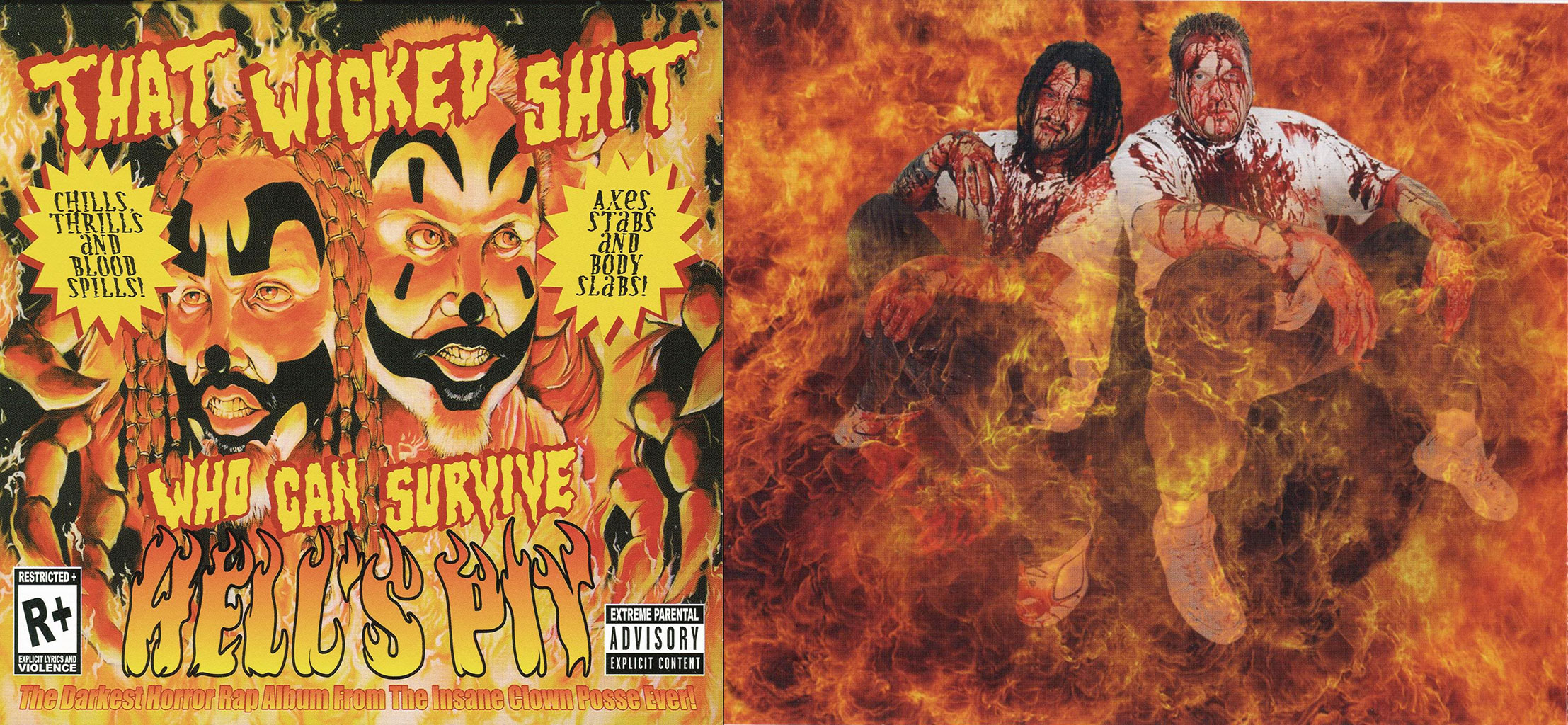
Hell’s Pit is the ICP’s magnum opus. For a record with no guest features, it represents their most original, pure, and sinister expression of the horrorcore genre, which they inherited from the Geto Boys and Esham the Unholy, and had, at that point, spent more than twelve years refining. The record is a harrowing depiction of the final destination for those deemed irredeemable. Pedophiles, abusers, corrupt judges, and the miserly are among those who meet their grisly fates. At the same time, it is a disturbing and satirical, depiction of Violent J’s own real-life struggle with depression, anxiety, and suicidal ideation. While these themes appear on their earlier records, they’re often couched in a jocular, self-deprecating tone. In Hell’s Pit, they are presented in their rawest form.
The album’s intro descends seamlessly into the next track, “Walk into the Darkness.” The song offers a firsthand account of someone possessed by “The Witch,” a proxy for the Devil, who has resigned themselves to the torments of Hell and carries out ghastly acts of violence.43
Walk into the darkness
(A place for those who chose to give a fuck less)
Wicked, dark and heartless
(We keep it nutty and bloody for everybody here)
I’m goin’ to Hell, and I’m knowin’ it well
And I got no problem showin’ it, I’m goin’ to jail
Anxiety and hopelessness permeate this album like a noxious gas, leaving me feeling woozy. My own experiences with depression and anxiety reemerged, tingling beneath the surface of my skin. Anyone who has experienced a panic attack knows that the more you resist it, the worse it becomes. The only way out is to surrender yourself to it. Hell’s Pit demands your submission, drawing you into a world from which there seems to be no escape.
This feeling of entrapment finds its clearest expression in “The Witch,” a song that can be interpreted as a portrayal of sleep paralysis.
The witch jumped on my back last night, I couldn’t breathe
In its clutch, I was frozen with fright
It went on for what seemed like hours of terror
To see the witches face stare in the dark at the mirror
ICP’s authentic portrayal of suffering is what makes this album, and many of their other records, such powerful works of art. Writer and psychoanalyst Avgi Saketopoulou describes this type of aesthetic experience as a form of “ethical sadism that is exigent in that it issues a necessary and imperative call to the audience to endure something difficult, something that will challenge them through its intensity and by means of what it repeats.”45 What’s being repeated here is the revisitation of trauma: an intentional return to a wound, which Saketopoulou describes as an act of “traumatophilia.”
“Traumatophilia” is not interested in the avoidance or repair of trauma—which she describes as “traumatophobia”—but what we do with it. This distinction is crucial, she argues, because wounds never fully heal and, moreover, we are drawn to touch them. A traumatophilic engagement—a willingness to touch the wound—can allow immobilized trauma to circulate anew, opening the possibility for new meaning to emerge. This can generate transformative, even enigmatic experiences that have the capacity to become a source of inspiration. Traumatophilia is, therefore, fundamentally an aesthetic experience, loosening it from the confines of the psychoanalytic couch or counseling room.
Art and performance are fertile ground for traumatophilic encounters. Audience members “who are able to bend their will (to stay in…and give themselves over to the [work] rather than trying to ‘control’ their reactions, or inhibit their pleasure, or leave),” Saketopoulou argues, “might then be able to endure an aesthetic experience that both strains and excites, calling something forth in them, something that can be perverse and overwhelming.”46
Such is my experience when I listen to Hell’s Pit. ICP’s work is rich with traumatophilic encounters. The Dark Carnival itself is a protracted and ongoing attempt to generate new meaning from the foundational traumas of their childhood: sexual and physical abuse, poverty, an absent father, incarceration, living in a burning city marked by deep racial, social, and economic unrest.
They pick at their wounds by reliving these experiences again and again in their music. The repetition of these traumas, not only in the creation and (re)performance of their work but also in our repeated listening, allows the trauma to become musical in a different register.
ICP’s fascination with their own trauma finds resonance among Juggalos who, through the act of listening to their music, also prod at their own wounds. Both transform trauma into a place of study. This explains the profound, often enigmatic devotion Juggalos feel toward ICP and, more importantly, toward one another. Juggalo Family is a traumatophilic response to a shared experience of alienation and suffering.
During a 2022 Discord Q&A, Violent J reflected on this when discussing “Suicide Hotline,” the third track on Hell’s Pit.
“Suicide Hotline” is meant to say you never know when everything’s gonna suddenly turn around in life. One second you want to die then suddenly your [sic] happy again. When your life is hell and depression is killing you, it’s hard to remember shit always gets better, but it always does. I’ve had crippling depression all my life but it’s true that it always does get better….Even in the worst possible cases shit gets better because we naturally adjust and adapt- all living creatures do….“Suicide Hotline” was meant to say when your feeling your worst and thinking about suicide like we all have (it crosses everyone’s mind, but we’re wise enough to never do it) soon you’ll see that – BAM – it all gets better….And just like at the end of “Suicide Hotline” it can happen outta knowhere [sic]. Bad times are just that—times, which all eventually pass.
It’s easy to interpret Family as an emancipatory space in which Juggalos can be their true selves, but I don’t believe Family is invested in the individual in quite this way. It’s more concerned with relinquishing the idea of the singular self in favor of a collectivity defined by the strange, incongruous, and fucked-up parts of being human. It’s not that Juggalos are freaks and everyone else is not; it’s that we’re all freaks, whether we realize it or not. Family begins from this premise and is, therefore, not merely hospitable to difference but constituted by its inevitability. If we think of Family as a kind of grammar of sociality, peculiar as it may be, it conjugates collectivity through difference.
This is hardly an arcane interpretation. It surfaces, however tacitly, whenever people say they don’t care for ICP’s music but respect and admire what the group represents. What they’re almost always referring to is the inclusiveness that Juggalos practice. There’s something deeply alluring about this, and for good reason: the desire for recognition and inclusion touches something fundamental about being human. Juggalos aren’t simply saying, “Look at how different I am.” They’re saying, “Look at how different we all are—and isn’t that beautiful, amazing, and worth celebrating, being loud about, making a mess over, and cleaning up after ourselves?”
For example, ICP’s live performances are a (re)enactment of the political rebellion they invoke in their music. The rebellion is both aspirational and real. It tells the story of ICP’s own survival in Detroit, a city whose own history is defined by survival under the violent machinations of capitalism—or what Chris Hedges has dubbed “a post-industrial zone of sacrifice.”
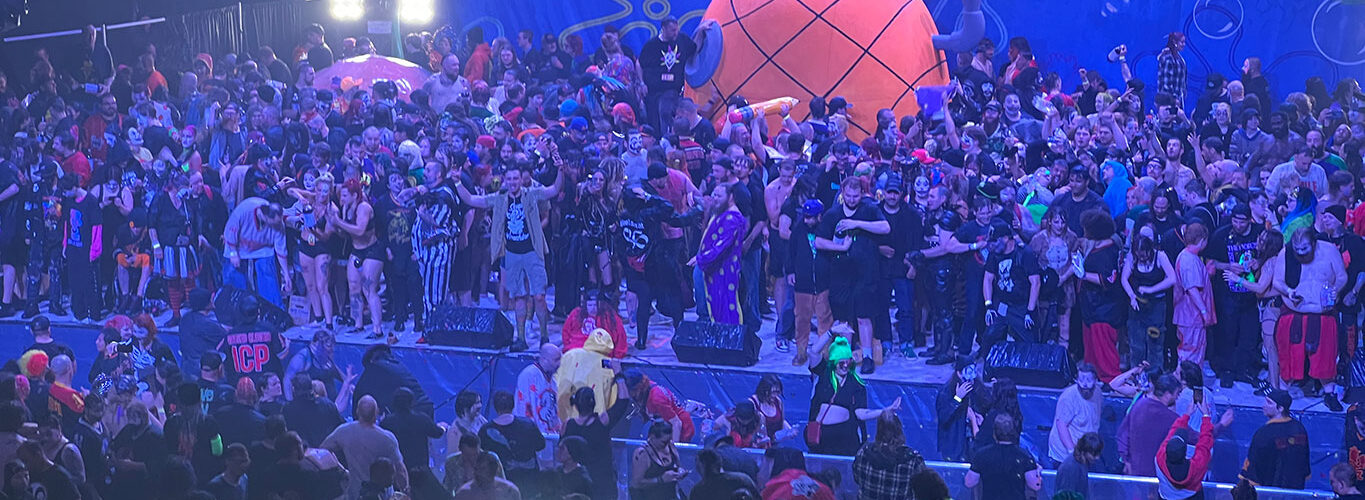
When I saw ICP perform again in May 2025 at a small club in Reading, PA, a spirit of rebellion permeated every aspect of their performance. It was a highly choreographed bacchanalia that more closely resembled a theatrical production than an ordinary concert, with each song functioning as a scene in a play. There was a cast of performers, stagehands, costume changes, and elaborate mise-en-scène. The bacchanalia onstage was mirrored by the audience. In a beautiful display of intergenerational play, there were grandparents with their adult children helping their grandchildren crowd surf for the first time, like tiny beach balls cascading across the surface of the crowd. Mosh pits erupted in every direction. Buckets of Faygo descended in a deluge, evoking the bewildering splash at the end of a log flume ride.
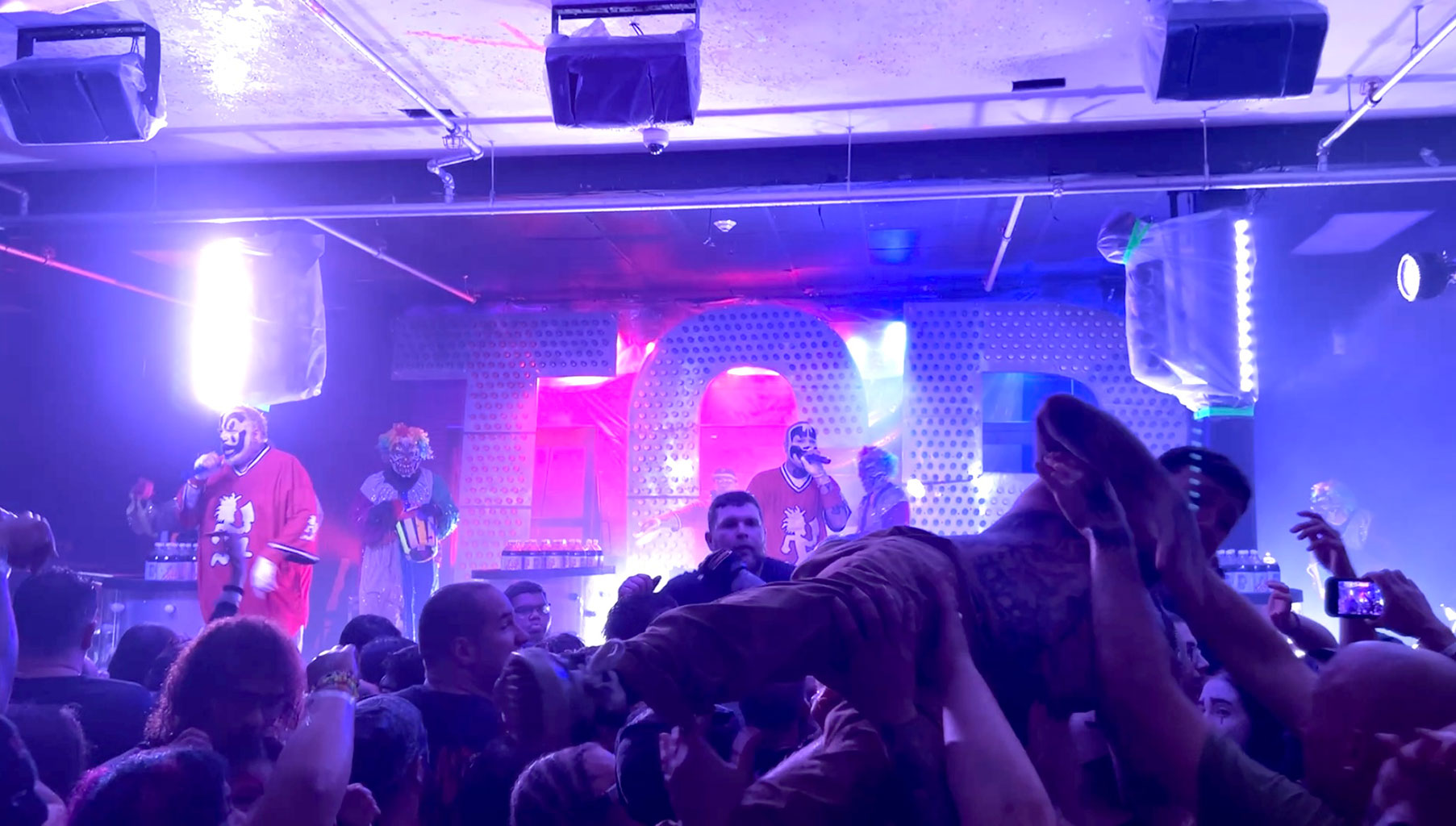
During the closing song “Pass Me By,” fans began storming the stage without warning, climbing over the barricade at the front of the crowd and scrambling over one another to get up. Some struggled to clear the barrier or haul themselves onto the stage until helping hands reached down to pull them up. Once there, they sang along, grabbed two-liters of Faygo, and hurled them into the crowd. The stage took on the character of a Hieronymus Bosch painting.
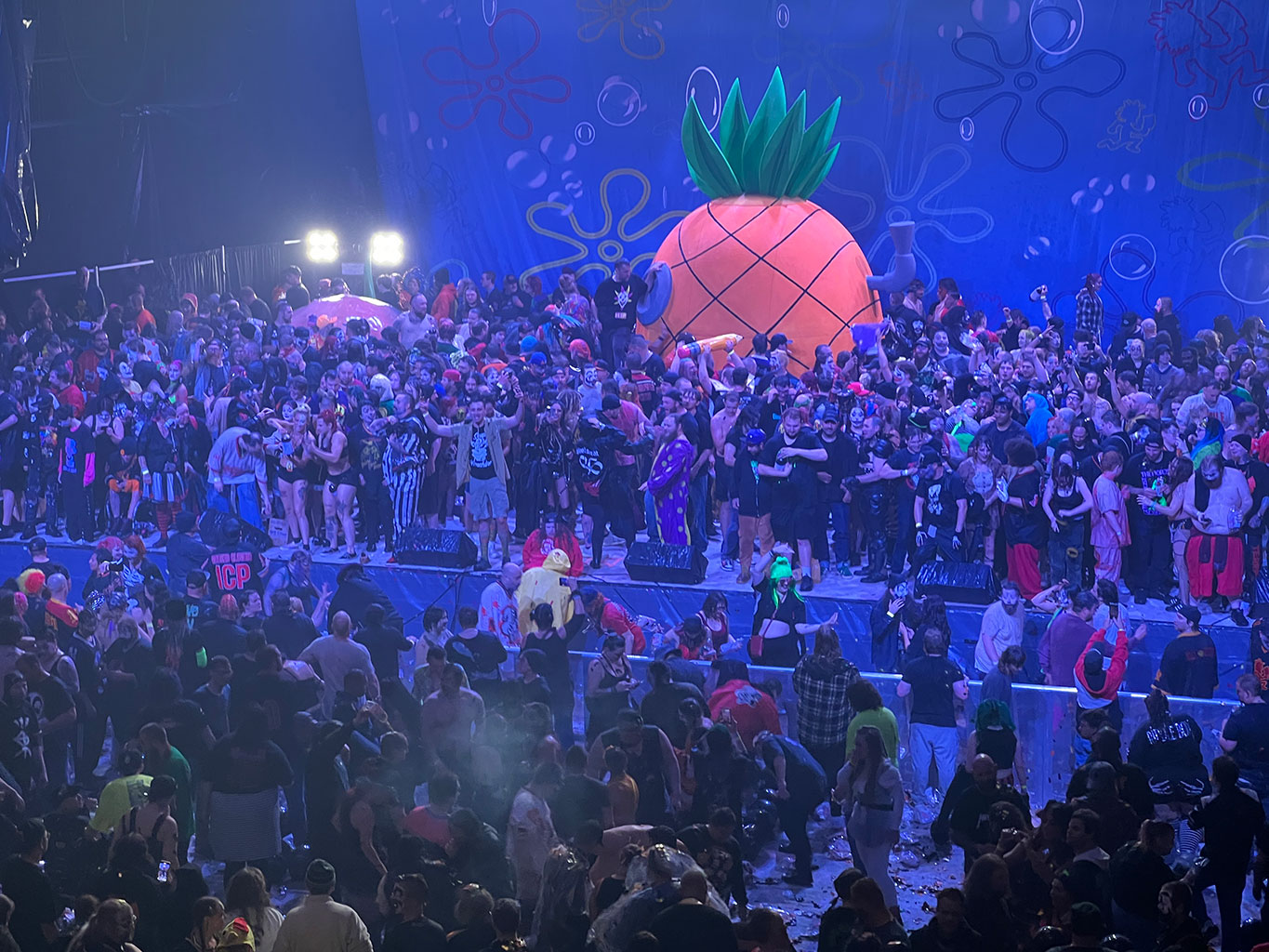
At the time, I didn’t know that this was a tradition known as “Faygo Armageddon” that occurs at the end of nearly all ICP performances. I was convinced I was witnessing a spontaneous uprising.
The closing song on their fourth album, The Great Milenko (1997), “Pass Me By,” is a playful eulogy. Using their trademark twist on Christian morality, the song imagines ICP’s own deaths alongside those of their loved ones, framing the afterlife as a utopian release from life on Earth, which is figured instead as a kind of hell.
This is our Hell now, we livin’ in it
But this bullshit’ll be over in a minute
…
We all gonna die, but I’m not gonna fry
Even though most never try
I’m not gonna let this pass me by, no
As the chorus looped again and again, ICP quietly disappeared, relinquishing the stage to the unruly crowd, which continued singing in unison until the song finally ended. What followed was a five-to-ten-minute period of confusion. There was no structure, no guidance, no clear sense of what was supposed to happen next—only a strange, liminal uncertainty that I can only describe as anarchy. The audience had taken over more than just the show. By all appearances, they had taken over the club itself. People raided whatever they could find onstage, dousing themselves with Faygo and indiscriminately catapulting empty Faygo cases and pieces of the set across the club. Triumphant shouts of “whoop whoop” echoed through the room.47 Were we staying or leaving? Would the staff intervene? Would we trash the place, or help clean it up? I had no idea what to do or what would happen next.
As spontaneously as it began, the mutiny subsided. Without any direction to do so, the crowd spilled out of the venue, wading through a literal sea of empty two-liter bottles. People’s feet stamped and splashed through puddles of Faygo an inch or two deep. The place was a complete disaster.
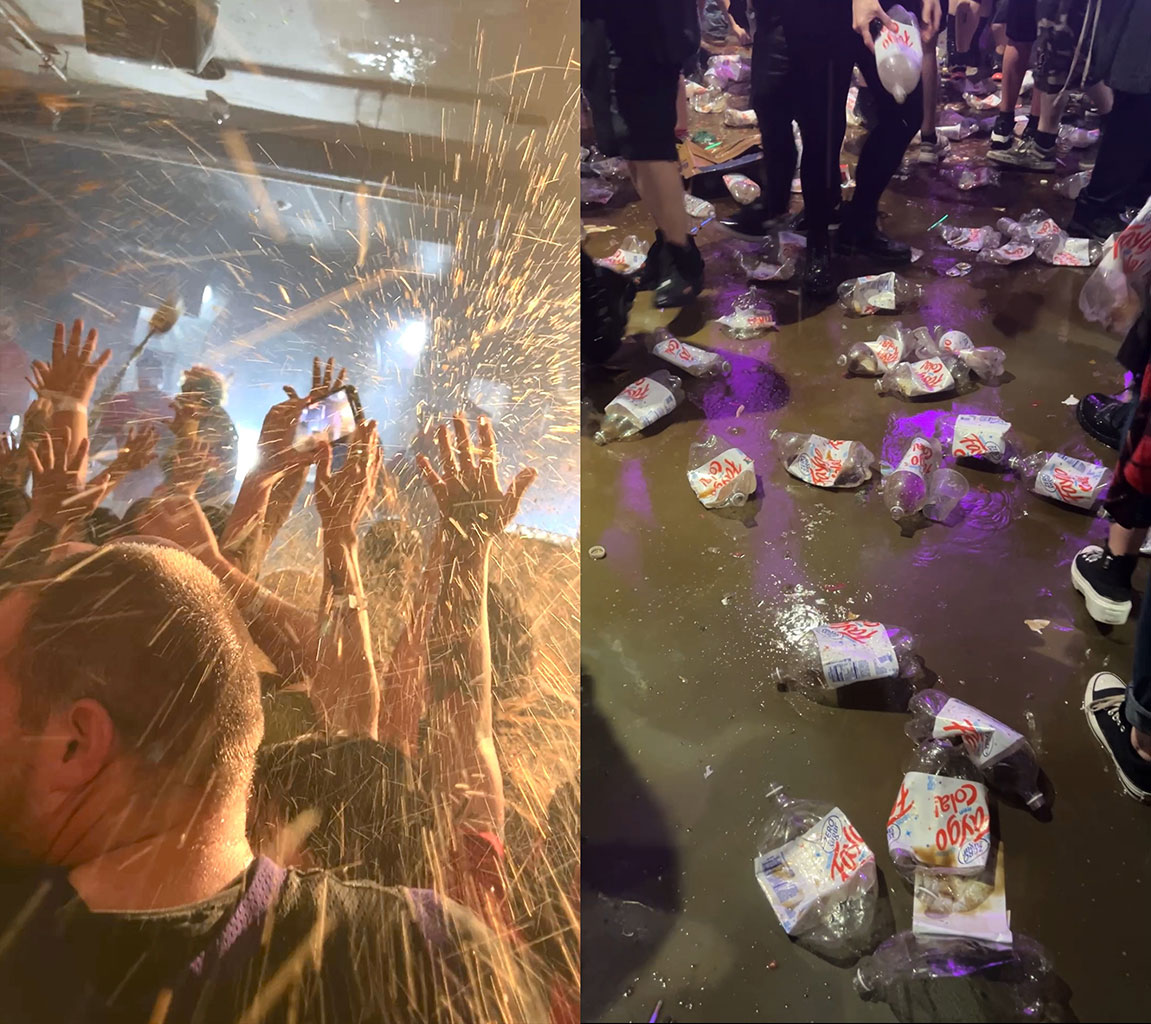
Once I made it outside, I immediately peeled my shirt off. My clothes were so profusely wet that I could wring them out like a rag. I had not only witnessed but survived one of the most moving performances I’d ever seen.
Lifelong Michigan resident and urban planner Zach Kilgore writes in a blog post entitled “The World Needs Detroit”:
In the 40s, the world needed us to save democracy. After the war, the world needed us to build their cars and make their music. Today, the world needs us to show them how we can go through hell and live to tell the tale.39
Just like their hometown Detroit, ICP’s music embodies the promise of resilience beneath its tough, often violent exterior. This is not an escape from suffering so much as an attempt to make something else possible in its wake: a way of surviving together, of finding beauty in the fucked-up parts of being human, and of imagining a more equitable world. Their music insists that survival itself can be the beginning of something else.


 Vee Hua 華婷婷


 Thuc Doan Nguyen

 Saelyx Finna