
 Carl Lawrence
Enter the Ghetto Zone
Then I ask who the fuck protects us from you?
Cops always beatin’ on someone
Shot a mute in the back, he told him not to run
And the mother fuckin’ Black Panthers know it
That’s why it’s cops now that are catching a bullet
– Lyrics from “Ghetto Zone” by Insane Clown Posse, Dog Beats, 1991
After a brief directionless period of working odd jobs, including an unsatisfying attempt to realize his childhood dream of being a professional wrestler, Bruce would finally turn to music as his life’s purpose. But he did not take that step alone. The same friends with whom he had formed a gang became his creative collaborators, transforming the figurative “band” he belonged to in his community into something literal. Together with Utsler, Utsler’s brother John, and their Delray friends, Inner City Posse transformed from a neighborhood gang into a lukewarm gangster rap outfit whose musical output was mostly a dramatization of their petty crimes.
Their hackneyed lyricism was consistent with the crude production methods they used to create these early releases. Albums like Intelligence & Violence (1989), Enter The Ghetto Zone (1990) and Bass-ment Cuts (1990) were recorded using a karaoke machine or improvised setups involving two tape decks facing each other—one playing the backing track while the other captured the recording of them rapping on top of it. The quality of these releases is so poor that calling them “albums” feels generous. They are more like rough sketches compared to the intricate work they would later produce.
As young artists searching for their own voices, they borrowed heavily from the hip hop sounds that were emerging at that time. Bruce and Utlser were serious students of the nascent genre, curating an extensive tape collection of their favorite groups. Acts like UTFO, the Geto Boys, the Beastie Boys, Sir Mix-A-Lot, N.W.A., KRS-One, and Run-D.M.C.’s Tougher Than Leather (1988) were hallowed.15 They were also connoisseurs of Detroit’s vibrant local rap scene. Artists such as Awesome Dre and the Hardcore Committee, Merciless Amir, K-Stone, AWOL, Detroit’s Most Wanted, Smiley, Rap Mafia, Papa J Smooth, and Kaos & Maestro were foundational influences on their early sound.
Despite the poor quality of ICP’s early recordings, they are not without merit. Music became a medium through which they dramatized their aggression toward the structural forces that led to their marginalization. In an astute and lucid demonstration of class consciousness, their early music frequently fantasizes about an uprising that would return the violence that the white, wealthy elite impose on inner city communities back onto the suburbs themselves. This orientation is made explicit on their 1991 EP Dog Beats, whose cassette liner notes cite the Black Panther Party and criticize Detroit’s wealthy suburbs for abandoning the city.
The EP opens with a track entitled “Ghetto Zone,” which begins with a sample from the movie Colors (1988), a Hollywood movie about the Los Angeles Police Department’s attempts to quell gang violence in the city. By using this, ICP frames the song within a militarized vision of the inner city that situates Detroit within a broader cultural narrative shaped by the War on Drugs, wherein inner city neighborhoods were perceived as armed, volatile zones requiring containment.
They got Uzis, they got shotguns, they got explosives
They got access to any kind of weapon they want within 24 hours
We got over 50,000 gangbangers out there
This triggers the beat, which descends on the listener’s eardrums in a violent strike before continuing in a slightly disorienting, but militant march. Over this, ICP paints a portrait of Delray plagued by scenes of gang violence and police brutality. They also employ samples from The Twilight Zone theme and Rod Stewart’s “Do Ya Think I’m Sexy,” adding a layer of ironic mockery to their depiction, which is echoed in the album artwork. A colorful clown swings on a rope while the factories of Zug Island loom ominously in the background. The image reflects the caricatured perceptions that suburban residents have about the inner city.
Southwest Detroit, this demented one’s home
“Ah, for Christ’s sake! You don’t talk about that garbage out here. That’s for the hell-hole where you come from.”
Southwest Detroit, this demented one’s home
“This is the good part of town. We let you deal with that type of bullshit. Your problems don’t concern us.”
The song’s chorus samples Ice-T’s 1988 single “I’m Your Pusher,” a track written in response to the crack epidemic that offers music as an alternative to drug use and street crime. If satire is ICP’s weapon of choice, this sample hams up their depiction of Delray as a hopeless and derelict place. It might also function as an affirmation of ICP’s own decision to pursue music as a way out from the trappings of gang life.
Come to Delray, a driveby ain’t shit
“The cops just don’t know what to do”
The song concludes with a call for solidarity among Delray’s rival gangs, invoking another sample from Colors (1988) that feels reminiscent of what many Delray residents still express today:
“These are my homeboys, vato. See, our homies here is all we have, man. I love them. They love me back, man. We barrio.”
….
And to all the sects running in Southwest Detroit
Good luck and stay strong
Latin Counts, Young Guns, CFP, X-men, To the Cobras, and DT
ICP38
This call for gang unity reflects the influence of Detroit’s leftist political traditions. It also reflects the influence of Detroit radio personality The Electrifying Mojo.15 Known for his radio show, which ran from 1977 through the mid-1980s, Mojo is celebrated for his audacious, genre-defying DJing style where he would play rock, funk, and electronic music records together in a single broadcast, sometimes even playing the entire side of a single record. The open format of his show cultivated a racially-diverse audience that was unusual for its time and helped shape Detroit’s appetite for eclectic music.
ICP’s fusion of rap and rock music—an approach that resists easy classification and, therefore, complicated their marketability—can be traced directly to Mojo. Drawing inspiration from fellow Detroit musician George Clinton, Mojo opened each broadcast by calling on his listeners—collectively known as the Midnight Funk Association—to rise like loyal troops as he “landed the Mothership.” Listeners signaled their allegiance by flashing car headlights or porch lights in unison at his command. Detroit DJ Mike Banks credits Mojo with harnessing this collective energy to ameliorate gang violence: “That summer gang warfare was at a height and Mojo would get on the radio and ask for peace, pray for peace, and then drop the B-52s, man.”39
Dog Beats (1991) marks an important turning point in ICP’s artistic development. Recognizing that simply replicating the prevailing sounds of gangster rap would not set them apart, they began to carve out a distinct aesthetic by embracing the polluted landscapes of Southwest Detroit as source material for a new, poetic vocabulary. After receiving some positive feedback on the clown-themed album cover, they decided to fully embrace the clown persona and rebranded themselves as the murderous Insane Clown Posse.
Detroit’s air is toxic
My eyeballs popped out they sockets
And fried in the street like a Steak Umm
*Pop* *Pop* Shake ’em, bake ’em
Break em off something from the smoke stack
I’ve been breathing all my life so I’m dying anyway
I’m nothing but a radiation freak show
– Lyrics from “Chop Chop” from ICP’s 1993 EP Beverly Kills 50187.
This shift was also precipitated by their embrace of an influential figure within Detroit’s local rap scene: Esham the Unholy. Esham is credited as the architect of a style known as “acid rap”—colloquially referred to as the “wicket shit”—which evolved from the horrorcore style pioneered by the Houston-based group Geto Boys with tracks like “Assassins” and their 1989 album Grip It! On That Other Level. Renowned for his debut album Boomin’ Words From Hell (1989), released at the age of 16, Esham pushed the genre into uncharted territory by styling himself as a satanist, rapping about the devil, and referring to his fans as “Suicidalists.”
While such themes had been explored in rock music (e.g. Black Sabbath), they were unprecedented in the world of rap, making Esham a groundbreaking figure in the late ‘80s and early ‘90s—and a formative inspiration for ICP, who described him as “just the most evil, pure Detroit rapper there was….[he] was larger than life, untouchable; almost even more than the stars on MTV and radio.”15
Esham’s music employed horror-laden imagery not merely for shock value, but as a vehicle to convey the disturbing realities experienced by Detroit’s inner city residents in the 1980s. In a 2024 interview, he pushes back against the notion that the “wicket shit” is merely gruesome, arguing instead that people were disturbed by it because it served as a warning of the real-life terror unfolding in the streets. In the same interview, he draws parallels between the systemic violence faced by Detroit and Palestine, saying, “If we go to Palestine right now, it would be gruesome as fuck…That’s the wicket shit. Bombs being bust off, little babies dying. The same thing happening in Palestine happened on the east side. So it’s not gruesome. It’s real life.”
The displacement of Black Detroiters through the deliberate destruction of the Black Bottom and Paradise Valley neighborhoods, for example, follows a similar logic as the settler-colonial violence enacted by Israel in Palestine’s West Bank.40 In both cases, dispossession operates through state power and the guise of urban renewal.
While Esham adopted the persona of a satanist to articulate his experience of Detroit as a hellscape, ICP drew inspiration from Southwest Detroit’s polluted landscape and embraced a murderous clown persona as a satirical reflection of the suburban caricature of the inner-city “thug.” ICP elected to represent themselves as the “scrubs” and outsiders that they were, mining their fears and anger as authentic creative material.15
Just as importantly, they believed that Esham had forged a sound that distinguished Detroit as its own hip-hop center, unique from the dominant East Coast/West Coast binary that structured rap music at the time. They identified the “wicket shit” as a musical lineage that was aligned with their efforts to uplift Southwest Detroit as a site of social and cultural vitality.
So, ICP modeled themselves after Esham. They not only built on his sound but also borrowed extensively from his marketing strategies. As ICP explains, by the early 1990s young rappers generally had two paths available to them. One route involved building a reputation through freestyle battles in the hope of being discovered—a trajectory famously dramatized by Eminem in the movie 8 Mile (2002). The other rejected this model entirely: instead of waiting to be discovered by industry gatekeepers, rappers could take the more arduous DIY approach and “straight the fuck up [inject] themselves right into the game the very way Esham’s crew did.”15
Esham accomplished this by making his merch and promotional materials ubiquitous in Detroit and establishing a presence that was impossible to ignore. This was amplified by the aura of mystery he deliberately cultivated: he avoided collaborations with record labels and only made rare appearances on other artists’ work. All of his music was released exclusively through his own label, Reel Life Productions, and he consistently employed creative strategies to make his records stand out, like using gold or red cassettes. Esham’s music and business savvy inspired fear and respect, positioning him as a figure of singular authority within Detroit’s rap scene.
Esham’s strategic use of mystery also corresponded with lessons Bruce and Utsler learned while working at the historic venue St. Andrew’s Hall in the early ‘90s. It was there that they first encountered the so-called “band scene” in Detroit. Bruce describes being most impressed by the national bands for their theatrical stage presence: “You would never see the band, not once, before they first took stage. Then after the show, you would never see them again. The only time you would ever see the band is when they were up on stage, bigger than life, under the lights, and doing what they do best. They were always in and out of the club like ghosts, like true superstars.”
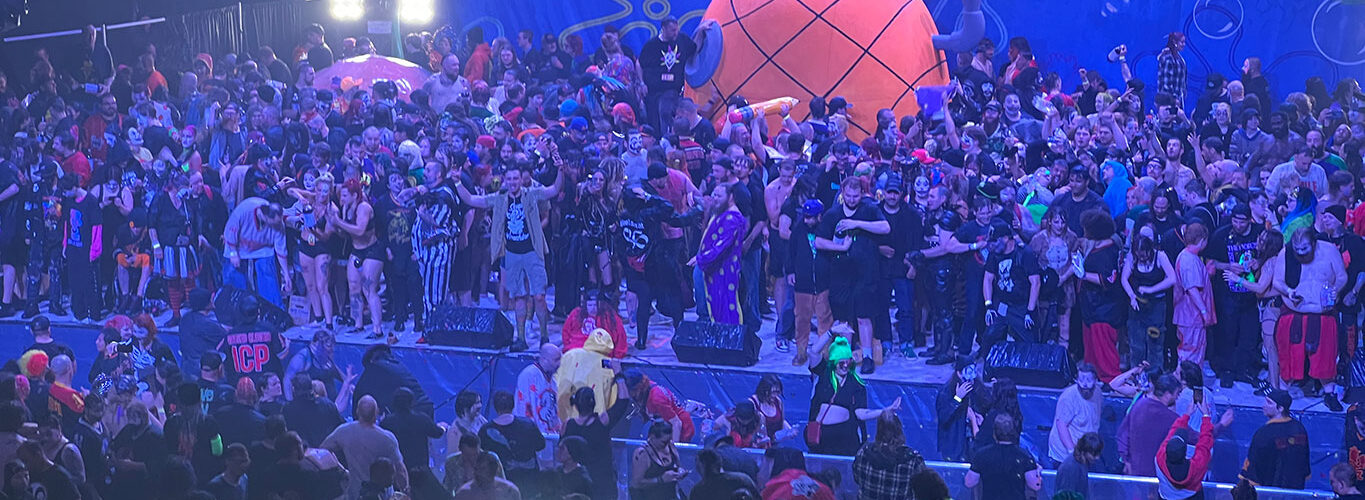
St. Andrew’s Hall and Esham imparted the first essential ingredient to building a credible cosmology: mystery. Nothing conveys ICP’s commitment to mystery more than their ubiquitous use of face paint. For more than 30 years, nearly every public appearance they’ve made has been in their iconic makeup. Despite the challenges posed by the internet, they have remained steadfast in their commitment to the bit. Their live performances also reflect this practice. The stage is always fully obscured during the transition between the opening acts and their own performance, rendering all set changes unknowable until they are revealed during the first song.
Their embrace of the clown persona was also an opportunity to apply the lessons in character building and storytelling they had gleaned from wrestling. Namely, the importance of a “gimmick,” which in the parlance of the wrestling industry refers to a wrestler’s in-ring persona. ICP’s gimmick is that of killer clowns.


 Vee Hua 華婷婷


 Thuc Doan Nguyen

 Saelyx Finna