
 Carl Lawrence
Carnival of Carnage
– Liner notes from ICP’s debut LP Carnival of Carnage (1992).
Wrestling is an important key to understanding ICP’s identity. As a form of low culture and mass entertainment, it offers audiences an escape from the hardships of everyday life through the staging of morality plays in which heroes and villains clash with one another. This theatricality, which is also referred to as “kayfabe”—a term used in the business to describe staying in character and maintaining the sanctity of fictional narratives—provides a constructive outlet for audiences to channel their aggression, pain, and dysfunction.
The Dark Carnival would become the ICP’s “angle,” explaining the origins and logic of their gimmick. Within this framework, Violent J and Shaggy 2 Dope assume the role of “babyfaces” (the heroes), while figures such as bigots and abusers are cast as “heels” (the villains) in an ongoing feud between good and evil.
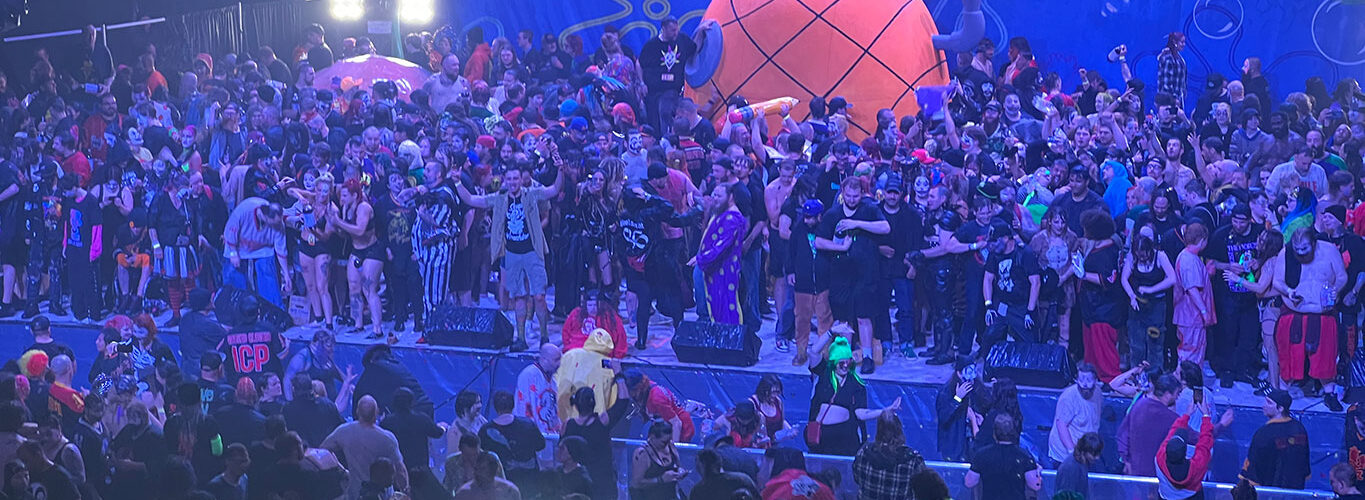
The Dark Carnival mythology would become so robust and elaborate that, by the year 2000, ICP was much more than just a band. They had produced films, comic books, operated a hotline, ran their own wrestling promotion, fully appropriated a brand of soda as an integral part of their identity, and offered an ever-expanding catalog of collectible merchandise and clothing that together formed the architecture of their unique fictional world. Even the artists they would later sign to their label, Psychopathic Records, were marketed as characters within ICP’s universe.
The complexity of this universe introduced a speculative quality to their artwork that blurred the line between reality and fiction. The Dark Carnival became its own living, breathing entity, making it easy for fans to become completely immersed—if not obsessed—with its intricacies and meaning.
Ironically, the term “gimmick” is often used to discredit ICP’s artistic merits. While it’s understandable that some might struggle to take two guys in clown paint seriously as artists, that hardly constitutes grounds for their dismissal. Even if ICP operates within the realm of macabre silliness, what they do is nonetheless an intricate act of profound creative talent. In another context, the idea of a “gimmick” could easily be reframed as a “brand” or “identity,” concepts celebrated in today’s influencer-driven, social media-dominated culture. If cultural impact is measured by brand strength and profitability, look no further: these killer clowns have cemented their place as a household name.
Esham and ICP would eventually forge a close bond and become frequent collaborators, beginning with Esham’s appearance on ICP’s first record, Carnival of Carnage (1992), which also marked the group’s debut under the name Insane Clown Posse.41 Esham produced the album’s title track and appears on the closing song, “Taste,” a track that explicitly articulates rebellion as a shared political and aesthetic project.
“Taste” stages a fantasy of retribution in which ICP, Esham, and fellow guests Jumpsteady (Violent J’s brother, Rob) and Capital E describe bringing a “taste” of inner city violence to affluent nearby suburbs which had long insulated themselves from Detroit’s inner city.
Rich bitch fucker took me for a sucker
Now we killing you instead of killing each other
Walked in your house, shot him in the mouth
Lean back the head and pour the brains out
My lyrics are strong, it’s only a song
The government front like they don’t know what’s going on
Fuck it, I’ll take the matter in my own hands
While ICP frames violence as an expression of class struggle, Esham escalates the rhetoric into a call for insurrection against the state itself. He even casts his collaboration with ICP as an act of cross-racial solidarity unified in a shared antagonism toward the government. “Taste” crystallizes Carnival of Carnage as a political project intended to mobilize the inner city slums into a collective mutiny against the structural inequality that produced it.
Guess who’s rolling with the ICP
The Black Devil coming straight from the D
I’m headed out to Birmingham
My temperature is burnin’, man
Looking for the governor to kill him and I think I can
Violent J know the way, so I’m gonna get you
Even the album’s liner notes read less like supplementary material than a political manifesto:
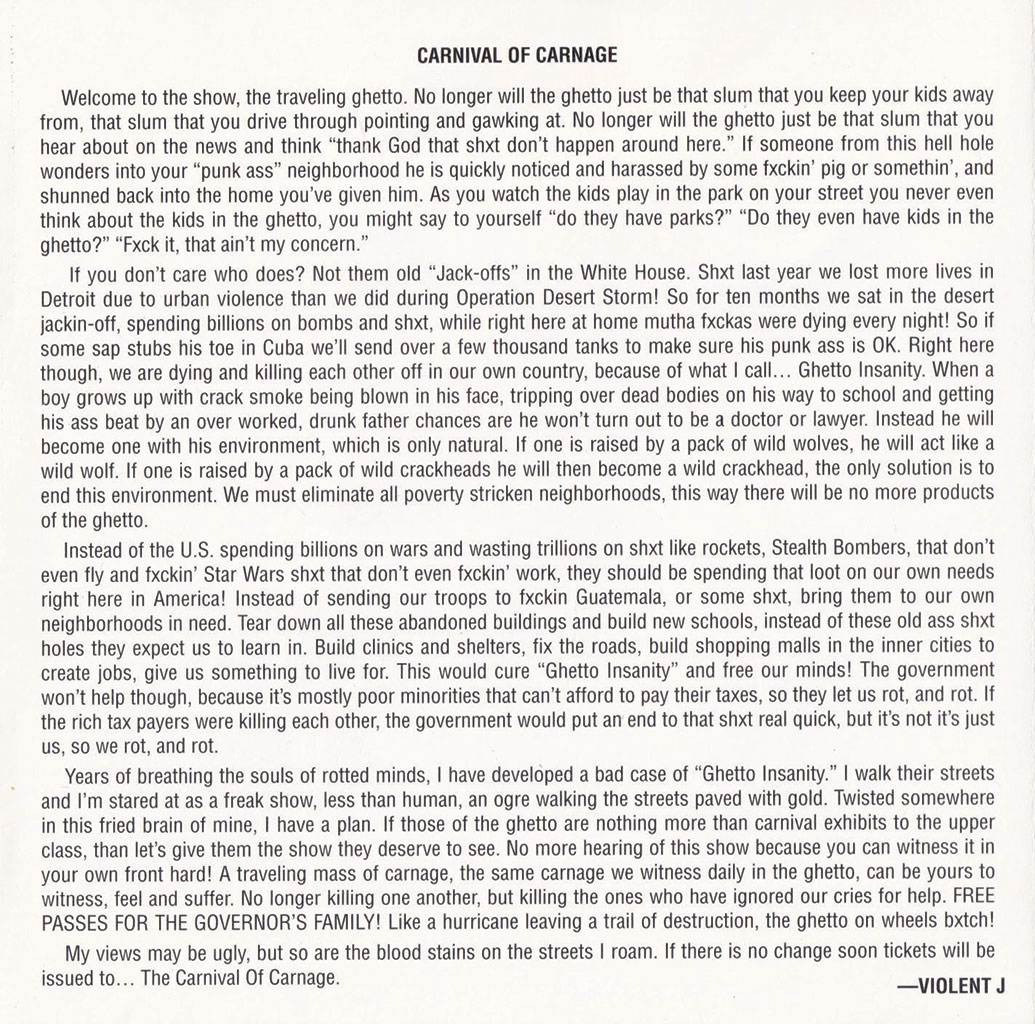
ICP weaponizes their dehumanization, transforming it into a fantasy of violent retribution against their oppressors. Their clever use of words like “ogre,” “freak show,” and “traveling mass” serves as a proxy for the economic and racial anxieties that lingered in Detroit long after the 1967 Uprising. This language began to compose a world in which poverty, racial difference, pollution, and violence are not merely marks of shame but, instead, symbols of power, resilience, and beauty.
Carnival of Carnage (1992) is also significant for its condemnation of white supremacy. The album is not ICP’s first to critique bigotry—both Intelligence & Violence (1989) and Dog Beats (1993) include explicit denunciations of racists—but it contains their first anti-racist anthem. Though not explicitly referenced in the liner notes, Carnival of Carnage promises violence against white supremacists in the song “Your Rebel Flag.”
Scalp a skinhead quick
And your greasy-ass triple Klan ain’t’ shit
And zip you up in a bag
And I’ll shit on a motherfuckin’ rebel flag
Yeah, shit on a rebel flag
Fuck your rebel flag!
This would mark the beginning of a sustained pattern. Nearly every subsequent ICP release includes at least one song depicting violence against racist bigots. On their second full-length album, Ringmaster (1994), the track “Mr. Johnson’s Head” describes the killing of a racist teacher, which is framed as an act of retaliation against a figure who espouses whitewashed historical myths and openly displays Confederate symbols.
I can hear the teacher man talking about Columbus
He nothing but an old dead fuck with a compass
Ran up on a beach and threw everybody off
And then he claimed discovery and now we all applaud….
I couldn’t stand the pressure, not another day
I didn’t like the fucker Mr. Johnson anyway
I sat up in his class, he hung a rebel flag
I cut the bigot’s head off and I stuffed it in my bag
Another example is the song “Terrible,” which appears on The Amazing Jeckel Brothers (1999). They describe their frustrations in a comparison between the anti-Black racism that’s foundational to U.S. history and the media’s ridiculous concern about the violence in ICP’s lyrics.
The country we live in was built by slaves
Beat on and murdered and stuffed in their graves
You put a slave owner on the one dollar bill
And you wanna know why I kill people?
When asked about the violent content of their lyrics, ICP often describes it as merely entertainment, likening it to professional wrestling or a Stephen King novel. As we have seen, wrestling, kung fu films, nature, gang life, and music all functioned as valuable escapism that helped ICP navigate the difficulties of their early lives. Yet embedded within their music is a codified language that speaks to personal hardships, as well as the social and political trauma of life in Detroit. That’s precisely what’s so compelling about these early releases: their explicit biographical grounding. The music offers listeners insight not only into the racial and economic violence endemic to Detroit at that time, but also into the radical ideas of self-determination and rebellion that were circulating through the city in the late 1980s and early 1990s.
Without an understanding of Detroit’s specific social and political context, ICP’s role as biographers of their hometown remains deeply underacknowledged.
In his book Acid Detroit, writer Joe Molloy draws on political theorist Fredric Jameson’s concept of the “political unconscious” to contextualize the role of grief in the work of John Brannon, the musician who fronted several Detroit rock and punk bands in the 1980s and 1990s, including Negative Approach and Laughing Hyenas. The political unconscious, Jameson suggests, holds that works of art express social problems that artists may not consciously articulate. The task of the critic, then, is to trace these works back to the underlying political or social conditions they seek to “solve,” or at least bring into consciousness. Molloy argues that Brannon, a Reagan-era youth who suffered the “social and psychic costs” of Detroit’s economic collapse firsthand, channeled a raw, seemingly purposeless rage in his music that’s akin to the arbitrary violence of Devil’s Night. Beneath this inchoate fury, expressed through the recurring theme of nothingness in his music, Molloy identifies a profound grief over the destruction of Detroit’s working-class hopes and the foreclosure of a viable future, which he tries to assuage through his music.39
As contemporaries of Brannon, ICP likewise grapples with a vision of Detroit that felt devoid of a future—a city that, at the time, “looked like a bombed-out war zone.” In an effort to create meaning and a sense of purpose amidst this devastation, they embraced the city’s polluted entrails and transformed them into a poetic playground, in which the suffering rise up and wreak vengeance against their oppressors.
Molloy’s analysis also reveals clear parallels between Detroit’s hardcore punk scene and ICP’s own proclivity for excess and spectacle. Detroit icons like Alice Cooper, MC5, and The Stooges—all associated with shock, confrontation, and theatrical showmanship—clearly inform ICP’s own violent and outlandish antics. This influence is not merely symbolic: just go to one of their shows and witness the debauchery that unfolds before you or listen to The Great Milenko (1997) where Alice Cooper himself appears on the album’s introduction track.
While ICP only receives a woefully (and unsurprisingly) brief mention in Molloy’s book, it nevertheless provides a useful framework for situating ICP within a broader Detroit musical lineage spanning more than sixty years. Tracing a throughline from Motown to hardcore punk and techno, and onward to contemporary rappers like Danny Brown, Molloy identifies “collectivism” as the unifying principle within Detroit’s music culture. It “showcases the desire to shift away from the archetypal lone genius in favor of communities, scenes and collaborative art experiments,” or what Molloy refers to as “freewheeling collective energy and cross-genre experimentation.”39
As with Brannon, Molloy demonstrates how each chapter of Detroit’s musical history offers valuable insights about the city at those specific moments in time. Take, for example, the depiction of Detroit’s dark, deserted streets in The Temptations’ 1968 song “Runaway Child, Running Wild” and you’ll find resonance with ICP’s own songwriting 36 years later, which similarly characterizes Detroit as eerie and desolate:
I tried to visit Shaggy, I stepped up off of my porch
And it was dark as fuck, I couldn’t see, not even with a torch
I hear the streets talkin’, and they aware of my moves
They whisperin’ and swingin’ from the trees, above I hear the loons
– Lyrics from ICP’s song “24” featured on their 2004 album The Wraith: Hell’s Pit.
It should be clear by this point that ICP are no anomaly within Detroit’s vibrant musical genealogy; they are a reflection of it. Bearing in mind that Detroit was the nation’s arson and homicide capital for several years during the 1970s and 1980s, the period during which the Motor City was recast as “Murder City,” the violence that permeates ICP’s music becomes much more understandable. It mirrors Detroit’s own pervasive history of violence, which the group exploits in grotesque and comedic ways.
ICP may not explicitly position themselves as documentarians of Detroit, but they do push back against the notion that their music is merely violent. Instead, they view their artistic project as carrying a deep responsibility to uplift the community. As Violent J explains:
Those who never dig below the surface of the music of ICP will probably judge it as a violent and evil thing. Those of us who have dug deeper, however, realize that there is a message that pertains to trying to save the human soul. We ain’t no kind of magical fuckin’ chosen prophets; we know that. I’d say, though, that we truly have within us a great concern for people, well most people, anyway. This motivates me to do what I do. If nothing else, I am on this planet trying to do the best I can and I believe I am doing something positive that is helping people.15
If Marvin Gaye asked “What’s Going On” in Detroit in 1971, mourning a city in crisis, ICP responded decades later with a call for insurrection. Shaped as much by the endemic poverty they experienced firsthand as by events such as the brutal police killing of Detroit resident Malice Green in 1992. Green was pulled over after police officers Walter Budzyn and Larry Nevers alleged that he was in possession of crack cocaine and beat him repeatedly with a flashlight, causing fatal injuries.42 ICP weaponized the city’s despair into a carnival of revolt. Casting themselves as the flamboyant ringleaders, their music imagines the derelict and oppressed banding together in song to deliver justice from the “horrifying midnight wagon,” whose rickety wheels spin under the looming banner of the Dark Carnival.
Don’t matter who you are, we going straight to hell
And it ain’t far, Mr. Nevers, you seem to be the kill joy
So get your ass in fat boy!
You can sit up in the front with the Ringmaster
With the ringading-dingalinga-ping-master
And get your motherfucking wind pipe chopped off
And your funky ass body gets dropped off
In the gutter, the wheels keep rollin’
Throwin’ heads out the back, nugget bowlin from the
Wagon Wagon, dead bodies draggin’
– Lyrics from ICP’s song “Wagon Wagon” featured on their record Ringmaster (1994).
ICP’s preoccupation with violence is a strategic reclamation of that violence. In imagining liberation, they insist that the revolution will not be bloodless; the bodies that are dragged behind the wagon will belong to the oppressors.
Their rhetoric of violent reckoning goes hand-in-hand with a parallel ethic of mutually supportive action, which together forms ICP’s notion of collectivism. Liberation, in their view, requires not only the overthrow of oppressive forces but also the construction of new social relations grounded in mutual aid and environmental responsibility. As one Juggalo succinctly put it, “We are here this weekend to fucking rage and party—and then clean up after ourselves.”44
Countless examples of this ethic can be found throughout their music and in their philanthropic work in Detroit. Food drives are a staple at many of their events, where bringing a donation often serves as the price of admission. During their Wicked Clowns for Outer Space Tour in 2000,attendees were offered a free CD in exchange for donations. The drive, however, had very specific rules: “No bullshit allowed. No yams and peas or any shit like that. Only the good shit, like Meatball Meteors and Creamy Loopy Lumps with Cheese.”15
They have a track record, as well, for showing up at homeless shelters on Thanksgiving with a U-Haul full of food. They’ve recorded singles and organized tours to support charitable causes, including raising funds for St. John’s Children’s Hospital of Illinois. They’ve also arranged Make-A-Wish fundraisers for terminally ill patients and even produced a benefit concert to support the family of a fan who passed away from cancer.
Their leadership has had a ripple effect among fans, inspiring efforts like those of the Juggalo nonprofit Scrub Care Unit (SCU), which quickly mobilized to provide relief after Hurricane Harvey devastated southern Texas in 2017.
Acceptance and compassion are not merely creative fodder for ICP’s music; they are lived practices shaped by their own lives and Detroit’s history of mutual aid. What began as a juvenile attempt to sublimate their poverty into something inclusive, defiant, and cool, evolved into the building blocks of their musical universe and the subculture that sprung up around it.

 Vee Hua 華婷婷


 Thuc Doan Nguyen

 Saelyx Finna